

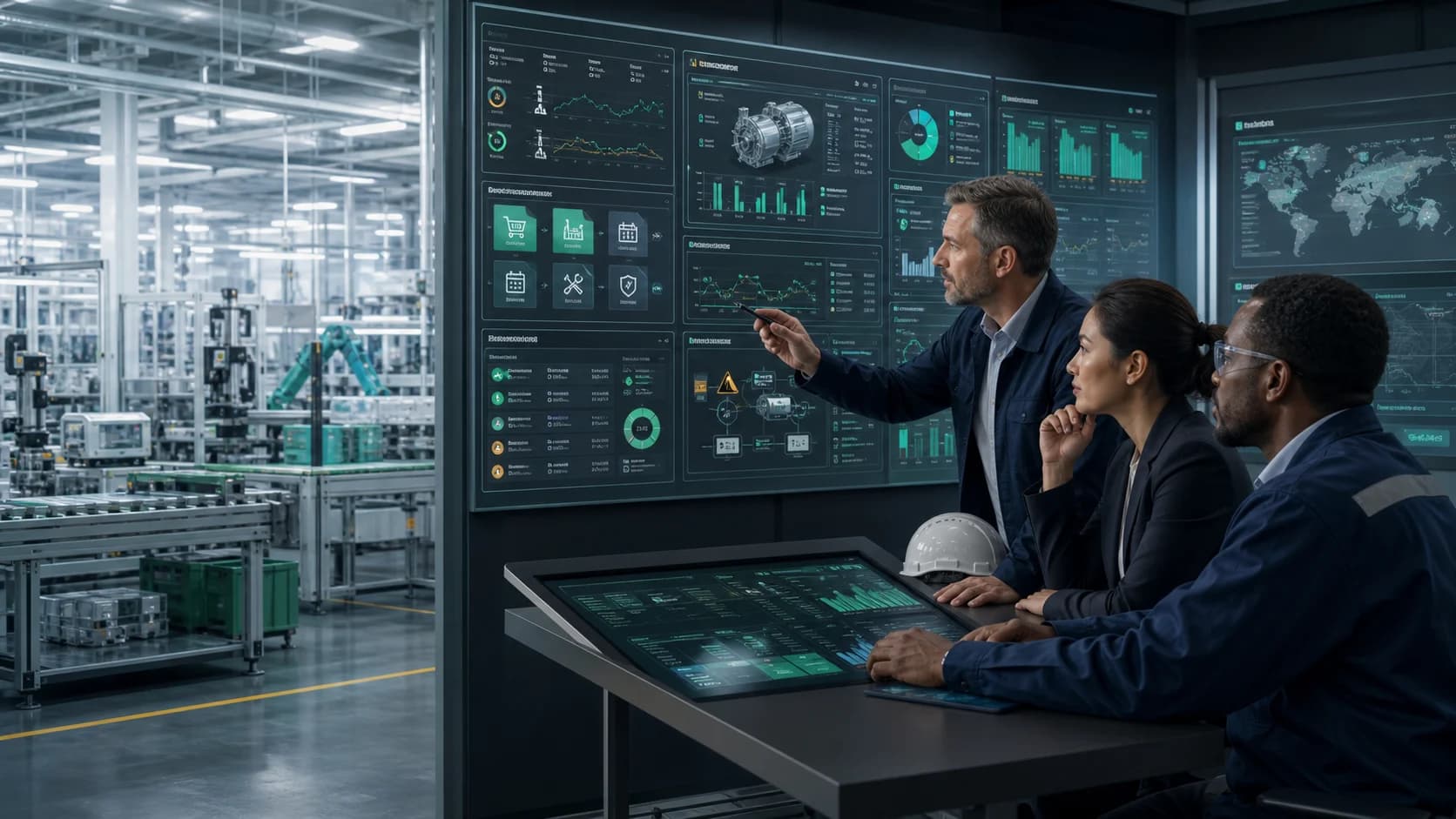
Manufacturing AI agents help operators connect ERP, inventory, production, supplier, and maintenance data so the business can forecast problems, recommend actions, and route high-impact changes through human approval.
Key takeaways
The best manufacturing AI agents do not sit beside the ERP. They connect ERP records, plant-floor activity, BOM costs, procurement, inventory, and maintenance signals into one governed action loop.
Predictive maintenance, supplier risk, inventory movement, and production scheduling need approval thresholds because they affect uptime, cash, service levels, and safety.
OPAG’s manufacturing pattern builds on its agentic governance control layer and the same workflow-first delivery model used across regulated operations.
What are manufacturing AI agents?
Manufacturing AI agents are controlled software workflows that use AI to inspect operations data, recommend or draft actions, and coordinate human approval across ERP, production, inventory, supplier, and maintenance processes.
A manufacturer already has signals everywhere: work orders, machine history, production output, BOM costs, purchase orders, warehouse movements, quality checks, supplier delays, and customer commitments. The issue is that these signals rarely reach the right decision-maker in time.
An AI agent can monitor those signals, explain what changed, suggest the next action, and prepare the system update. Governance decides whether that update happens automatically, waits for a supervisor, or escalates to finance, procurement, quality, or plant leadership.
Which manufacturing AI use cases usually pay back first?
The strongest first use cases sit near downtime, inventory, production scheduling, supplier reliability, quality exceptions, or BOM cost control.
Manufacturing AI should start where the operational pain is measurable. If a signal can reduce downtime, prevent stockouts, improve throughput, protect margin, or shorten reporting cycles, it is a candidate for a governed agent.
The first workflow should be narrow enough to ship and important enough for plant, finance, and IT teams to sponsor. OPAG typically looks for a keystone workflow that can pay for the next three capabilities.
- Predictive maintenance that flags failure risk and routes work orders for review.
- Inventory optimization for raw material, WIP, finished goods, slow movers, and stock transfer exceptions.
- BOM costing and margin monitoring when material, labor, supplier, or yield assumptions drift.
- Production scheduling support that balances orders, machine capacity, operator availability, and constraints.
- Supplier risk monitoring that watches lead times, quality issues, pricing movement, and late purchase orders.
- Conversational ERP reporting with source-linked answers for owners, plant managers, finance, and operations.
How should AI connect with manufacturing ERP?
AI should connect to ERP through role-aware, logged, and scoped workflows so answers and actions reflect live business records without bypassing permissions or approvals.
A manufacturing agent becomes valuable when it sees the same operating truth as the business. That means ERP, inventory, production, procurement, finance, and quality data must be connected through a controlled interface rather than pasted into a standalone AI tool.
The agent should not freely write to core systems. It should read approved records, draft the recommended change, explain the evidence, and route sensitive actions to a human owner. Accepted, edited, rejected, and rolled-back actions should be logged.
- Use role-based access so each user only sees records they are allowed to inspect.
- Separate read, draft, approve, and write permissions.
- Attach every recommendation to source records and workflow events.
- Log final actions in a way operations, finance, IT, and auditors can understand.
How do AI agents support predictive maintenance?
They combine machine history, utilization, maintenance records, production commitments, and anomaly signals to recommend when equipment should be inspected or serviced.
Predictive maintenance is not only a model problem. It is a workflow problem. A signal is useful only if someone sees it, trusts it, understands the operational tradeoff, and can act before downtime compounds.
A governed maintenance agent can identify risk, explain the likely driver, check production commitments, draft a maintenance request, and route the recommendation to the right supervisor. The business can then compare accepted recommendations with downtime, repair cost, and override patterns.
What is a practical rollout plan for manufacturing AI agents?
Start with one plant, one workflow, and one accountable owner. Map the data, define the allowed actions, choose the approval thresholds, and measure whether the agent improves decisions without creating hidden risk.
After the first workflow is stable, add adjacent capabilities. Maintenance connects to inventory. Inventory connects to supplier risk. BOM costing connects to finance. Production planning connects to customer commitments. The value compounds when the controls stay consistent.
- Weeks 1-2: map ERP, production, procurement, maintenance, quality, and finance signals.
- Weeks 3-6: build the first read-and-recommend workflow with source evidence.
- Weeks 7-10: add approval thresholds, exception routing, and operator dashboards.
- Weeks 11-13: deploy with plant users, track overrides, and tune recommendations.
- After launch: expand autonomy only where evidence, adoption, and risk metrics support it.
Frequently asked questions
What problem do manufacturing AI agents solve?+
They reduce the delay between operational signals and accountable action. Instead of waiting for manual reports, the business can detect issues, understand the source, draft responses, and approve changes inside one workflow.
Can AI agents update manufacturing ERP records automatically?+
They can, but only after the workflow has proven accuracy and risk controls. OPAG recommends separating read, draft, approve, and write permissions so sensitive ERP updates remain governed.
What manufacturing data is needed for AI agents?+
Useful sources include ERP records, production orders, inventory movements, BOMs, supplier history, maintenance logs, machine telemetry where available, quality checks, finance data, and customer commitments.
Why choose OPAG for manufacturing AI?+
OPAG combines manufacturing ERP experience, governed AI architecture, role-based access, human approvals, source-linked answers, and audit trails so plant teams can move from AI experiments to production workflows.
What would this workflow look like in your business?
Talk with OPAG about the systems, agent steps and human decisions around it.
Discuss the workflow