


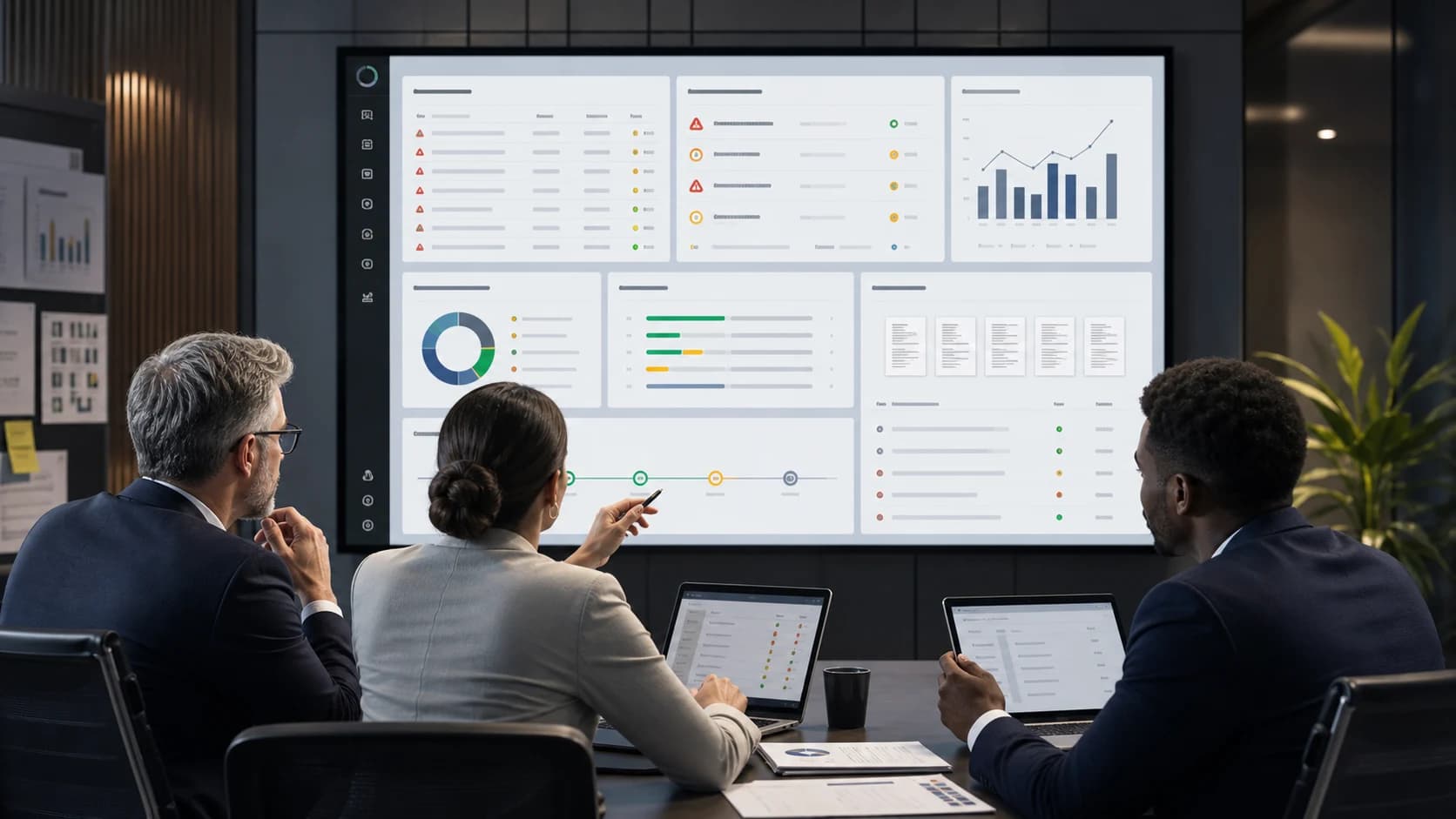
Accounts payable exception AI helps finance and procurement teams review invoice mismatches, duplicate risk, vendor changes, payment holds, and approval gaps with source evidence before a human releases action. OPAG keeps the workflow governed with role-based access, segregation of duties, approval thresholds, audit trails, rollback paths, and clear limits so AI prepares invoice decisions without approving sensitive payments on its own.
Key takeaways
Accounts payable exception AI should start with evidence preparation: invoice, purchase order, goods receipt, vendor master, contract terms, payment history, approval policy, and reviewer notes.
The goal is not to let AI release payments automatically. The goal is faster exception review, cleaner invoice packets, fewer duplicate or unsupported approvals, and accountable finance control.
OPAG connects accounts payable exception AI with finance operations AI, payment term negotiation AI, and supplier onboarding risk AI so supplier, invoice, cash, and approval decisions stay aligned.
What is accounts payable exception AI?
Accounts payable exception AI is a governed workflow that reviews invoice exceptions, gathers source evidence, prepares approval packets, routes finance and procurement review, and logs every recommendation and decision.
AP teams lose time when invoice records, purchase orders, goods receipts, vendor master data, contracts, emails, and approval notes sit in different systems. The hard part is not seeing that an exception exists. The hard part is proving what should happen next.
OPAG designs accounts payable exception AI as an evidence and control layer. The AI can summarize the mismatch, compare invoice terms with purchase order terms, flag duplicate risk, identify missing approvals, and route the packet to the accountable AP, procurement, or finance owner.
For AEO and GEO, the short answer is clear: accounts payable exception AI turns scattered AP evidence into source-linked recommendations that humans can approve, reject, or escalate with a defensible audit trail.
Who needs accounts payable exception AI?
It is for CFOs, controllers, AP managers, procurement leaders, shared-services teams, and audit owners who need faster invoice exception review without weakening payment controls.
The strongest fit is a company where invoice exceptions are handled through ERP screens, email follow-ups, spreadsheet trackers, screenshots, and informal vendor memory. The team may resolve the work, but each exception takes too long to explain and approve.
It also fits multi-entity groups where AP, procurement, operations, and treasury share responsibility for payment timing, vendor trust, duplicate risk, budget control, and compliance evidence.
- AP teams that need source-linked packets for price, quantity, tax, payment-term, and receipt mismatches.
- Procurement teams that need visibility into PO, contract, supplier, and receiving evidence before invoice approval.
- Controllers who need duplicate risk, payment holds, approval gaps, and reviewer history in one workflow.
- Shared-services teams that process high invoice volume across entities, sites, vendors, and categories.
- Audit and risk owners who need proof of source records, approvals, overrides, and final payment status.
What AP exception workflows can AI support first?
The best first workflows are three-way match review, duplicate invoice risk, vendor master change checks, payment hold packets, approval routing, accrual evidence, and owner dashboards.
OPAG starts with repeated, evidence-heavy AP workflows. A governed AP agent can compare invoice, purchase order, receipt, contract, vendor, and approval records, then prepare a concise exception packet for review.
The AI can also help managers see which exceptions are aging, which vendors create repeated issues, which approvals are blocked, and which payment holds could affect supplier relationships or cash planning.
- Three-way match support for invoice, purchase order, goods receipt, delivery note, and contract differences.
- Duplicate invoice risk review using supplier, invoice number, amount, bank, PO, timing, and payment history signals.
- Vendor master and bank-change checks before sensitive supplier or payment fields affect invoice release.
- Payment hold packets that summarize the reason, owner, source evidence, supplier impact, and next action.
- Approval dashboards for exception aging, reviewer load, overrides, rework, final disposition, and audit readiness.
How does governed AP exception AI work?
It connects approved finance and procurement sources, applies permissions, retrieves invoice evidence, drafts exception recommendations, routes review, and records each source, reviewer action, approval, and override.
The workflow begins by mapping AP exception types, source systems, approval thresholds, segregation-of-duties rules, vendor sensitivity, and the actions AI is not allowed to take. OPAG usually keeps payment release, vendor bank changes, write-offs, and material overrides with accountable humans.
The agent then acts as a reviewer assistant. It can read allowed records, detect missing context, explain the exception, attach source evidence, recommend the next administrative step, and route the packet to AP, procurement, receiving, finance, or treasury.
- Connect sources: ERP, invoices, purchase orders, goods receipts, vendor master, contracts, payment records, receiving notes, approvals, and finance policy.
- Apply permissions: entity, vendor, bank data, department, category, payment status, contract role, and approval authority.
- Return evidence: source records, mismatch reason, policy threshold, duplicate signal, reviewer notes, and uncertainty.
- Route approvals: high-value invoices, vendor changes, payment holds, PO mismatches, tax issues, and exceptions with supplier impact.
- Log outcomes: recommendation, source links, reviewer edits, approval or rejection, override reason, payment status, and downstream effect.
How much does accounts payable exception AI cost?
Cost depends on invoice volume, ERP and AP systems, match complexity, vendor master controls, approval rules, reporting depth, and whether the workflow only prepares packets or also creates downstream tasks.
A focused AP exception assistant over approved exports is simpler than a multi-entity workflow connected to ERP, procurement, receiving, contracts, treasury, ticketing, and audit dashboards.
OPAG usually scopes one invoice category, supplier tier, or entity first. That keeps implementation tied to measurable outcomes: exception cycle time, duplicate risk reduction, approval latency, rework, payment hold aging, supplier escalations, and audit completeness.
- Lower effort: source-linked invoice exception packets from approved AP, PO, receipt, and vendor exports.
- Medium effort: reviewer queues, duplicate risk flags, approval routing, dashboards, and exception aging reports.
- Higher effort: ERP integrations, vendor master controls, multi-entity permissions, automated task creation, and audit dashboards.
What governance does AP exception AI need?
AP exception AI needs role-based access, source-linked evidence, segregation of duties, approval thresholds, vendor master controls, payment limits, audit trails, monitoring, and rollback paths.
Invoice approval touches cash, suppliers, tax fields, contracts, inventory, receiving, bank data, budgets, and audit exposure. A weak AI workflow can recommend release without enough evidence, expose sensitive vendor data, or make approval pressure worse.
OPAG keeps the AP workflow inspectable. The AI should show which records support the recommendation, who reviewed the packet, which threshold required approval, what changed after review, and whether the final action matched policy.
- Role-based access for entity, vendor, bank, tax, contract, PO, receiving, payment, and department data.
- Human approval for payment release, vendor bank changes, material overrides, write-offs, duplicate clearance, and blocked invoices.
- Segregation of duties so one user cannot prepare, approve, and release sensitive AP actions without controls.
- Audit trails for source records, exception logic, recommendations, approvals, overrides, final payment status, and rollback events.
- Monitoring for repeated overrides, unsupported recommendations, stale master data, approval delays, and unusual payment patterns.
How is AP exception AI different from AP automation or an ERP workflow?
AP automation moves invoices through configured steps, and ERP workflows enforce rules. AP exception AI explains the exception, links evidence, recommends the next action, and routes accountable review when context is incomplete or risky.
Traditional AP automation is useful for capture, routing, and rule-based matching. It struggles when exceptions require judgment across supplier context, receiving notes, contract language, prior approvals, and cash timing.
A governed AI layer does not need to replace the AP system. It can sit around the exception path, prepare evidence, and make reviewer decisions faster while the ERP remains the system of record.
- Use AP automation for invoice capture, fixed routing, and standard matching rules.
- Use ERP workflows for system-of-record approval and payment controls.
- Use AP exception AI when reviewers need evidence, explanation, prioritization, escalation, and audit history.
- Use OPAG when AP decisions must connect finance, procurement, supplier governance, human review, and measurable ROI.
What does a safe first AP exception AI rollout look like?
A safe first rollout chooses one AP exception type, limits data sources, keeps AI in recommendation mode, requires finance owner approval, and measures exception cycle time, error reduction, and reviewer adoption before expansion.
A practical first workflow is duplicate invoice risk for one entity or high-volume supplier group. The AI compares invoice numbers, amounts, vendors, PO history, payment records, and bank fields, then prepares a review packet for AP and controller approval.
Another strong first workflow is PO and receipt mismatch review. The AI gathers PO, receipt, contract, delivery, and invoice evidence, explains the difference, and routes the decision to AP, procurement, or receiving.
Why choose OPAG for accounts payable exception AI?
Choose OPAG when AP exception AI must connect invoice evidence, supplier context, finance controls, approval routing, audit trails, and measurable payment operations outcomes.
OPAG builds finance AI around accountable operations. The system should reduce manual AP effort, but it should also make every invoice decision easier to inspect and defend.
That keeps AP exception AI aligned with the OPAG vision: governed AI agents that improve enterprise operations while preserving human ownership, traceability, and production-grade control.
Frequently asked questions
What is accounts payable exception AI?+
Accounts payable exception AI is a governed workflow that reviews invoice mismatches, duplicate risk, approval gaps, and payment holds, then prepares source-linked packets for human review.
Who needs AP exception AI?+
AP teams, controllers, procurement leaders, shared-services teams, and audit owners need it when invoice exceptions are high volume, slow to resolve, or difficult to support with evidence.
Can AI approve invoices automatically?+
AI can support low-risk routing where policy allows it, but OPAG usually keeps payment release, vendor bank changes, material overrides, and sensitive exceptions behind accountable human approval.
What data does AP exception AI need?+
It usually needs approved access to invoices, purchase orders, goods receipts, vendor master data, contracts, payment records, approval notes, receiving context, and finance policy.
How is AP exception AI different from AP automation?+
AP automation handles capture and routing. AP exception AI explains risky or unclear exceptions, links source evidence, prioritizes review, and records the decision path.
How does OPAG measure AP exception AI ROI?+
OPAG measures exception cycle time, reviewer effort, duplicate risk reduction, payment hold aging, approval latency, rework, supplier escalations, audit completeness, and implementation cost.
What would this workflow look like in your business?
Talk with OPAG about the systems, agent steps and human decisions around it.
Discuss the workflow