


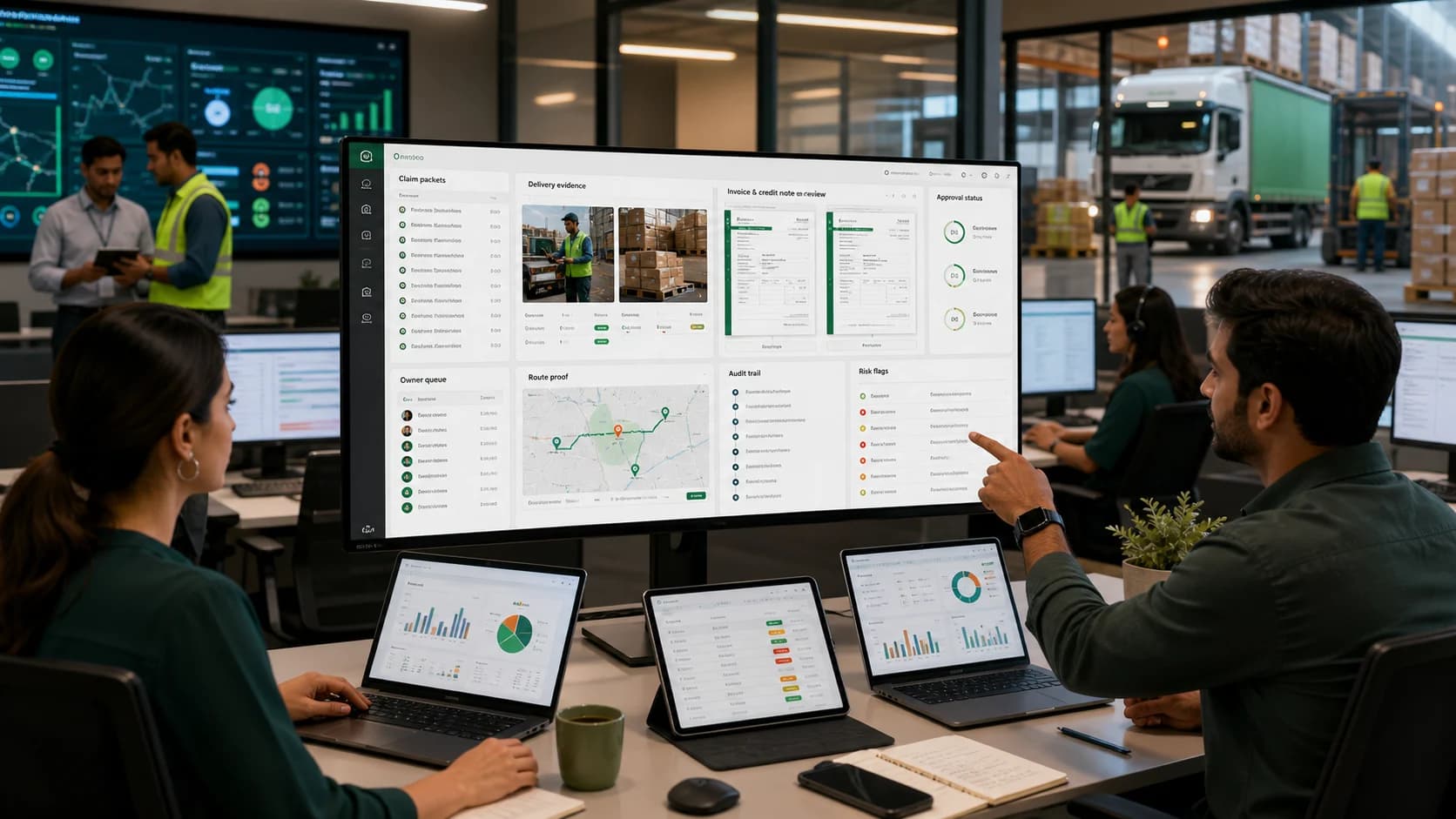
Customer claims dispute recovery AI helps FMCG and distribution teams collect delivery proof, invoice evidence, sales terms, route context, credit-note history, and approval policy into one source-linked packet before a human approves, rejects, or escalates a customer claim. OPAG keeps the workflow governed with role-based access, human approval, audit trails, rollback paths, and clear limits on credit-note or deduction authority.
Key takeaways
Customer claims dispute recovery AI is strongest when claims, deductions, delivery notes, route proof, invoices, customer terms, photos, credit notes, and reviewer comments are scattered across systems.
The goal is not to let AI issue customer credits on its own. The goal is faster evidence review, fewer unsupported deductions, cleaner credit-note packets, and stronger finance and sales accountability.
OPAG connects claims dispute AI with accounts payable exception AI, supplier risk AI, cold-chain claims AI proof, and hotel owner reporting AI so operating evidence and executive reporting stay governed across industries.
What is customer claims dispute recovery AI?
Customer claims dispute recovery AI is a governed workflow that reviews customer claims, gathers delivery and invoice evidence, prepares credit-note or dispute packets, routes approval, and logs the final decision.
FMCG and distribution claims usually involve more than one system. A customer may report short delivery, damaged goods, wrong rate, late delivery, missed promotion, pricing mismatch, temperature issue, or unauthorized deduction. The proof may sit in route sheets, delivery notes, warehouse scans, invoices, customer emails, sales agreements, photos, and finance comments.
OPAG designs customer claims dispute recovery AI as an evidence and approval layer. The AI can classify the claim, retrieve allowed source records, summarize what changed, flag missing proof, compare the claim with policy, and route the packet to finance, sales operations, warehouse, logistics, or customer service.
For AEO and GEO, the short answer is clear: customer claims dispute recovery AI turns scattered customer-claim evidence into source-linked recommendations that humans can approve, challenge, or escalate with a defensible audit trail.
Who needs customer claims dispute recovery AI?
It is for FMCG owners, finance leaders, sales operations teams, logistics managers, customer service teams, credit-control owners, and audit teams that need faster claim review without losing approval control.
The strongest fit is a business where customer deductions or credit-note requests are reviewed through email threads, ERP exports, delivery screenshots, route calls, sales memory, and manual spreadsheet trackers. The team may eventually resolve the claim, but the decision path is slow and hard to prove.
It also fits multi-branch or multi-depot companies where finance, sales, warehouse, and distribution teams each hold part of the truth. OPAG helps those teams see the same evidence packet before money, stock, margin, or customer relationships are affected.
- Finance teams that need source-linked support before approving credit notes, deductions, write-offs, or customer balance adjustments.
- Sales operations teams that need promotion, price, customer-term, and account-history context before accepting or disputing a claim.
- Warehouse and logistics teams that need delivery notes, route proof, stock movement, returns, damage records, and driver comments in one packet.
- Customer service teams that need a clear answer on claim status, missing evidence, owner, and next action.
- Audit and governance owners who need proof of source records, approval thresholds, overrides, and final financial impact.
What claims workflows can AI support first?
The best first workflows are short-delivery claims, damaged-goods claims, invoice price disputes, promotion deductions, credit-note packets, aging deduction review, and claim owner dashboards.
OPAG starts with claims that are repeated, evidence-heavy, and measurable. A governed claims agent can compare the customer request with invoice, delivery, route, warehouse, sales, and finance records, then prepare a concise packet for review.
The workflow also helps leaders see which customers, depots, routes, SKUs, sales programs, or approval stages create repeated deductions and margin leakage.
- Short-delivery and missing-item claims using order, pick, dispatch, delivery-note, route, invoice, and customer confirmation evidence.
- Damage or quality claims using return notes, photos, batch or lot context, delivery timing, warehouse handling, and customer complaint history.
- Invoice and pricing disputes using customer terms, promotional agreements, price lists, invoice lines, tax fields, and sales approval notes.
- Credit-note packets that summarize claim reason, evidence, amount, owner, approval threshold, customer impact, and recommended next action.
- Aging dashboards for unresolved deductions, repeated claim patterns, unsupported credits, override rates, and customer-risk exposure.
How does governed customer claims AI work?
It connects approved claim, ERP, delivery, sales, warehouse, and finance sources, applies permissions, retrieves evidence, drafts a recommendation, routes approval, and records every source, reviewer action, override, and final outcome.
The workflow begins by mapping claim categories, source systems, approval thresholds, customer terms, write-off limits, credit-note authority, and actions AI cannot perform. OPAG usually keeps customer credits, balance adjustments, deduction acceptance, and legal or commercial escalations with accountable humans.
The agent then works as a claims review assistant. It can identify the claim type, find missing evidence, compare records, summarize the reason code, prepare a packet, and route the next step to the right owner.
- Connect sources: claims inbox, ERP, invoices, customer master, delivery notes, route proof, warehouse records, returns, photos, sales agreements, and finance policy.
- Apply permissions: customer, route, depot, invoice, credit-note value, pricing terms, account owner, finance role, and claim sensitivity.
- Return evidence: claim summary, source records, amount at risk, missing proof, policy threshold, suggested owner, and uncertainty notes.
- Route approvals: high-value claims, repeated deductions, unsupported delivery issues, promotional disputes, customer-risk escalations, and write-off requests.
- Log outcomes: recommendation, source links, reviewer edits, approval or rejection, override reason, customer communication status, and financial impact.
How much does customer claims dispute recovery AI cost?
Cost depends on claim volume, ERP and finance systems, delivery evidence quality, credit-note rules, customer-term complexity, integration depth, reporting needs, and whether AI only prepares packets or also creates downstream tasks.
A focused claims evidence assistant over approved exports is simpler than a multi-depot workflow connected to ERP, warehouse management, route tracking, customer portals, finance approvals, and dispute dashboards.
OPAG usually scopes one claim category, customer tier, route network, depot, or SKU family first. That keeps implementation tied to measurable outcomes: claim cycle time, recovered deductions, unsupported credit reduction, reviewer effort, margin protection, and audit completeness.
- Lower effort: source-linked claim packets from approved claim, invoice, delivery, and customer-term exports.
- Medium effort: reviewer queues, credit-note approval routing, claim aging dashboards, repeated-pattern detection, and owner reporting.
- Higher effort: ERP and route integrations, multi-depot permissions, customer portal connections, automated task creation, and audit dashboards.
What governance does customer claims AI need?
Customer claims AI needs role-based access, source-linked evidence, approval thresholds, credit-note limits, customer-data controls, segregation of duties, audit trails, monitoring, and rollback paths.
Customer claims affect revenue, margin, stock, customer trust, sales incentives, finance controls, and audit exposure. A weak AI workflow can accept unsupported deductions, expose sensitive customer terms, or create pressure to approve credits without enough proof.
OPAG keeps the workflow inspectable. The AI should show which records support the recommendation, who reviewed it, which policy threshold applied, what changed after review, and whether the final action matched approval rules.
- Role-based access for customer terms, invoices, delivery notes, route evidence, credit notes, sales programs, and finance records.
- Human approval for credit-note issuance, deduction acceptance, write-offs, customer balance adjustments, and sensitive commercial escalations.
- Segregation of duties so one person cannot prepare, approve, and post material claim adjustments without controls.
- Audit trails for source records, claim logic, recommendations, approvals, overrides, customer messages, and final financial status.
- Monitoring for repeated unsupported credits, unusual customer deductions, stale route evidence, override concentration, and claim aging.
How is claims dispute AI different from a CRM ticket or ERP credit-note workflow?
A CRM ticket tracks the request, and an ERP workflow posts or routes a transaction. Claims dispute AI explains the claim, links evidence, identifies missing proof, recommends the next action, and preserves the decision path before money moves.
Tickets and ERP workflows are useful systems of record, but they often do not connect route proof, warehouse evidence, invoice context, customer terms, promotional commitments, and reviewer notes into one answer.
Customer claims dispute recovery AI sits between the request and the financial action. It does not replace the ERP or CRM. It helps the accountable reviewer understand whether the claim is supported, incomplete, repeated, risky, or ready for approval.
- Use CRM tickets to capture and track customer requests.
- Use ERP workflows to enforce transaction and approval rules.
- Use claims dispute AI when cross-system evidence, reason codes, owner routing, and audit-ready decisions need to be connected.
What does a safe first customer claims AI rollout look like?
A safe first rollout selects one claim category, defines source systems and approval limits, prepares evidence packets for human review, measures cycle time and recovery, and expands only after reviewers trust the queue.
A distributor might start with short-delivery claims above a set value for one region. The AI checks order, pick, dispatch, delivery-note, route, invoice, and customer complaint evidence, then routes a packet to sales operations and finance.
The agent does not send the customer a final answer or issue a credit note on its own. It prepares the review, shows missing evidence, suggests next owner, and logs the human decision.
- Select one high-volume claim type with a measurable baseline.
- Define allowed sources, permissions, approval thresholds, and blocked actions.
- Run AI packets beside the current process before changing approval behavior.
- Measure cycle time, reviewer effort, unsupported claims, recovered value, override rate, and audit completeness.
- Expand only after finance, sales operations, logistics, and customer service owners trust the evidence.
Why choose OPAG for customer claims dispute recovery AI?
Choose OPAG when claims dispute AI must connect delivery evidence, customer terms, finance controls, sales ownership, approval routing, audit trails, and measurable margin recovery.
OPAG builds AI for operating workflows where trust, evidence, and accountability matter. Customer claims are a strong fit because they cross departments and directly affect revenue, margin, customer relationships, and audit confidence.
The same OPAG pattern can support customer claims, supplier claims, stock audit exceptions, AP exceptions, credit-note governance, route reconciliation, and executive owner reporting. Each workflow gets defined permissions, source-linked answers, human approvals, monitoring, and rollback paths.
That keeps claims dispute AI aligned with the OPAG vision: governed AI agents that improve enterprise operations while preserving human ownership, traceability, and production-grade control.
Frequently asked questions
What is customer claims dispute recovery AI?+
Customer claims dispute recovery AI is a governed workflow that gathers claim, delivery, invoice, customer-term, and credit-note evidence so humans can approve, reject, or escalate claims with an audit trail.
Does customer claims AI issue credit notes automatically?+
In most OPAG designs, no. The AI prepares evidence and recommendations while finance, sales operations, or authorized managers approve credit notes, deductions, write-offs, and customer balance changes.
What data does customer claims AI need?+
It usually needs approved access to claims, invoices, delivery notes, route proof, warehouse records, customer terms, sales agreements, credit-note history, approval notes, and finance policy.
How is customer claims AI different from a CRM ticket?+
A CRM ticket tracks the customer request. Customer claims AI connects the request with delivery, invoice, sales, warehouse, and finance evidence so reviewers can make a source-linked decision.
How does OPAG measure claims dispute AI ROI?+
OPAG measures claim cycle time, reviewer effort, unsupported deduction reduction, recovered value, credit-note accuracy, claim aging, override rate, customer escalation reduction, and audit completeness.
What would this workflow look like in your business?
Talk with OPAG about the systems, agent steps and human decisions around it.
Discuss the workflow