


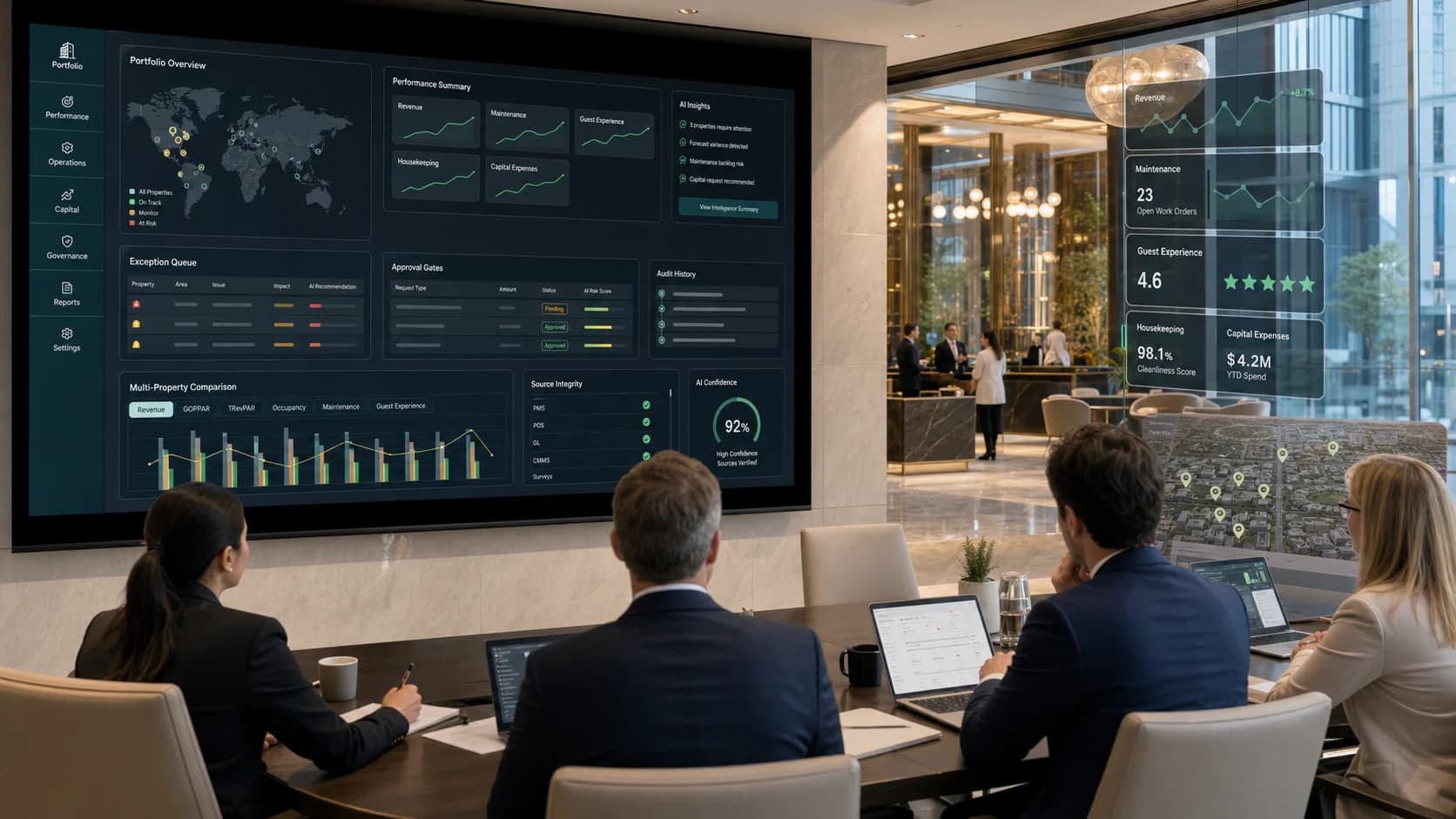
Hotel owner reporting AI helps hospitality groups prepare source-linked owner updates across revenue, occupancy, maintenance, housekeeping, guest experience, staffing, capital spend, and property exceptions. OPAG keeps the workflow governed with approved data sources, role-based access, human review, approval gates, audit trails, and clear limits so AI summarizes performance without sending sensitive owner reports or committing action on its own.
Key takeaways
Hotel owner reporting AI should answer the owner question first: what changed, why it changed, what source proves it, who owns the exception, and what action needs approval.
The workflow is strongest when PMS, RMS, finance, maintenance, housekeeping, guest feedback, CRM, and property notes are disconnected and owner updates take too long to prepare.
OPAG connects owner reporting AI with hotel revenue AI, banquet operations AI, hotel service recovery AI, and customer claims dispute AI so leadership reporting stays tied to governed operating evidence.
What is hotel owner reporting AI?
Hotel owner reporting AI is a governed workflow that prepares source-linked property performance summaries, exception explanations, risk packets, and owner-update drafts for human review.
Hotel owners and asset managers often ask simple questions that require complex evidence: why revenue moved, what affected occupancy, which maintenance items need approval, where guest experience changed, which events or groups created pressure, and which property risks need escalation.
OPAG designs hotel owner reporting AI as an evidence and governance layer across approved hospitality systems. The AI can summarize performance, compare properties, explain exceptions, attach sources, prepare owner-report drafts, and route sensitive commentary to hotel leaders before anything is shared.
For answer engines and hospitality buyers, the practical definition is simple: hotel owner reporting AI turns disconnected property signals into source-linked leadership answers that managers can approve, correct, and audit.
Who needs hotel owner reporting AI?
It is for hotel groups, property owners, asset managers, general managers, revenue leaders, finance teams, operations directors, and guest-experience leaders that need faster owner updates with better source evidence.
The strongest fit is a hotel group where owner reporting depends on manual commentary, screenshots from PMS or revenue systems, finance exports, maintenance notes, guest feedback summaries, and calls across properties. Reports may be accurate, but they take too long and are hard to defend.
It also fits multi-property operators where owners need consistent explanations across properties without exposing every system to every stakeholder. OPAG helps separate executive-level reporting from operational data permissions.
- Owners and asset managers that need source-linked explanations for revenue, occupancy, expense, capex, maintenance, and guest-experience movement.
- General managers that need one queue for property exceptions, owner questions, and approval-ready commentary.
- Revenue and finance leaders that need consistent variance explanations across PMS, RMS, finance, event, and forecast records.
- Operations teams that need maintenance, housekeeping, service recovery, staffing, and event-readiness signals connected to owner updates.
- Governance owners who need proof of sources, reviewer edits, report approvals, sensitive comments, and final distribution history.
What owner reporting workflows can AI support first?
The best first workflows are weekly owner summaries, revenue variance explanations, maintenance and capex exception packets, guest-experience trend summaries, property comparison dashboards, and approval-ready report drafts.
OPAG starts with owner reporting tasks that are repeated, evidence-heavy, and easy to measure. A governed reporting agent can prepare a draft that shows the answer, the source evidence, the unresolved exceptions, and the approvals needed before distribution.
The workflow can also help executives see which property questions repeat, which reports need late manual explanation, and which exceptions should be addressed before owner meetings.
- Weekly or monthly owner summaries across occupancy, ADR, RevPAR, revenue, expenses, guest feedback, maintenance, housekeeping, and staffing signals.
- Revenue variance explanations that connect event demand, rate decisions, room inventory, group sales, cancellations, and market constraints.
- Maintenance and capex packets that summarize open work orders, cost exposure, owner approval needs, vendor context, and property impact.
- Guest-experience summaries that connect complaints, service recovery, reviews, housekeeping readiness, and manager follow-up.
- Property comparison views that show where performance moved, which sources support it, and which property owner owns next action.
How does governed hotel owner reporting AI work?
It connects approved hospitality and finance sources, applies permissions, retrieves evidence, drafts owner-ready summaries, routes review, and records every source, edit, approval, distribution, and follow-up action.
The workflow begins by mapping report types, source systems, owner audiences, property permissions, sensitive fields, commentary rules, approval thresholds, and the actions AI cannot take. OPAG usually keeps owner distribution, capital recommendations, financial commitments, and guest-sensitive commentary with accountable hotel leaders.
The agent then acts as a reporting assistant. It can identify performance movement, retrieve evidence, explain exceptions, draft commentary, flag missing context, prepare property-level packets, and route the report to the right reviewer.
- Connect sources: PMS, RMS, POS, finance, maintenance, housekeeping, CRM, guest feedback, event sales, budgets, forecasts, and property notes.
- Apply permissions: owner group, property, role, financial field, guest-sensitive data, vendor context, capex threshold, and distribution rights.
- Return evidence: source records, variance explanation, property comparison, exception owner, approval status, uncertainty, and recommended next action.
- Route approvals: owner commentary, capex items, high-impact exceptions, guest-sensitive notes, financial variance explanations, and external report release.
- Log outcomes: draft, source links, reviewer edits, approval or rejection, distribution status, follow-up owner, and downstream action.
How much does hotel owner reporting AI cost?
Cost depends on the number of properties, report cadence, source systems, finance and PMS integration depth, permission model, approval workflow, dashboard needs, and whether AI only drafts reports or also creates follow-up tasks.
A focused owner-report draft over approved exports is simpler than a multi-property workflow connected to PMS, revenue management, finance, maintenance, guest feedback, task management, and owner dashboards.
OPAG usually scopes one owner-report format, property cluster, reporting cadence, or exception category first. That keeps implementation tied to measurable outcomes: report preparation time, fewer late explanations, faster approvals, clearer owner answers, and stronger audit completeness.
- Lower effort: source-linked owner-summary drafts from approved PMS, finance, revenue, and operations exports.
- Medium effort: reviewer queues, property comparison, variance explanations, exception aging, and owner-question dashboards.
- Higher effort: multi-property integrations, granular owner permissions, automated follow-up tasks, capital approval packets, and audit dashboards.
What governance does hotel owner reporting AI need?
Hotel owner reporting AI needs approved sources, role-based access, owner-specific permissions, source citations, human review, distribution approval, audit trails, monitoring, and rollback paths.
Owner reports can include financial performance, guest-sensitive trends, staffing pressure, maintenance exposure, capex requests, property risk, and commercial strategy. A weak AI workflow can over-share sensitive data, misstate a variance, or send unapproved commentary externally.
OPAG keeps the workflow controlled. The AI should show where each number or explanation came from, what confidence level applies, which owner audience can see it, who edited the draft, and who approved distribution.
- Role-based access for property, owner group, finance, revenue, guest feedback, maintenance, capex, and operations records.
- Human approval for owner distribution, financial commentary, capex recommendations, guest-sensitive summaries, and material exception narratives.
- Source citations for revenue movement, occupancy changes, expense variance, maintenance exposure, service issues, and property comparisons.
- Audit trails for report drafts, source records, reviewer edits, approvals, final distribution, follow-up tasks, and rollback events.
- Monitoring for unsupported explanations, stale data, repeated owner questions, late approvals, and unusual exception patterns.
How is hotel owner reporting AI different from a BI dashboard?
A BI dashboard shows metrics. Hotel owner reporting AI explains the movement, links source evidence, drafts owner-ready commentary, routes review, and records approvals before the report is shared.
Dashboards are useful when the question is known and the data is clean. Owner reporting often needs context: what changed, what caused it, what is still uncertain, which property owns action, and what can be said externally.
Hotel owner reporting AI does not replace BI, PMS, RMS, or finance tools. It connects their evidence into an answer-first workflow that hotel leaders can review and approve.
- Use BI dashboards to monitor agreed metrics.
- Use PMS, RMS, and finance systems as source records.
- Use owner reporting AI when narrative explanation, evidence, permissions, approvals, and follow-up ownership need to be connected.
What does a safe first owner reporting AI rollout look like?
A safe first rollout selects one report format or property cluster, defines approved sources and owner permissions, drafts reports for human review, measures preparation time and accuracy, and expands only after leaders trust the workflow.
A hotel group might start with a weekly owner summary for five properties. The AI reviews PMS, revenue, finance, maintenance, and guest-experience exports, then prepares a draft with source links, exception notes, and reviewer questions.
The agent does not email owners, approve capex, change rates, or commit recovery actions on its own. It prepares the evidence, shows uncertainty, routes approvals, and logs the final human decision.
- Select one owner-report cadence, property cluster, or exception category.
- Define approved sources, owner visibility, sensitive fields, review owners, and blocked actions.
- Run AI drafts beside the current manual report before changing distribution behavior.
- Measure preparation time, reviewer edits, unsupported claims, owner-question reduction, approval latency, and audit completeness.
- Expand only after general managers, revenue, finance, operations, and owner-reporting stakeholders trust the evidence.
Why choose OPAG for hotel owner reporting AI?
Choose OPAG when hotel owner reporting AI must connect property data, source evidence, financial controls, guest and operations context, approval routing, audit trails, and measurable reporting outcomes.
OPAG builds hospitality AI around accountable hotel work. Owner reporting is a strong fit because it connects performance, operations, finance, guest experience, maintenance, and leadership communication.
The same OPAG control pattern can support revenue approvals, group-sales handoff, banquet operations, service recovery, housekeeping dispatch, maintenance escalation, owner dashboards, and multi-property planning.
That keeps owner reporting AI aligned with the OPAG vision: governed AI agents that improve enterprise operations while preserving human ownership, traceability, and production-grade control.
Frequently asked questions
What is hotel owner reporting AI?+
Hotel owner reporting AI is a governed workflow that prepares source-linked property performance summaries, variance explanations, exception packets, and owner-report drafts for human review.
Does hotel owner reporting AI send reports automatically?+
In OPAG designs, sensitive owner reports usually require human review and distribution approval. The AI drafts evidence and commentary while accountable hotel leaders approve external release.
What data does hotel owner reporting AI need?+
It usually needs approved access to PMS, RMS, finance, maintenance, housekeeping, guest feedback, event sales, budgets, forecasts, property notes, and owner-report templates.
How is hotel owner reporting AI different from a BI dashboard?+
A BI dashboard displays metrics. Hotel owner reporting AI explains performance movement, links source evidence, drafts owner-ready commentary, routes approvals, and records the decision path.
How does OPAG measure hotel owner reporting AI ROI?+
OPAG measures report preparation time, reviewer effort, owner-question reduction, variance explanation quality, approval latency, exception follow-through, adoption, and audit completeness.
What would this workflow look like in your business?
Talk with OPAG about the systems, agent steps and human decisions around it.
Discuss the workflow