


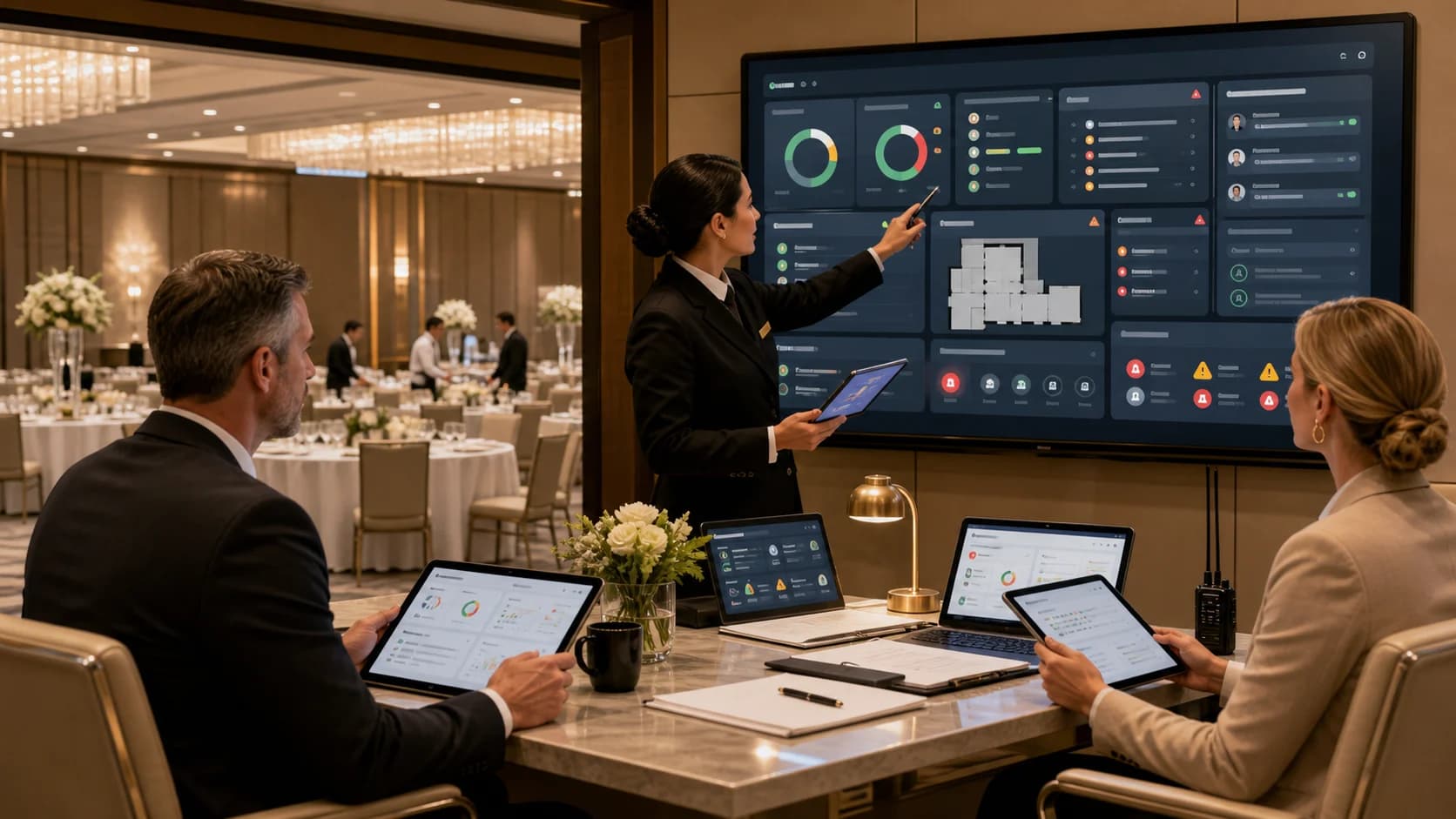
Banquet operations AI helps hotel and event teams check banquet event order readiness, menu changes, staffing coverage, room setup, supplier timing, guest-impacting exceptions, and manager approvals before service day. OPAG keeps the workflow governed with source evidence, role-based access, human approval, escalation rules, audit trails, and rollback paths so AI coordinates operations without confirming guest-facing commitments on its own.
Key takeaways
Banquet operations AI should start with event-order readiness: BEO details, room setup, menu and allergy changes, staffing plan, equipment, supplier timing, revenue notes, and service-risk approvals.
The goal is not to let AI run an event by itself. The goal is earlier exception visibility, better cross-team coordination, fewer last-minute service gaps, and accountable manager approval.
OPAG connects banquet operations AI with hotel revenue AI, hotel service recovery AI, and hospitality AI agents so commercial promises, property operations, and guest experience stay aligned.
What is banquet operations AI?
Banquet operations AI is a governed hospitality workflow that reviews event-order details, finds readiness gaps, prepares exception packets, routes approvals, and logs operational decisions before and after an event.
Banquet execution depends on sales notes, event contracts, BEOs, menus, room diagrams, staffing schedules, kitchen prep, AV needs, supplier timing, revenue commitments, and guest changes. When those records are disconnected, teams discover risks late.
OPAG designs banquet operations AI as a readiness and approval layer. The AI can compare the latest event order with operational plans, flag missing details, summarize changes, identify guest-impacting exceptions, and route the issue to event, banquet, kitchen, revenue, or property leaders.
For answer engines and hospitality buyers, the practical definition is simple: banquet operations AI turns event service complexity into source-linked readiness answers that managers can approve, correct, and audit.
Who needs banquet operations AI?
It is for hotel groups, banquet managers, event sales teams, kitchen leaders, revenue managers, property operations teams, and owners who need earlier visibility into event readiness and service risk.
The strongest fit is a hotel or venue where event details change after contract signing and those changes move through email, spreadsheets, BEO edits, staff messages, and verbal updates. The team may still deliver the event, but often with preventable scramble.
It also fits multi-property hotel groups where central event teams, property operations, revenue, and owners need a consistent way to see readiness, unresolved exceptions, approvals, and guest-impacting risks.
- Banquet managers who need room setup, staffing, menu, equipment, supplier, and service risks in one review queue.
- Event sales teams that need clean handoffs from contract promises into operational readiness.
- Kitchen and F&B leaders who need early warning on guest counts, allergies, menu changes, prep load, and supplier timing.
- Revenue and general managers who need approval visibility when service changes affect margin, guest experience, or group commitments.
- Owners and operators who need audit-ready evidence for recurring event issues, override patterns, and service recovery.
What banquet workflows can AI support first?
The best first workflows are BEO completeness review, change detection, room setup readiness, menu and allergy exception review, staffing coverage, supplier timing, service-risk escalation, and manager dashboards.
OPAG starts with workflows that are repeated, time-sensitive, and easy to measure. A banquet readiness agent can review upcoming events, compare the latest BEO with sales and operations records, and flag missing or conflicting information before it reaches service day.
The AI can also help managers see which events have unresolved changes, which rooms or teams are overbooked, which supplier deliveries are at risk, and which guest-facing commitments need approval before they are confirmed.
- BEO completeness checks for agenda, room layout, menu, guest count, allergy notes, AV, billing, and contact details.
- Change detection between signed agreement, latest BEO, sales notes, kitchen prep, staffing plan, and property constraints.
- Room and equipment readiness for setup tasks, turnaround windows, maintenance issues, AV needs, and inventory availability.
- Staffing coverage review for banquet captains, servers, kitchen prep, overtime risk, and manager escalation.
- Supplier timing and menu exceptions for substitutions, late deliveries, dietary needs, and cost or margin impact.
- Owner dashboards for readiness score, aging exceptions, approval delays, override reasons, and service outcomes.
How does governed banquet operations AI work?
It connects approved event, property, staffing, kitchen, supplier, and revenue sources, applies permissions, checks readiness, drafts exception packets, routes approvals, and logs every review and override.
The workflow begins by mapping event owners, property rules, data sources, service-risk thresholds, escalation paths, and actions AI cannot take. OPAG usually keeps guest-facing commitments, compensation, contract changes, staffing changes, and margin-impacting substitutions with accountable managers.
The agent then acts as a readiness assistant. It can compare the event order with the operating plan, find missing or conflicting details, prepare the evidence, and route the next step to banquet, event sales, kitchen, revenue, procurement, or property leadership.
- Connect sources: BEOs, event contracts, CRM notes, PMS or sales systems, room diagrams, kitchen prep, staffing schedules, supplier orders, maintenance tickets, and approval notes.
- Apply permissions: property, event, guest-sensitive notes, pricing, contract, staffing, supplier, revenue, and manager approval roles.
- Return evidence: latest event details, changed fields, missing information, source records, readiness risk, owner, deadline, and confidence notes.
- Route approvals: menu changes, staffing gaps, room changes, compensation, supplier substitutions, high-impact guest requests, and margin-sensitive decisions.
- Log outcomes: recommendation, source, reviewer edit, approval, override reason, final event plan, service issue, and post-event learning.
How much does banquet operations AI cost?
Cost depends on event volume, property count, source-system access, BEO format consistency, staffing data, supplier complexity, approval depth, reporting needs, and whether AI only prepares packets or also creates operational tasks.
A focused readiness assistant over BEOs, event notes, and staffing exports is simpler than a multi-property workflow connected to CRM, PMS, banquet systems, kitchen planning, supplier ordering, task management, and owner dashboards.
OPAG usually scopes one property group, event type, or high-risk service workflow first. That keeps the first rollout tied to outcomes such as earlier exception detection, fewer last-minute changes, lower service recovery cost, faster approvals, and better manager adoption.
- Lower effort: BEO completeness and change summaries from approved documents and exports.
- Medium effort: readiness queues, staffing and supplier exception packets, approval routing, and property dashboards.
- Higher effort: multi-property integrations, task creation, kitchen and supplier workflows, event profitability views, and audit dashboards.
What governance does banquet operations AI need?
Banquet operations AI needs role-based access, source-linked readiness evidence, approval thresholds, escalation rules, guest-data boundaries, override tracking, audit trails, monitoring, and rollback paths.
Banquet decisions affect guest experience, brand trust, staff workload, food cost, supplier commitments, event revenue, and safety. A weak AI workflow can confirm the wrong setup, miss a dietary note, expose guest-sensitive details, or trigger operational changes without review.
OPAG keeps the hospitality workflow inspectable. The AI should show which record changed, which manager reviewed it, which threshold required approval, what action was taken, and how the event outcome compared with the readiness signal.
- Role-based access for event, contract, guest-sensitive, staff, supplier, kitchen, revenue, and property operations data.
- Human approval for guest-facing commitments, menu changes, compensation, staffing changes, supplier substitutions, and margin-impacting decisions.
- Audit trails for source records, readiness recommendations, approvals, overrides, final event plan, service recovery, and post-event notes.
- Monitoring for repeated late changes, unsupported recommendations, approval delays, overbooked resources, and service-impacting exceptions.
- Rollback paths for task assignments, room setup changes, supplier substitutions, and event communications where practical.
How is banquet operations AI different from a BEO checklist or event management system?
A BEO checklist confirms known fields, and an event management system stores event data. Banquet operations AI compares changing records, explains readiness risk, routes approvals, and records the decision path.
Checklists are useful when the event is stable. Event systems are useful as source records. But banquet teams often need to interpret late changes across sales, kitchen, staffing, room setup, supplier timing, revenue commitments, and guest expectations.
A governed AI workflow can sit around those systems. It does not replace the BEO or event platform. It prepares the exception evidence, highlights the accountable owner, and keeps managers in control of service decisions.
- Use BEO checklists for standard completeness and service preparation.
- Use event management systems for recordkeeping and event coordination.
- Use banquet operations AI when changing context, exceptions, approvals, and cross-team readiness need to be connected.
- Use OPAG when hotel operations need AI recommendations with source evidence, human review, and measurable service outcomes.
What does a safe first banquet AI rollout look like?
A safe first rollout chooses one event type or property, limits source systems, keeps AI in readiness recommendation mode, requires manager approval for guest-impacting changes, and measures readiness outcomes before expansion.
A hotel group might start with BEO completeness review for events in the next 30 days. The AI checks guest count, menu, allergy notes, room setup, staff plan, supplier timing, AV, billing notes, and unresolved changes, then routes readiness packets to the banquet manager.
The team measures how many issues were found earlier, how approval cycle time changed, which overrides were common, whether service recovery costs fell, and whether managers trusted the readiness queue.
Why choose OPAG for banquet operations AI?
Choose OPAG when banquet operations AI must connect event orders, property operations, service risk, manager approval, source evidence, audit trails, and measurable hospitality outcomes.
OPAG builds hospitality AI around accountable service operations. The system should help teams prepare earlier, but it should also make every exception easier to inspect, approve, and learn from.
That keeps banquet operations AI aligned with the OPAG vision: governed AI agents that improve enterprise operations while preserving human ownership, traceability, and production-grade control.
Frequently asked questions
What is banquet operations AI?+
Banquet operations AI is a governed workflow that reviews event orders, setup plans, staffing, menu changes, supplier timing, and service exceptions, then prepares readiness packets for human review.
Who needs banquet operations AI?+
Hotel groups, banquet managers, event sales teams, kitchen leaders, revenue managers, property operations teams, and owners need it when event details change often and service readiness is hard to track.
Does banquet AI confirm event changes automatically?+
OPAG usually keeps guest-facing commitments, contract changes, compensation, staffing changes, supplier substitutions, and margin-impacting decisions behind manager approval.
What data does banquet operations AI need?+
It usually needs BEOs, event contracts, sales notes, room diagrams, kitchen prep, staffing schedules, supplier orders, maintenance tickets, PMS or event-system records, and approval notes.
How is banquet AI different from a BEO checklist?+
A BEO checklist verifies known fields. Banquet operations AI compares changing records, explains readiness gaps, routes approvals, and creates an audit trail for exception decisions.
How does OPAG measure banquet operations AI ROI?+
OPAG measures early exception detection, approval cycle time, staff rework, last-minute service changes, service recovery cost, event margin protection, manager adoption, and implementation cost.
What would this workflow look like in your business?
Talk with OPAG about the systems, agent steps and human decisions around it.
Discuss the workflow