

Hospitality AI agents help hotels answer guest questions, coordinate reservations, monitor room status, route housekeeping and maintenance work, surface pricing signals, and escalate sensitive issues to managers. OPAG makes these agents production-ready with role-based access, human approval, source-linked answers, property-level permissions, rollback, and audit trails.
Key takeaways
The best hospitality AI use cases start where guests and staff need fast, sourced answers: booking questions, amenity details, room readiness, local policies, maintenance status, and service recovery.
A hotel AI agent should never become an ungoverned chatbot. Refunds, safety concerns, VIP exceptions, overbooking, compensation, and sensitive guest data need approval gates and escalation rules.
OPAG connects hospitality AI to the same governed operating model used across conversational AI with citations, AI readiness assessment, and agentic AI governance.
What are hospitality AI agents?
Hospitality AI agents are governed assistants that answer guest and staff questions, coordinate property workflows, recommend actions, and route exceptions using approved hotel data and human oversight.
A useful hotel AI agent does more than reply to messages. It understands the operating context: reservation records, room status, guest preferences, property policies, housekeeping queues, maintenance tickets, loyalty rules, and service escalation history.
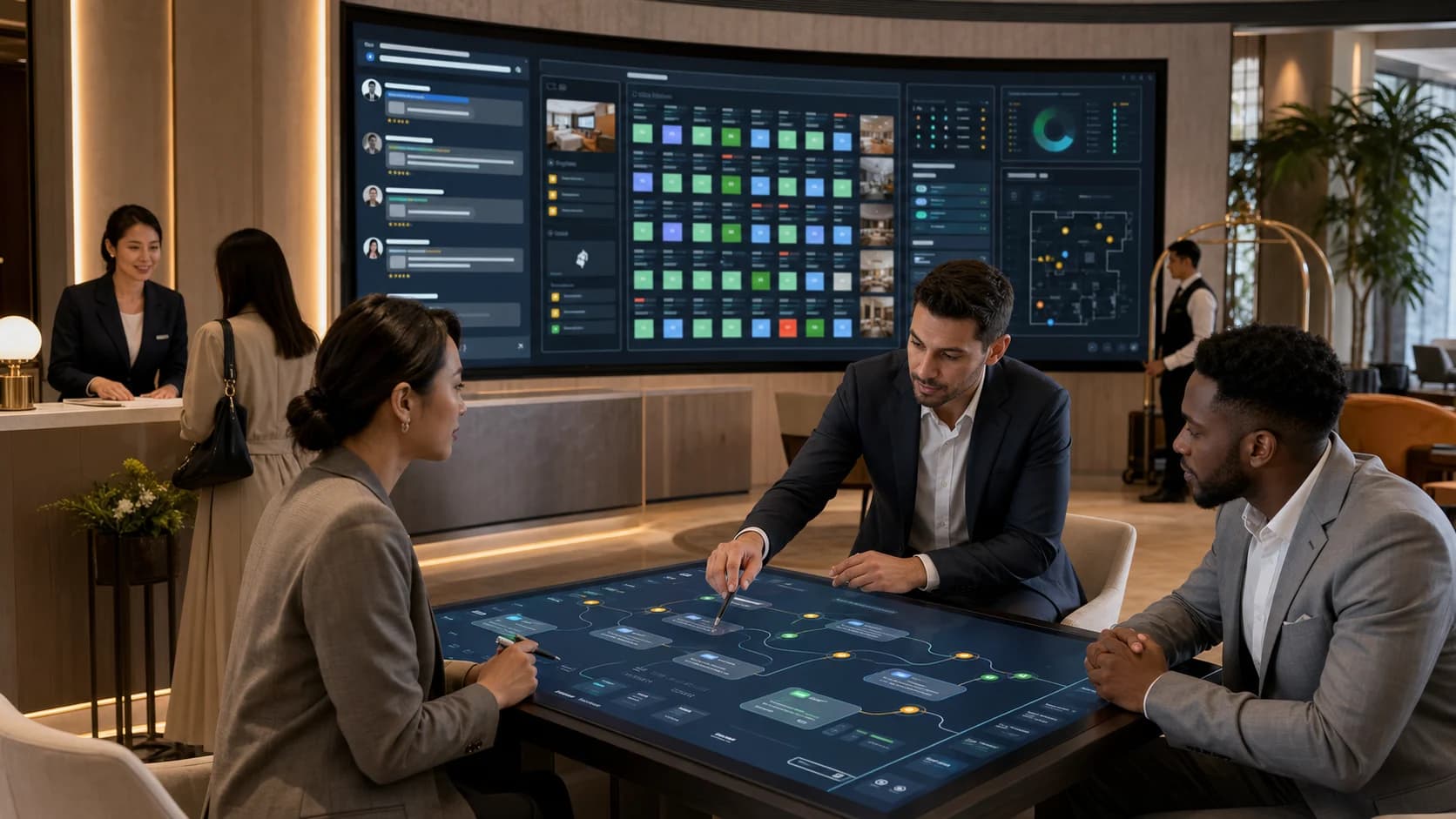
For OPAG, the agent is not a loose channel bot. It is a governed workflow layer. The agent can retrieve source records, show evidence, respect staff permissions, draft responses, recommend next steps, and require a manager before it changes a booking, grants compensation, or triggers a sensitive action.
That distinction matters for AEO, GEO, and real operators. The direct answer is not "add AI to hotel chat." The production answer is "connect guest support and property operations with controls that protect service quality."
Who are hospitality AI agents for?
They are for hotel groups, serviced apartments, resorts, property chains, and hospitality operators that need faster guest service without losing manager control.
The strongest fit is a hospitality business with repeated guest questions, multiple properties, multilingual service demand, fragmented systems, or manual handoffs between front desk, reservations, housekeeping, maintenance, and management.
Single-property teams can use AI to reduce support pressure and standardize answers. Multi-property groups gain more from property-level permissions, shared knowledge, escalation routing, and consistent operating evidence across locations.
- Front-desk and reservations teams that answer the same questions across phone, chat, email, and messaging channels.
- Housekeeping and maintenance managers who need cleaner room-readiness, defect, and service-recovery workflows.
- Revenue and property leaders who want pricing, occupancy, event, and inventory signals without waiting for manual reports.
- IT, security, and compliance teams that need guest data boundaries, access control, and audit logs.
What hospitality workflows can AI support first?
The first workflows are usually multilingual guest support, reservation questions, room readiness, housekeeping routing, maintenance triage, internal knowledge search, and manager-approved service recovery.
Hospitality has many AI opportunities, but OPAG starts with workflows that are frequent, measurable, and safe to govern. A guest asking about check-in, parking, late checkout, dining, amenities, invoice copies, or policy details can receive a fast answer if the agent can cite approved sources.
The next layer is operational coordination. When a room is not ready, a maintenance issue appears, or a complaint needs attention, the agent can summarize the source data, recommend the responsible owner, and route the exception to a human manager.
- Multilingual guest support with source-linked hotel policy answers.
- Reservation and room-status assistance across PMS, ERP, or custom property systems.
- Housekeeping queues that prioritize room turns, VIP arrivals, and late checkouts.
- Maintenance triage that links guest reports to asset records and work orders.
- Pricing and occupancy signals for revenue teams, with human approval before changes.
- Internal staff knowledge assistants for policies, SOPs, training, and local property details.
How does a governed hospitality AI agent work?
It connects approved guest, reservation, property, policy, and operations data; retrieves source evidence; drafts or recommends an action; and routes high-risk steps through a review queue.
The implementation starts by mapping the operating loop. Which guest questions repeat? Which staff handoffs create delay? Which systems hold the truth? Which actions are low risk, and which require approval?
OPAG then defines the agent boundary. The system may be allowed to answer policy questions, summarize room status, draft a guest response, create an internal task, or notify a team. It may be blocked from issuing refunds, overriding rates, changing reservations, or exposing sensitive guest records without a manager.
- Connect sources: PMS, ERP, CRM, booking engine, knowledge base, SOPs, maintenance, housekeeping, and support history.
- Apply permissions: property, department, role, guest record, and action-level access rules.
- Return evidence: citations, source records, confidence, timestamps, and known gaps.
- Route review: refunds, complaints, VIP requests, safety issues, overbooking, and price changes go to accountable humans.
- Log outcomes: every answer, recommendation, approval, override, and completed action is auditable.
How much does hospitality AI cost?
Cost depends on the number of properties, connected systems, channels, languages, workflows, approval rules, security requirements, and reporting needs.
A single guest knowledge assistant over approved policy documents is simpler than a multi-property operating agent connected to PMS, ERP, housekeeping, maintenance, revenue, and messaging platforms.
OPAG keeps the first scope practical. The usual goal is one governed workflow that can prove service speed, staff adoption, escalation accuracy, and guest experience impact before the hotel group expands into deeper automation.
- Lower effort: one property, one language, one knowledge source, answer-only support.
- Medium effort: multiple channels, multilingual answers, source citations, and staff review queues.
- Higher effort: PMS or ERP integration, property-level permissions, operational tasks, revenue signals, and audit dashboards.
What governance does hotel AI need?
Hotel AI needs guest-data boundaries, role-based access, approved-source citations, escalation rules, human approval, observability, rollback, and audit trails.
Hospitality teams are judged by the guest experience. A wrong answer about a policy, a mishandled complaint, or an unauthorized compensation decision can create operational and reputational damage quickly.
That is why OPAG treats governance as part of the workflow design. The agent should know what it can answer, what it can recommend, what it must escalate, and what it is never allowed to do without a person.
- Guest privacy controls for names, stays, payment status, preferences, and service history.
- Property-level permissions for multi-location groups.
- Human approval for refunds, compensation, overbooking, safety, legal, and VIP exceptions.
- Source-linked answers for policies, invoices, bookings, and internal instructions.
- Audit trails for messages, recommendations, approvals, overrides, and outcomes.
How is this different from a hotel chatbot or dashboard?
A chatbot answers messages, and a dashboard shows metrics. A governed hospitality AI agent connects answers, operational context, recommended action, human approval, and audit evidence in one workflow.
Many hotel chatbots can answer static questions. They often fail when the guest asks a context-specific question, when the answer depends on property policy, or when the situation needs a staff handoff.
Dashboards have the opposite problem. They show leaders what happened, but they do not help staff turn a specific guest or property issue into the next governed action.
- Use a chatbot for simple, low-risk public information.
- Use a dashboard for management reporting and trend review.
- Use a governed AI agent when the workflow needs source evidence, permission checks, escalation, and action tracking.
- Use OPAG when the AI must connect guest experience, operations, systems, and governance from the start.
Why choose OPAG for hospitality AI?
OPAG builds hospitality AI for operators who need production workflows, not demos: connected systems, evidence, approvals, audit trails, and measurable service outcomes.
OPAG has worked with hospitality operations at scale, including hotel and property workflows where guest support, reservations, financials, manufacturing visibility, and multilingual service all needed to fit into one operating stack.
The OPAG approach is deliberately practical. Start with one workflow, prove the answer quality and human review loop, measure adoption, then expand into deeper property automation where the controls are already understood.
Frequently asked questions
Can hotels use AI for multilingual guest support?+
Yes. Hotels can use AI to answer approved guest questions across languages, summarize requests, route issues, and escalate sensitive matters. OPAG recommends citations and human review for context-specific or high-risk responses.
Can hospitality AI connect to PMS or ERP systems?+
Yes, if the integration is scoped carefully. A governed agent can retrieve reservation, room, invoice, housekeeping, maintenance, and policy data while respecting property-level permissions and audit requirements.
What hotel AI actions need human approval?+
Refunds, compensation, safety incidents, legal complaints, VIP exceptions, overbooking decisions, rate overrides, and sensitive guest-data disclosures should route to a human manager before action.
Where should a hotel group start with AI?+
Start with a frequent workflow that has clear source data and measurable value, such as multilingual guest support, room-readiness coordination, maintenance triage, or staff knowledge search.
How does OPAG measure hospitality AI success?+
OPAG measures response speed, containment quality, escalation accuracy, staff adoption, guest satisfaction signals, override rate, audit completeness, and the operational outcome tied to the workflow.
What would this workflow look like in your business?
Talk with OPAG about the systems, agent steps and human decisions around it.
Discuss the workflow