


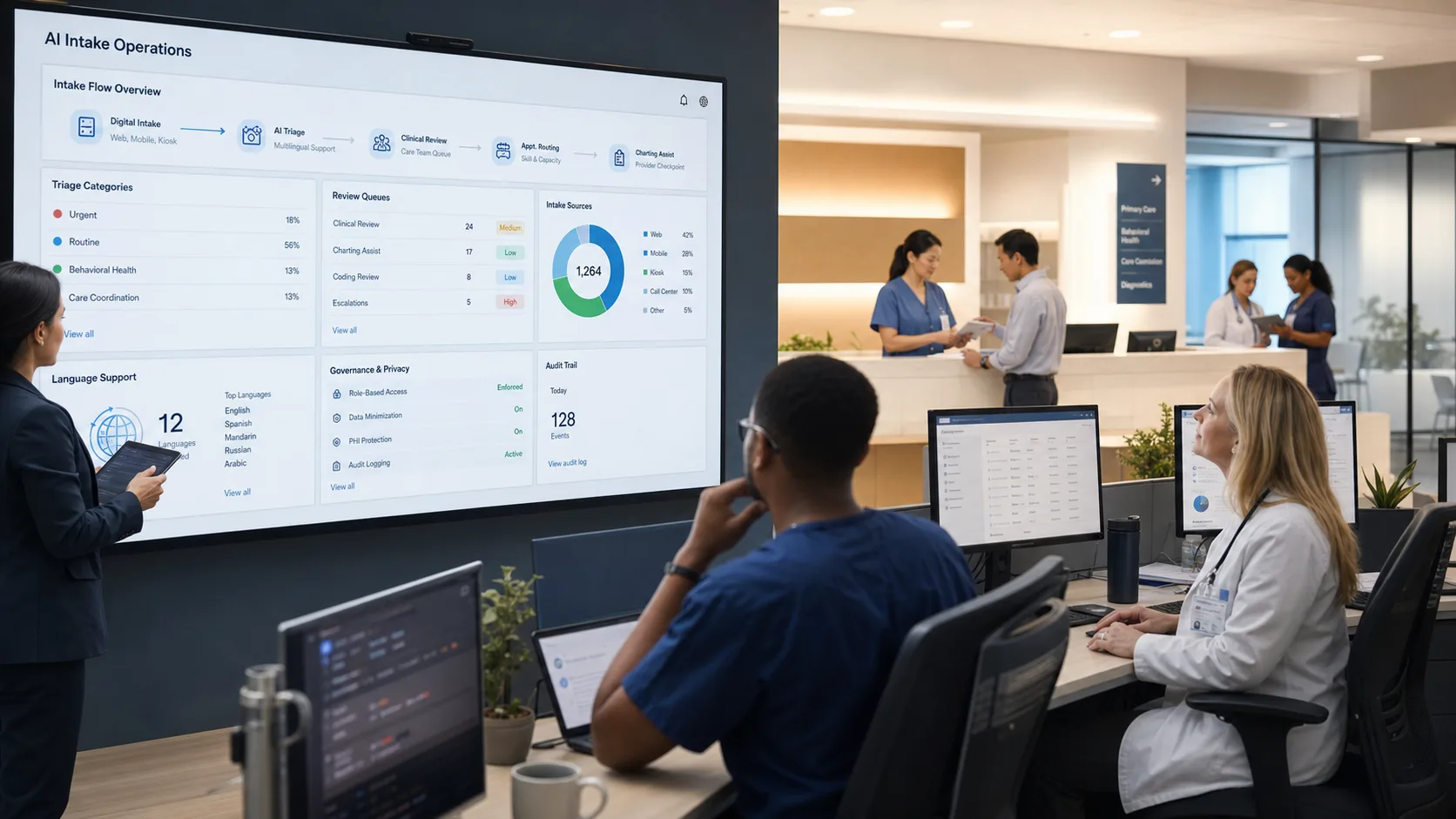
Healthcare AI intake helps clinics and providers collect patient information, summarize forms, support multilingual triage, route appointments, prepare charting drafts, and surface escalation needs. OPAG keeps it governed with privacy boundaries, role-based access, provider review, source evidence, audit logs, and no unsupervised clinical decision-making.
Key takeaways
Healthcare AI should be treated as intake and decision support, not autonomous care. The accountable clinician or care team must own clinical review and final decisions.
The safest first workflows are administrative or assistive: form completion, multilingual intake, appointment routing, chart preparation, prior context summaries, and escalation detection.
OPAG designs healthcare AI intake with the same control model used in legal AI with citations, conversational AI with citations, and governed workflow automation.
What is healthcare AI intake?
Healthcare AI intake is a governed workflow that collects patient context, organizes it for staff, supports triage routing, drafts summaries, and sends uncertain or sensitive cases to human review.
Healthcare intake is often slow because information arrives through forms, calls, portals, emails, PDFs, referrals, and conversations. Staff then re-enter details, resolve missing answers, route the patient, and prepare the chart for a clinician.
A governed AI intake workflow can reduce that friction. It can ask follow-up questions, translate or normalize responses, summarize the issue, identify missing fields, prepare a draft note, and route the file to the right queue. The clinical owner still reviews the work before decisions are made.
For OPAG, the important word is governed. Patient context, care decisions, escalation, and documentation need evidence, permissions, privacy boundaries, and audit logs from the beginning.
Who needs healthcare AI intake?
Healthcare AI intake is for clinics, provider groups, specialty practices, virtual-care teams, and care operations groups that want faster intake without weakening clinical accountability.
The best fit is a healthcare operation with repeated intake questions, multilingual patient demand, high call volume, missing form data, referral complexity, or staff time lost to manual chart preparation.
It is also useful when leaders need a controlled path into AI. Intake is close enough to operations to show value quickly, but sensitive enough to force the right governance habits before expanding.
- Front-office teams that need cleaner forms, fewer callbacks, and faster appointment routing.
- Care coordinators who need summarized context, missing-field detection, and escalation flags.
- Clinicians who want charting support but need to inspect and approve the evidence.
- IT and compliance owners who need privacy controls, role-based access, and audit-ready logs.
What healthcare intake workflows can AI support first?
Strong first workflows include digital intake forms, multilingual patient support, missing-information checks, appointment routing, referral summaries, draft chart notes, and escalation detection.
OPAG usually recommends starting with support around information flow, not autonomous diagnosis. The agent helps collect, organize, summarize, and route information so the care team can focus on clinical judgment.
This keeps the first deployment measurable. Leaders can track intake completion, staff time, callback volume, routing accuracy, patient wait time, clinician review effort, and audit completeness.
- Patient intake forms that adapt to missing or unclear answers.
- Multilingual intake support for English, Spanish, Urdu, Arabic, or other priority languages.
- Appointment routing based on approved rules, specialty, urgency, location, and availability.
- Referral and prior-record summaries with source references.
- Draft charting support for provider review.
- Escalation flags for urgent symptoms, privacy issues, incomplete consent, or care-coordination gaps.
How does governed healthcare AI intake work?
It collects structured and unstructured intake data, checks approved rules, cites source inputs, drafts summaries, assigns review queues, and logs every output for clinical and operational oversight.
The workflow starts before automation. OPAG maps the intake journey: patient entry points, forms, call scripts, referral documents, systems of record, review owners, escalation rules, and actions the AI is not allowed to take.
The agent then works inside a controlled boundary. It can clarify information, summarize patient-provided context, detect missing fields, prepare a draft note, or route the file. The provider or care team approves clinical interpretation and next steps.
- Connect intake sources: portal forms, phone notes, PDFs, referrals, CRM, EHR-adjacent systems, and policy documents.
- Apply permissions: role, clinic, specialty, patient context, record type, and action-level controls.
- Show evidence: source fields, uploaded documents, timestamps, confidence, and missing data.
- Route queues: administrative review, clinical review, urgent escalation, coding review, or care coordination.
- Log activity: question, answer, source, reviewer, edit, approval, override, and final disposition.
How much does healthcare AI intake cost?
Cost depends on intake volume, languages, forms, integrations, compliance requirements, review queues, analytics, and whether the workflow touches clinical documentation.
A lightweight intake assistant over one form and one review queue is much simpler than a multilingual intake system connected to scheduling, referral documents, EHR-adjacent data, charting support, and multiple specialties.
OPAG scopes cost by workflow complexity. The key question is not "how much AI can we add?" It is "which intake step has enough value, evidence, and review ownership to go live safely first?"
- Lower effort: digital intake completion, missing-field checks, and administrative review.
- Medium effort: multilingual support, referral summaries, appointment routing, and multiple queues.
- Higher effort: charting support, specialty rules, sensitive integrations, analytics, and stricter audit requirements.
What governance does healthcare AI intake need?
It needs privacy boundaries, role-based access, source evidence, clinical review, escalation rules, audit logs, monitoring, and clear limits on what the AI may decide.
Healthcare AI creates value only when trust is preserved. Patients, providers, compliance teams, and leadership need to know where an answer came from, who reviewed it, and what the system was allowed to do.
OPAG designs the controls before launch. The agent can assist intake and documentation, but clinical interpretation, diagnosis, treatment, medication, discharge, and urgent-care decisions remain accountable human work unless a regulated clinical process explicitly approves otherwise.
- Data minimization so the agent only sees the context required for its workflow.
- Role-based access for front-office staff, nurses, clinicians, care coordinators, and administrators.
- Provider review for charting drafts, triage support, and sensitive summaries.
- Escalation for urgent symptoms, consent gaps, privacy concerns, and vulnerable-patient scenarios.
- Audit trails for every source, output, review, correction, approval, and override.
How is healthcare AI intake different from a form builder or chatbot?
A form builder collects fields, and a chatbot answers questions. A governed healthcare intake agent organizes patient context, checks rules, cites sources, routes review, and creates audit evidence.
Form builders are useful, but they do not understand missing context, referral complexity, multilingual nuance, or downstream review queues. Generic chatbots can answer simple questions, but they rarely provide the evidence and controls that care operations need.
Healthcare intake requires a stronger pattern: structured capture, source evidence, permission checks, human review, and workflow measurement. That is where OPAG focuses.
- Use a form builder for static, low-complexity intake.
- Use a chatbot for simple public FAQs and scheduling guidance.
- Use a governed AI intake agent when the work involves patient context, routing, summaries, review, and audit evidence.
- Use OPAG when intake automation must connect workflow design, systems, privacy, and provider accountability.
What does a safe first healthcare AI rollout look like?
A safe first rollout starts with one intake workflow, one patient group or specialty, approved source data, clear escalation rules, provider review, and measurable operating outcomes.
For example, a clinic might start with multilingual new-patient intake for one specialty. The agent helps patients complete the form, identifies missing information, summarizes the reason for visit, and routes the file to administrative or clinical review.
The workflow does not diagnose. It improves preparation. Staff can see the source fields, the summary, the missing data, the escalation reason, and the reviewer decision. That evidence gives leadership a practical basis for expansion.
Why choose OPAG for healthcare AI intake?
OPAG builds healthcare AI intake as a governed operating workflow with privacy, evidence, human review, auditability, and measurable ROI from day one.
OPAG exists for businesses that need AI to survive production scrutiny. In healthcare, that means the system must be useful to staff, understandable to clinicians, acceptable to compliance, and measurable for leadership.
The delivery model is practical: assess readiness, choose a safe first workflow, connect approved data, build the review loop, monitor performance, and expand only when the evidence supports it.
Frequently asked questions
Can AI automate patient intake safely?+
Yes, when it is scoped as a governed workflow. AI can collect information, check missing fields, summarize context, support routing, and prepare drafts, while providers and care teams review sensitive or clinical outputs.
Should AI make triage decisions by itself?+
No. OPAG recommends using AI for triage support, escalation detection, and routing assistance, with accountable healthcare staff reviewing clinical interpretation and next steps.
Can healthcare AI intake support multiple languages?+
Yes. A governed intake workflow can support multilingual patient conversations and summaries, but the implementation should include approved language coverage, source review, escalation, and staff validation.
What data should healthcare AI intake access?+
It should only access the minimum approved data needed for the workflow, such as intake forms, referral documents, scheduling context, policies, and selected patient context under role-based permissions.
How does OPAG measure healthcare AI intake ROI?+
OPAG measures intake completion rate, callback reduction, staff time saved, routing accuracy, review effort, patient wait time, escalation quality, audit completeness, and the outcome selected for the first workflow.
What would this workflow look like in your business?
Talk with OPAG about the systems, agent steps and human decisions around it.
Discuss the workflow