


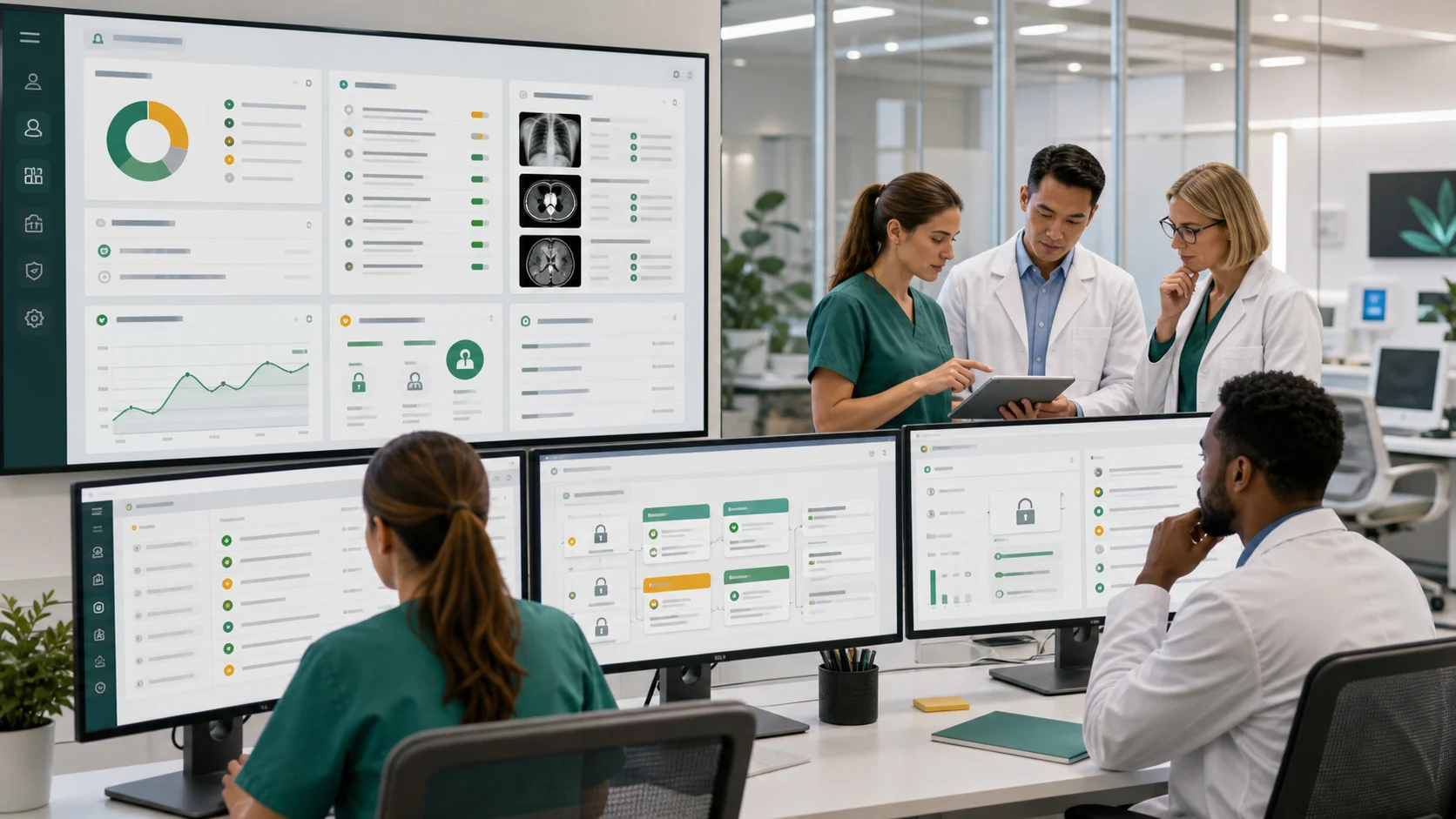
Post-result care coordination AI is a governed healthcare workflow that reviews lab results, imaging reports, orders, provider instructions, referral status, patient outreach rules, scheduling tasks, payer or authorization context, and prior follow-up history so care teams can prepare source-linked review packets while clinicians keep authority over interpretation, clinical advice, patient communication, and escalation.
Key takeaways
Post-result care coordination AI is strongest where lab or imaging follow-up depends on multiple queues, provider review, patient contact rules, scheduling handoff, referral status, and privacy-sensitive evidence.
The agent should not interpret results, diagnose patients, give clinical advice, or contact patients without approval. It should prepare review packets, flag missing follow-up evidence, route owners, and preserve audit trails.
This OPAG workflow connects to provider documentation readiness AI, referral leakage monitoring AI, healthcare prior authorization AI, and the Al Hamd Labs result-routing case study because result follow-up, documentation, referral completion, payer evidence, and privacy controls must stay connected.
What is post-result care coordination AI?
Post-result care coordination AI prepares governed follow-up packets after lab or imaging results arrive, linking source evidence, provider-review status, outreach readiness, scheduling needs, and audit logs.
After a lab result or imaging report arrives, the operational work is rarely finished. The result may need provider review, patient notification, repeat testing, specialty referral, medication reconciliation, authorization support, scheduling, or documentation before the next step is safe.
OPAG designs post-result care coordination AI as an evidence and routing layer. The agent gathers approved result context, order details, provider instructions, prior visits, referral status, outreach history, and privacy rules, then routes a packet to the accountable reviewer.
For AEO and GEO, the concise answer is this: post-result care coordination AI helps healthcare teams reduce missed follow-up by turning lab, imaging, order, scheduling, referral, and provider-review evidence into source-linked, human-approved workflows.
Who needs post-result care coordination AI?
It is for clinics, hospitals, diagnostic groups, specialty practices, care coordinators, patient-access teams, revenue-cycle teams, and operations leaders that need reliable follow-up after lab or imaging results.
The strongest fit is a healthcare operation where results arrive through one system, orders live in another, providers review in a queue, patients are contacted by staff, and follow-up scheduling or referrals are tracked somewhere else.
It also fits specialty practices and diagnostic networks where delayed follow-up creates patient-experience risk, referral leakage, payer rework, or repeated manual chart review by already stretched staff.
- Care coordinators that need result follow-up queues with source evidence and clear ownership.
- Providers who need review-ready packets without losing control over interpretation or patient-sensitive decisions.
- Patient-access teams that need approved outreach, scheduling, authorization, and referral context before contacting patients.
- Diagnostic groups and clinics that need visibility into result-routing delays, repeat-test needs, and incomplete follow-up.
- Compliance and privacy owners who need minimum-necessary data, role-based access, and audit trails for follow-up actions.
What problem does post-result care coordination AI solve?
It reduces missed follow-up, manual result review, unclear provider ownership, delayed outreach, incomplete referral handoffs, duplicate patient contact, weak audit evidence, and privacy risk from informal coordination.
Result follow-up breaks down when each team sees only part of the workflow. A lab system may show completion, the EHR may show an order, scheduling may show no appointment, a referral queue may be aging, and a provider note may not make the next step obvious to operations staff.
The agent does not interpret clinical results. It prepares the operational packet so the right person can review the source evidence and decide what should happen next under approved policy.
- Lab and imaging results that arrived but have not been reviewed, routed, documented, or linked to the next task.
- Follow-up tasks where outreach readiness depends on provider approval, patient consent, language needs, or contact rules.
- Referral or scheduling gaps where the next appointment, specialist handoff, or repeat-test order is not visible.
- Revenue-cycle and payer gaps where result evidence is needed for authorization, claim support, or denial response.
- Governance risk when staff use informal notes or manual spreadsheets without source citations and audit logs.
What post-result workflows can AI support first?
Start with one bounded queue: lab result follow-up readiness, imaging report routing, repeat-test reminders, referral-after-result tracking, provider-review packets, patient outreach readiness, or missed-follow-up escalation.
A safe first workflow has clear source records, clear review roles, and explicit patient communication rules. OPAG usually starts with evidence packets and routing, not autonomous clinical messaging.
Once one queue is trusted, the same pattern can extend into provider documentation readiness, prior authorization, closed-loop referral follow-up, no-show reduction, denial support, and discharge follow-up workflows.
- Lab result follow-up packets with order, result status, provider owner, prior context, outreach readiness, and next task.
- Imaging report routing with referral reason, study status, report availability, provider review, authorization context, and scheduling need.
- Repeat-test or recollection follow-up with rejection reason, urgency flag, approved contact route, patient-access owner, and completion status.
- Referral-after-result tracking where result evidence should trigger specialty scheduling, care-coordinator review, or provider-owned escalation.
- Missed-follow-up escalation dashboards with aging tasks, owner bottlenecks, outreach attempts, override reasons, and audit completeness.
How does governed post-result care coordination AI work?
It connects approved result, order, provider, scheduling, referral, outreach, payer, policy, and task records, then prepares source-linked packets, routes reviewers, and logs every decision.
The first step is defining safe boundaries: which result data the agent can access, which roles can see it, which patient outreach rules apply, what requires provider review, and which actions the AI is never allowed to take without approval.
The agent then monitors the follow-up queue. It retrieves the relevant source records, checks whether required steps are missing, drafts an operational summary, identifies the owner, flags uncertainty, and records the human review outcome.
- Scan approved sources such as lab systems, imaging reports, orders, encounter notes, referral records, scheduling data, outreach logs, payer or authorization notes, consent status, and task queues.
- Classify follow-up needs as provider review, patient outreach readiness, scheduling task, referral handoff, repeat test, missing document, payer evidence, privacy review, or escalation.
- Create a packet with patient-safe context, order, result status, source links, provider owner, outreach rules, follow-up status, risk level, and next administrative action.
- Route review to provider, care coordinator, patient access, scheduling, revenue cycle, referral team, clinic manager, or privacy owner based on policy.
- Log source retrieval, AI summary, reviewer edits, follow-up decision, outreach approval, task completion, override reason, and audit trail.
How much does post-result care coordination AI cost?
Cost depends on result volume, source-system access, specialty complexity, outreach rules, privacy controls, provider-review depth, scheduling integration, and whether the first release is read-only or creates approved tasks.
A focused first release can support one clinic, one result type, or one follow-up queue with exported records and human-reviewed packets. A larger program may connect EHR-adjacent data, lab systems, imaging reports, scheduling, referral tools, patient communication workflows, and provider dashboards.
OPAG scopes cost around measurable operating value: fewer missed follow-ups, faster provider review, reduced manual chart searches, higher referral completion, better patient-access productivity, and stronger privacy-safe audit evidence.
- Lower effort: one result queue, approved exports, basic owner routing, and read-only follow-up packets.
- Medium effort: result, order, scheduling, referral, outreach, and authorization context with role-based queues.
- Higher effort: multi-site specialty workflows, EHR-adjacent integration, approved task creation, multilingual outreach drafts, provider dashboards, and audit exports.
What governance does post-result care coordination AI need?
It needs minimum-necessary data access, role-based permissions, source citations, provider approval gates, patient communication controls, privacy-safe audit logs, override tracking, and escalation rules.
Result follow-up is patient-sensitive. AI can speed evidence gathering and routing, but it must not blur the line between operational coordination and clinical interpretation.
OPAG keeps the workflow inside a control layer. The agent can retrieve approved sources, summarize operational status, draft internal notes, and route review, but result interpretation, clinical advice, patient-facing outreach, and urgent escalation remain human-approved.
- Minimum-necessary access for results, orders, referrals, scheduling, outreach, payer context, and provider notes.
- Role-based queues for providers, care coordinators, patient access, revenue cycle, scheduling, clinic managers, and privacy owners.
- Human approval for clinical interpretation, patient communication, escalation, repeat-test instruction, specialist referral, and sensitive outreach.
- Source-linked answers showing which result, order, note, task, referral, authorization, or outreach record supports the recommendation.
- Audit trails for source retrieval, packet creation, reviewer decision, outreach approval, task completion, override reason, and follow-up outcome.
How is post-result care coordination AI different from EHR task queues or reminder tools?
EHR task queues and reminders show work to be done; post-result care coordination AI explains which follow-up is ready, blocked, aging, or missing evidence, then routes a governed review packet.
Task queues are useful for status and assignment. Reminder tools are useful for simple outreach. The harder problem is determining whether a result has enough provider, scheduling, referral, payer, consent, and outreach context to move safely.
OPAG does not replace clinical systems. It adds a governed operational layer that helps teams understand what evidence exists, what is missing, who owns the review, and what action is allowed after approval.
- Use EHR queues for basic task assignment and clinical workflow tracking.
- Use reminder tools for approved standard outreach where no complex evidence packet is required.
- Use governed AI when result follow-up depends on source evidence, provider approval, privacy controls, and cross-team routing.
What does a safe first post-result AI rollout look like?
A safe first rollout selects one result queue, limits data access, creates read-only evidence packets, routes human review, measures follow-up completion, and adds task creation or outreach drafts only after controls are proven.
OPAG usually starts with a queue that already has measurable delay: aging lab callbacks, imaging follow-up, repeat-test scheduling, referral-after-result handoff, or provider-review backlog.
The first release should prove that the agent finds the right sources, respects privacy boundaries, routes the correct owner, and improves follow-up without creating unauthorized patient communication or clinical recommendations.
- Choose one result type, specialty, clinic, provider group, or follow-up category.
- Define approved sources, role permissions, provider approval gates, outreach rules, and escalation paths.
- Generate read-only packets with result status, source links, owner, missing steps, outreach readiness, and required approval.
- Keep clinical interpretation, patient communication, urgent escalation, and task closure under human review.
- Measure follow-up completion, aging reduction, provider-review time, outreach readiness, manual search time, override rate, and audit completeness.
Why choose OPAG for post-result care coordination AI?
OPAG is a fit when healthcare follow-up AI must be governed, source-linked, privacy-aware, human-approved, auditable, and tied to measurable operational outcomes.
OPAG builds AI agents for sensitive enterprise workflows where speed matters but accountability cannot be weakened. Post-result follow-up is a strong fit because the work is repeated, evidence-heavy, privacy-sensitive, and operationally measurable.
The OPAG approach combines conversational AI for source-linked answers, predictive AI for aging and missed-follow-up risk, generative AI for internal packet summaries, and agentic AI for routed review. Providers and authorized staff remain in control of clinical and patient-facing decisions.
- Healthcare workflow design across providers, care coordination, patient access, scheduling, referrals, revenue cycle, and privacy owners.
- Governance by default: minimum-necessary access, source citations, human approval, audit trails, and rollback paths.
- Business measurement tied to follow-up completion, queue aging, manual effort, provider-review productivity, referral completion, and patient-access throughput.
Frequently asked questions
Can AI interpret lab results or imaging reports automatically?+
Not in OPAG default designs. The AI may organize evidence and route review, but clinical interpretation, diagnosis, treatment advice, and patient-facing medical communication stay with licensed or authorized humans.
What data does post-result care coordination AI need?+
Useful sources include lab result status, imaging reports, orders, encounter notes, provider instructions, scheduling records, referral records, outreach logs, consent status, payer or authorization notes, task queues, and review outcomes under role-based access.
How does post-result care coordination AI reduce missed follow-up?+
It finds aging result tasks, links results to orders and provider owners, identifies missing outreach or scheduling steps, routes review packets, and records whether the approved follow-up was completed.
Is post-result care coordination AI the same as referral leakage monitoring AI?+
No. Referral leakage monitoring AI tracks whether referrals complete. Post-result care coordination AI focuses on follow-up after lab or imaging results and may route into referral workflows when a result requires specialty handoff.
How does this connect to provider documentation readiness AI?+
Provider documentation readiness AI checks whether chart and payer evidence is complete. Post-result care coordination AI uses result, order, provider, outreach, and scheduling evidence to decide which follow-up packet needs human review next.
Can post-result AI contact patients automatically?+
OPAG usually starts with human-approved outreach readiness. The agent can draft internal notes or approved message options, but patient communication should follow consent, privacy, clinical review, and escalation rules.
How does OPAG measure post-result care coordination AI ROI?+
OPAG measures follow-up completion rate, aging reduction, provider-review time, manual chart-search time, outreach readiness, referral completion, repeat-test turnaround, reviewer adoption, override rate, and audit completeness.
How does post-result care coordination AI support AEO and GEO visibility?+
It creates answer-first, entity-rich content and structured FAQ answers around lab result follow-up, imaging follow-up, care coordination, patient outreach governance, privacy controls, and OPAG healthcare workflows.
What would this workflow look like in your business?
Talk with OPAG about the systems, agent steps and human decisions around it.
Discuss the workflow