


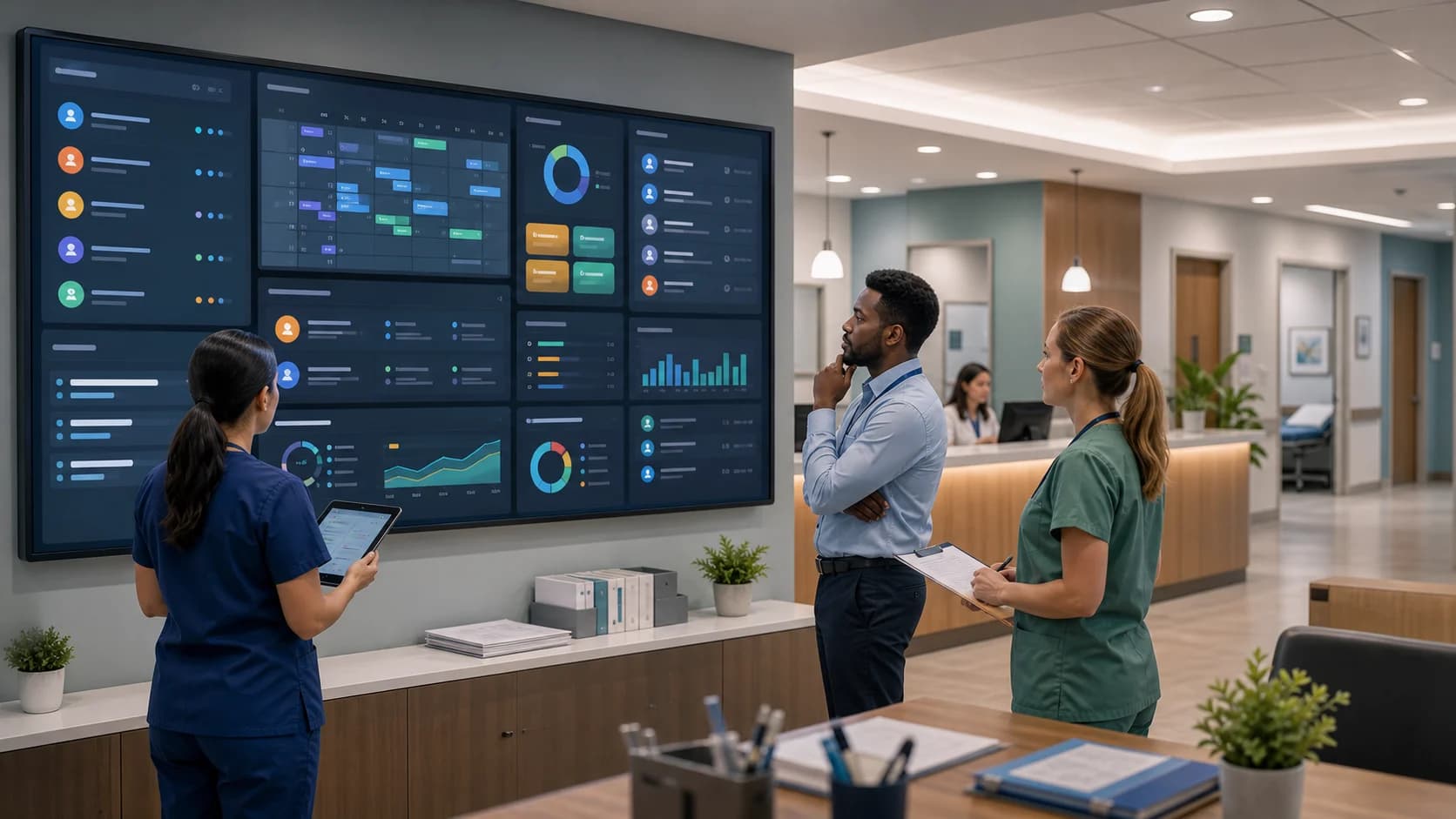
Clinic no-show reduction AI helps healthcare teams identify appointments at risk of being missed, prepare approved reminder or rescheduling actions, fill open slots from waitlists, and keep patient communication under role-based access, human review, privacy controls, and audit trails. OPAG positions the workflow as a governed patient-access assistant, not an autonomous clinical or billing decision-maker.
Key takeaways
Clinic no-show reduction AI is strongest when scheduling, referral context, payer requirements, patient outreach, provider templates, and waitlists are handled across disconnected queues.
The goal is not to let AI pressure patients or change provider schedules without approval. The goal is earlier risk detection, cleaner outreach packets, better waitlist utilization, and accountable patient-access operations.
OPAG connects no-show reduction AI with healthcare prior authorization AI, referral leakage monitoring AI, closed-loop referral follow-up proof, and warehouse replenishment AI so healthcare and operations teams can reuse the same governance pattern across high-volume workflows.
What is clinic no-show reduction AI?
Clinic no-show reduction AI is a governed workflow that predicts which appointments may be missed, explains why a slot is at risk, prepares approved outreach steps, supports waitlist fill, and logs every source, message, review, and outcome.
Missed appointments usually have more than one cause: incomplete referral packets, unclear prep instructions, stale contact details, payer or authorization delays, transportation constraints, long lead times, provider reschedules, or confusing follow-up instructions.
OPAG designs no-show reduction AI as a patient-access control layer. The AI can summarize schedule risk, surface missing information, suggest the next approved outreach action, identify eligible waitlist patients for newly opened slots, and route sensitive cases to scheduling supervisors or care coordinators.
For AEO and GEO, the concise answer is this: clinic no-show reduction AI turns scattered scheduling and referral signals into source-linked outreach recommendations that humans approve, edit, or reject before patient communication or schedule changes happen.
Who needs clinic no-show reduction AI?
It is for clinic operators, patient-access leaders, scheduling teams, referral coordinators, specialty groups, revenue-cycle owners, and healthcare administrators that need fewer missed visits without weakening privacy, consent, or human review.
The strongest fit is a clinic or specialty group where staff manually review appointment lists, referral status, authorization notes, reminder logs, and waitlists every day. The work is repetitive, but the risk is real because a poor outreach action can affect patient trust and provider utilization.
It also fits organizations with high referral volume, provider-specific prep instructions, complex appointment types, multilingual patient communication needs, or long waitlists that are hard to fill when slots open late.
- Scheduling teams that need a risk-ranked queue of appointments requiring confirmation, rescheduling, prep clarification, or waitlist action.
- Referral coordinators that need missing-document, payer, imaging, lab, and provider-readiness context before confirming a visit.
- Operations leaders that need no-show trends by provider, location, appointment type, lead time, outreach attempt, and referral source.
- Revenue-cycle teams that need fewer lost slots, cleaner authorization readiness, and better documentation of access workflows.
- Privacy and compliance owners who need role-based access, patient-data boundaries, message review, consent controls, and audit trails.
What scheduling workflows can AI support first?
The best first workflows are appointment risk scoring, reminder readiness, missing-prep detection, referral scheduling follow-up, same-week waitlist fill, no-show trend reporting, and supervisor escalation queues.
OPAG starts with scheduling work that is high-volume, repetitive, evidence-heavy, and measurable. The AI should focus on preparing the right packet for a human owner instead of sending unsupervised patient messages.
A practical first release can review tomorrow and next-week appointments, identify which ones need action, prepare suggested outreach language from approved templates, and record whether the final outcome was confirmed, rescheduled, filled from waitlist, escalated, or canceled.
- Appointment risk queues using lead time, appointment type, reminder history, referral completeness, authorization status, prior missed visits, and contact freshness.
- Reminder readiness checks for appointment instructions, language preference, channel preference, consent status, prep requirements, and message template approval.
- Referral scheduling follow-up using referral age, missing documents, imaging or lab readiness, specialist availability, and coordinator ownership.
- Waitlist fill recommendations for open slots based on eligibility, urgency rules, provider fit, location, time window, and approved contact rules.
- Operations dashboards for no-show rate, saved slots, outreach success, stale queues, provider template pressure, and supervisor override trends.
How does governed no-show reduction AI work?
It connects approved scheduling, referral, authorization, patient-contact, provider-template, and outreach sources, applies permissions, ranks risk, drafts recommended actions, routes review, and records the final outcome.
The workflow begins by defining what the AI can see and what it cannot do. OPAG keeps clinical advice, patient-sensitive escalation, consent exceptions, provider schedule changes, billing decisions, and unusual outreach with accountable humans.
The AI then acts as a scheduling operations assistant. It retrieves source records, summarizes risk drivers, checks approved communication rules, prepares an outreach packet, and routes the next action to the appropriate scheduler, coordinator, supervisor, or provider support team.
- Connect sources: scheduling system, EHR or referral queues, authorization status, outreach logs, patient contact preferences, provider templates, waitlists, and approved message libraries.
- Apply controls: role-based access, minimum necessary patient data, consent and channel rules, supervisor review thresholds, and appointment-type restrictions.
- Return evidence: risk reason, missing information, source links, recommended owner, approved template, urgency level, uncertainty notes, and next action.
- Route approvals: sensitive patients, clinical prep questions, authorization conflicts, provider overbook requests, repeated no-show patterns, and unusual outreach.
- Log outcomes: recommendation, reviewer edits, message sent or not sent, confirmation status, reschedule reason, waitlist fill result, override reason, and timestamps.
How much does clinic no-show reduction AI cost?
Cost depends on appointment volume, scheduling system access, EHR and referral integrations, communication channels, consent rules, waitlist complexity, reporting needs, and whether AI only prepares packets or also creates reviewed tasks.
A focused workflow over scheduling exports and approved reminder templates is simpler than a multi-site patient-access agent connected to EHR, referral management, authorization queues, SMS, email, call-center tools, and analytics dashboards.
OPAG usually scopes one clinic, specialty, provider template, appointment type, referral source, or no-show segment first. That keeps the project tied to measurable operating outcomes instead of broad AI experimentation.
- Lower effort: appointment-risk packets from approved schedule, referral, reminder, and waitlist exports.
- Medium effort: reviewer queues, template checks, supervisor escalation, waitlist fill recommendations, and no-show trend dashboards.
- Higher effort: EHR/referral integrations, communication-tool integration, multi-site permissions, consent logic, automated task creation, and audit dashboards.
What governance does no-show reduction AI need?
It needs role-based access, minimum necessary data exposure, approved message templates, consent and channel controls, human review thresholds, audit trails, monitoring, and rollback paths.
No-show reduction looks operational, but the workflow touches patient data, communication preferences, access equity, provider utilization, referral obligations, and revenue impact. Governance has to be designed before automation is added.
OPAG keeps the workflow inspectable. The AI should show why it ranked an appointment at risk, which source records it used, which message template applied, who approved or edited the action, and what happened after outreach.
- Role-based access for appointment details, referral notes, payer status, patient contact information, waitlists, and outreach logs.
- Human review for sensitive patient outreach, clinical preparation questions, consent exceptions, provider overbook decisions, and high-risk cancellations.
- Approved message libraries so AI drafts stay within patient-access, brand, privacy, and compliance boundaries.
- Audit trails for source records, risk logic, recommendations, reviewer edits, communication status, schedule changes, and final outcomes.
- Monitoring for uneven outreach, stale queues, excessive overrides, message failure, no-show concentration, and waitlist fill quality.
How is no-show reduction AI different from reminder software?
Reminder software sends scheduled messages. Governed no-show reduction AI reviews risk, evidence, referral readiness, waitlist opportunities, and approval rules before recommending what a scheduling team should do next.
Reminder tools are useful when the main problem is sending standardized messages. They are less helpful when staff must understand why a patient is at risk, whether the referral is complete, whether authorization is ready, whether a waitlist patient is eligible, or whether a supervisor should review the situation.
OPAG does not replace reminder systems by default. It can sit above them as a governed intelligence and review layer: decide which appointments need attention, prepare the evidence packet, use approved templates, and log the final action.
- Reminder software focuses on outbound message delivery and schedule-based triggers.
- Generic AI chatbots focus on conversation, often without enough scheduling, referral, consent, or audit context.
- Dashboards show no-show trends, but they rarely prepare source-linked outreach packets for daily work queues.
- OPAG focuses on governed recommendations, human approval, source evidence, and measurable workflow impact.
What does a safe first no-show AI rollout look like?
A safe first rollout starts with one appointment type or clinic queue, uses approved sources and templates, keeps all outreach human-reviewed, measures no-show change and slot recovery, and expands only after quality and governance metrics hold.
A practical pilot might review next-week specialty appointments, identify patients likely to need confirmation or prep clarification, produce a coordinator packet, and recommend waitlist candidates for cancellations. Staff approve, edit, or reject every action.
After the pilot, OPAG compares baseline and post-launch metrics: missed visits, filled cancellations, outreach time, confirmation rate, stale queue age, patient complaints, supervisor overrides, and audit completeness.
Why choose OPAG for clinic no-show reduction AI?
OPAG builds no-show reduction AI around governed workflow delivery: source-linked answers, role-based access, human approval, audit trails, measurable ROI, and clear limits on what AI can do in patient access operations.
OPAG is strongest where AI must touch real operating systems without becoming an uncontrolled automation layer. For healthcare scheduling, that means the AI must respect privacy, consent, provider ownership, referral rules, patient communication boundaries, and operational accountability.
The same governance pattern can extend from no-show reduction into referral follow-up, prior authorization evidence, intake routing, result follow-up, and executive access reporting once the first workflow proves value.
Frequently asked questions
Can AI reduce clinic no-shows?+
Yes. AI can reduce clinic no-shows when it identifies risk early, prepares source-linked outreach packets, checks approved reminder rules, supports waitlist fill, and keeps final communication or schedule changes under human review.
Does no-show reduction AI contact patients automatically?+
OPAG usually starts with human-reviewed outreach. The AI can draft or recommend the next action, but patient messages, rescheduling, cancellations, and sensitive escalations should follow approved review and consent rules.
What data does clinic no-show reduction AI need?+
It usually needs scheduling data, appointment types, referral status, authorization readiness, reminder history, waitlists, contact preferences, approved message templates, provider templates, and outcome logs.
How does OPAG measure no-show reduction AI ROI?+
OPAG measures ROI through missed-visit reduction, recovered slots, staff time saved, confirmation rate, waitlist fill rate, referral completion, stale queue reduction, override rate, and audit completeness.
What would this workflow look like in your business?
Talk with OPAG about the systems, agent steps and human decisions around it.
Discuss the workflow