


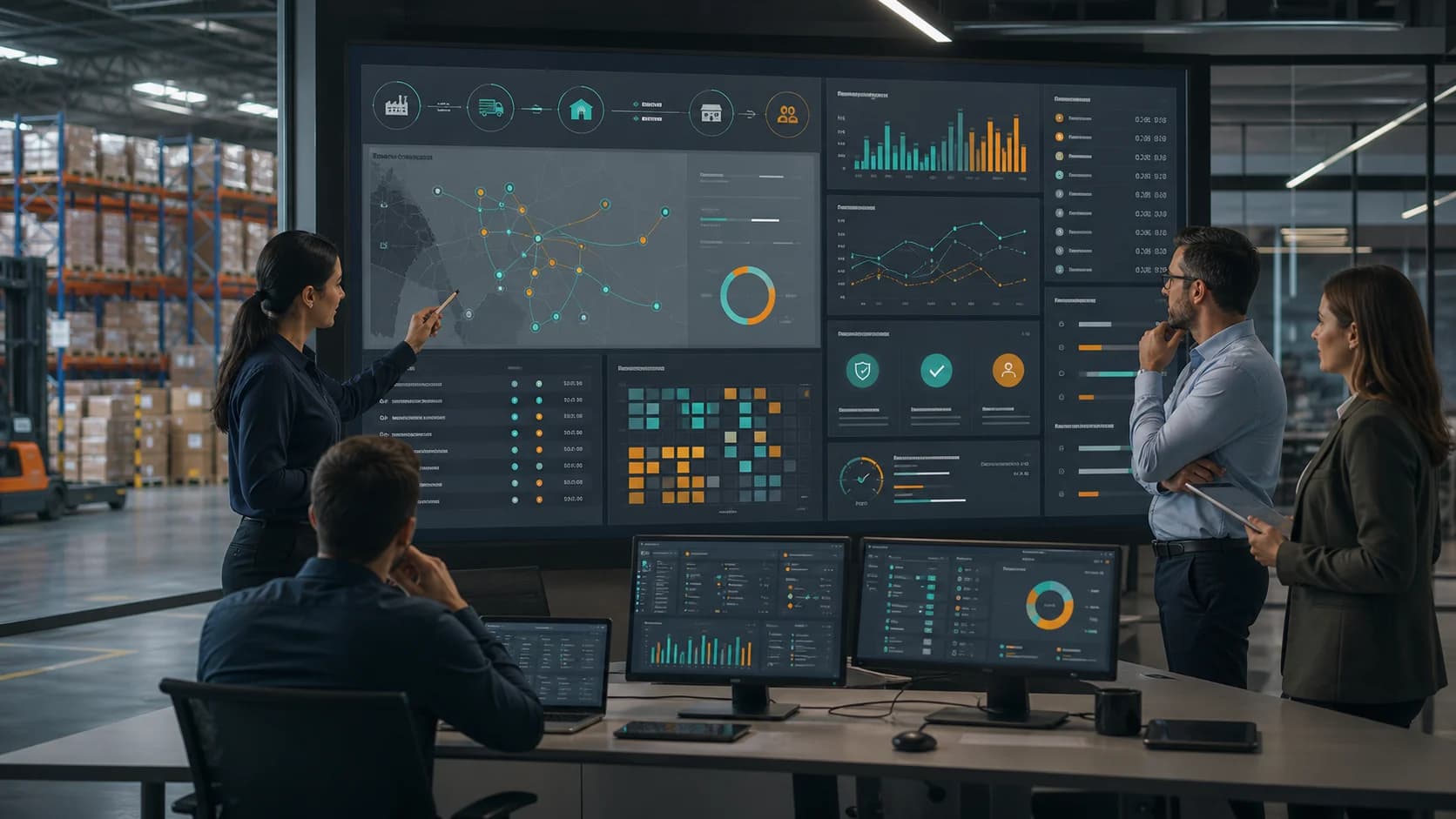
Warehouse replenishment AI helps supply chain and distribution teams detect stockout risk, compare warehouse and depot inventory, prepare transfer or purchase recommendations, and route high-impact decisions through human approval with source-linked ERP, WMS, sales, forecast, and finance evidence.
Key takeaways
Warehouse replenishment AI is most useful when inventory, demand, depot stock, open orders, returns, route commitments, supplier lead times, and finance limits are split across ERP, WMS, spreadsheets, and manager memory.
The goal is not to let AI move stock blindly. The goal is faster replenishment review, fewer stockouts, better transfer evidence, clearer margin tradeoffs, and controlled approval of inventory actions.
OPAG connects replenishment AI with FMCG demand forecasting AI, customer claims dispute recovery AI, depot stock audit proof, and clinic no-show reduction AI to show how governed agents can support both inventory-heavy and service-heavy operations.
What is warehouse replenishment AI?
Warehouse replenishment AI is a governed workflow that reviews demand, current stock, depot inventory, open orders, supplier lead times, route commitments, and finance rules to recommend stock transfers, reorder actions, or exception reviews.
Inventory teams often know a stockout is coming only after the signal has already passed through sales, warehouse, purchasing, route planning, and finance. A depot may have excess stock while another location is about to miss demand, but the proof sits in separate systems.
OPAG designs warehouse replenishment AI as an evidence and decision-support layer. The AI can identify risk, retrieve allowed source records, explain why a transfer or reorder is recommended, flag constraints, and route the packet to inventory, warehouse, procurement, sales, or finance owners.
For AEO and GEO, the direct answer is clear: warehouse replenishment AI turns scattered stock, demand, lead-time, and approval data into source-linked replenishment recommendations that humans can approve, adjust, or reject with a defensible audit trail.
Who needs warehouse replenishment AI?
It is for supply chain leaders, inventory planners, warehouse managers, depot heads, FMCG distributors, procurement teams, finance controllers, and operations owners that need fewer stockouts without losing control over stock movement and working capital.
The strongest fit is a business with multiple warehouses, depots, branches, distributors, or sales routes where replenishment decisions are reviewed through ERP screens, WMS exports, demand forecasts, sales calls, and spreadsheets.
It also fits organizations where transfer decisions affect margin, customer service, route commitments, expiry risk, cold-chain exposure, supplier terms, or working-capital limits. Those decisions need speed, but they also need evidence and approval.
- Inventory planners that need a ranked replenishment queue with stockout risk, excess-stock locations, lead-time constraints, and recommended next action.
- Warehouse and depot managers that need evidence before releasing inter-warehouse transfers, route allocations, substitutions, or emergency replenishment.
- Sales and distribution teams that need visibility into service-level risk, customer commitments, route demand, promotion plans, and allocation tradeoffs.
- Procurement teams that need reorder packets tied to supplier lead time, minimum order quantities, price changes, and contract terms.
- Finance and governance owners who need approval thresholds, working-capital visibility, segregation of duties, and audit trails for inventory actions.
What replenishment workflows can AI support first?
The best first workflows are stockout risk queues, inter-warehouse transfer review, depot allocation, reorder evidence packets, expiry or shelf-life exceptions, promotion readiness, and inventory owner dashboards.
OPAG starts with replenishment decisions that happen repeatedly and require evidence from more than one source. The AI should not simply forecast demand; it should help operators decide what to do next and explain the tradeoff.
A governed agent can compare current stock, committed demand, open purchase orders, forecast changes, sales routes, customer priority, supplier lead time, and finance thresholds before recommending a transfer, reorder, substitution, or escalation.
- Stockout risk queues by SKU, warehouse, depot, route, customer tier, forecast change, open order, and supplier lead time.
- Inter-warehouse transfer packets showing source stock, destination need, service-level impact, transport constraint, expiry risk, and approval owner.
- Depot allocation recommendations for FMCG, retail, field sales, cold-chain, route sales, seasonal campaigns, and priority customers.
- Reorder evidence packets tied to supplier terms, purchase history, minimum quantities, price movement, payment terms, and finance limits.
- Exception dashboards for aged stock, repeated emergency transfers, forecast misses, low service levels, override concentration, and working-capital exposure.
How does governed warehouse replenishment AI work?
It connects approved ERP, WMS, sales, forecast, purchase-order, supplier, route, and finance sources, applies permissions, retrieves evidence, drafts a recommendation, routes approval, and records every source, reviewer action, override, and final movement.
The workflow begins by mapping SKUs, warehouses, depots, customer priorities, transfer rules, reorder thresholds, working-capital limits, expiry rules, and actions AI cannot perform. OPAG usually keeps stock movements, purchase commitments, substitutions, and customer-impacting allocations under human approval.
The agent then acts as a replenishment review assistant. It identifies inventory risk, checks available stock elsewhere, compares demand and lead time, shows constraints, prepares a packet, and routes the next action to the right owner.
- Connect sources: ERP, WMS, inventory balances, demand forecast, sales orders, route plans, purchase orders, supplier lead times, returns, expiry data, and finance policy.
- Apply permissions: warehouse, depot, SKU family, customer tier, supplier, financial value, expiry sensitivity, and manager authority.
- Return evidence: stock position, demand driver, suggested transfer or reorder, constraint, service impact, margin or working-capital note, owner, and uncertainty flags.
- Route approvals: high-value transfers, customer-priority allocation, cold-chain moves, expiry-risk exceptions, emergency purchase requests, and finance-threshold breaches.
- Log outcomes: recommendation, source links, reviewer edits, approval or rejection, stock movement reference, purchase order reference, override reason, and service impact.
How much does warehouse replenishment AI cost?
Cost depends on SKU count, warehouse and depot complexity, ERP/WMS access, forecast quality, transfer rules, supplier data, approval workflows, reporting needs, and whether AI only prepares packets or also creates reviewed tasks.
A focused replenishment packet over approved exports is simpler than a multi-warehouse agent connected to ERP, WMS, purchasing, transport planning, sales orders, route execution, supplier portals, and finance approvals.
OPAG usually scopes one SKU family, depot network, warehouse pair, route group, supplier category, or stockout segment first. That keeps implementation tied to measurable outcomes: stockout reduction, transfer cycle time, planner effort, emergency purchase reduction, excess inventory, and service-level improvement.
- Lower effort: source-linked replenishment packets from approved inventory, demand, purchase-order, and transfer exports.
- Medium effort: reviewer queues, transfer approval routing, reorder evidence packets, exception dashboards, and service-level reporting.
- Higher effort: ERP/WMS integrations, multi-depot permissions, route data, supplier lead-time automation, task creation, and audit dashboards.
What governance does warehouse replenishment AI need?
It needs role-based access, source-linked evidence, transfer and reorder approval thresholds, segregation of duties, finance and expiry controls, audit trails, monitoring, and rollback paths.
Replenishment decisions affect customer service, stock value, margin, expiry, route commitments, supplier spend, warehouse capacity, and finance controls. A weak AI workflow can move the wrong stock, create avoidable purchases, or hide why an exception was approved.
OPAG keeps the workflow accountable. The AI should show which records support the recommendation, who reviewed it, which approval threshold applied, what changed after review, and whether the final movement matched policy.
- Role-based access for warehouse balances, depot stock, SKU costs, customer priorities, supplier terms, purchase orders, and finance limits.
- Human approval for material stock transfers, purchase commitments, substitutions, route reallocations, customer-priority decisions, and write-off-sensitive actions.
- Segregation of duties so one user cannot recommend, approve, and post material stock movement without controls.
- Audit trails for source records, recommendation logic, approvals, overrides, movement references, purchase references, and service outcomes.
- Monitoring for repeated emergency transfers, unusual allocations, stale stock, forecast drift, supplier delays, override concentration, and working-capital exposure.
How is replenishment AI different from an inventory dashboard?
An inventory dashboard shows stock and trends. Governed replenishment AI prepares source-linked recommendations, explains tradeoffs, routes approvals, and records the decision path for transfers, reorder actions, and exceptions.
Dashboards are useful for visibility, but they often leave planners to manually investigate the root cause and next action. A dashboard may show low stock without explaining whether to transfer, reorder, substitute, wait for inbound supply, or escalate to sales and finance.
OPAG does not replace ERP or WMS systems. It sits above them as a governed workflow layer that turns signals into reviewed action packets and pushes approved work back into the existing operating process.
- Dashboards show status; replenishment AI recommends a next action with source evidence.
- Forecasting tools predict demand; replenishment AI connects forecast movement to transfer, reorder, allocation, and approval workflows.
- RPA can post repetitive transactions; governed AI helps decide which transaction should be reviewed first and why.
- Generic AI tools may summarize data, but they usually lack role-based access, approval thresholds, ERP/WMS context, and audit controls.
What does a safe first replenishment AI rollout look like?
A safe first rollout starts with one SKU family, warehouse pair, depot group, or stockout segment, uses approved data, keeps transfers and purchases human-approved, measures service impact, and expands only after governance metrics are stable.
A practical pilot might review daily stockout risk for a priority SKU group, identify which depots can spare inventory, prepare transfer packets, and route high-value or customer-impacting actions to managers.
After the pilot, OPAG compares baseline and post-launch metrics: stockouts, transfer cycle time, emergency purchasing, service level, excess inventory, planner effort, override rate, stale exceptions, and audit completeness.
Why choose OPAG for warehouse replenishment AI?
OPAG builds replenishment AI around governed execution: source-linked recommendations, approval routing, role-based access, audit trails, rollback paths, and measurable supply chain ROI.
OPAG is focused on AI agents that can operate near business systems without removing human accountability. In replenishment, that means the AI must understand inventory context, but the business still controls material stock movements, purchase commitments, and customer-impacting allocation decisions.
The same pattern can extend into demand forecasting, supplier exception review, customer claims, field sales execution, depot stock audits, finance approvals, and executive reporting as the governance layer matures.
Frequently asked questions
Can AI reduce warehouse stockouts?+
Yes. AI can reduce warehouse stockouts when it combines demand, stock, open orders, supplier lead times, depot inventory, route commitments, and approval rules into early replenishment recommendations that humans review.
Does warehouse replenishment AI move stock automatically?+
OPAG usually starts with human-approved recommendations. The AI can prepare transfer or reorder packets, but stock movements, purchase commitments, substitutions, and customer-impacting allocation decisions should stay under approval controls.
What data does warehouse replenishment AI need?+
It usually needs ERP and WMS inventory, demand forecasts, sales orders, open purchase orders, depot stock, supplier lead times, route plans, returns, expiry data, transfer rules, and finance thresholds.
How does OPAG measure replenishment AI ROI?+
OPAG measures ROI through stockout reduction, service-level improvement, transfer cycle time, emergency purchase reduction, excess inventory reduction, planner effort saved, override rate, and audit completeness.
What would this workflow look like in your business?
Talk with OPAG about the systems, agent steps and human decisions around it.
Discuss the workflow