


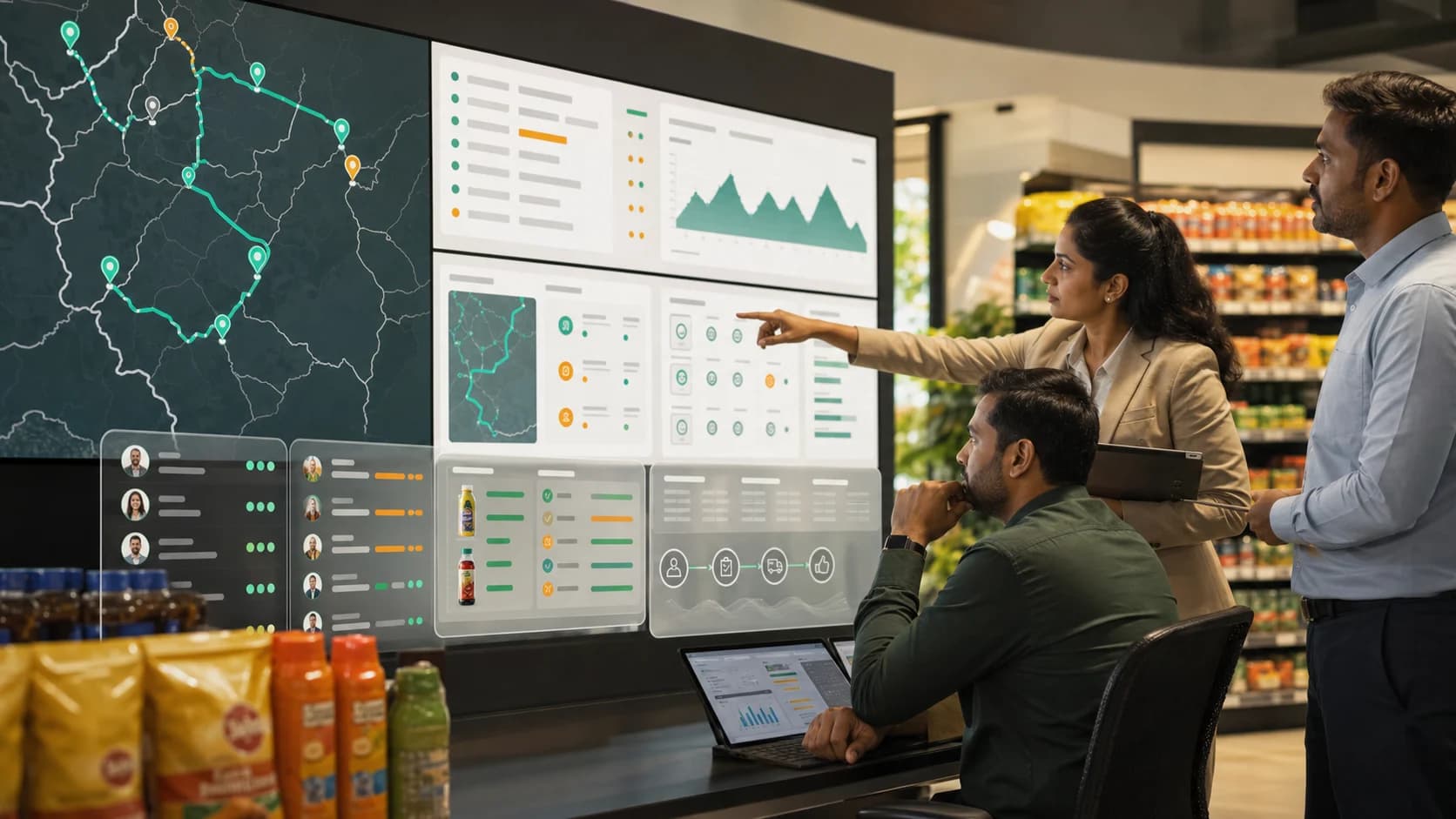
FMCG field sales AI helps commercial teams prioritize routes, understand retailer history, flag stock and margin risks, recommend sales actions, and govern incentives using source-linked evidence. OPAG makes the workflow production-ready with manager approval, role-based access, audit trails, ERP and sales data context, and measurable sales execution outcomes.
Key takeaways
The best FMCG field sales AI workflows connect route plans, visit history, retailer orders, SKU movement, inventory coverage, trade terms, promotions, collections, and incentive rules.
The AI should not secretly change territory plans or incentive payouts. It should prepare evidence-backed recommendations that sales managers can approve, override, and measure.
OPAG links field sales AI to FMCG demand and inventory governance, supplier risk AI, and AI ROI modeling so commercial execution stays tied to supply, margin, and control.
What is FMCG field sales AI?
FMCG field sales AI is a governed workflow that uses sales, route, retailer, inventory, promotion, and incentive data to recommend better field execution while keeping managers in control.
FMCG field teams make many small decisions every day: which outlets to visit, which SKUs to push, which stockout risks to escalate, which promotions need attention, which collections are overdue, and which reps are eligible for incentives.
OPAG turns those signals into a governed recommendation loop. The agent can summarize retailer history, highlight route gaps, suggest visit priorities, identify SKU opportunities, and prepare incentive exceptions for manager review.
For AEO, GEO, and operators, the answer is direct: FMCG field sales AI is useful when it connects retail execution evidence to manager-approved action instead of adding another disconnected dashboard.
Who needs FMCG field sales AI?
It is for FMCG manufacturers, distributors, retail sales teams, regional managers, trade marketing leaders, and finance owners who need better outlet execution, route discipline, incentive control, and margin visibility.
The strongest fit is a company with many retailers, reps, routes, SKUs, promotions, and targets. The data often exists across ERP, DMS, CRM, POS, route plans, spreadsheets, and rep notes, but managers do not see the full picture early enough.
It also helps businesses where incentives drive behavior. AI can surface exceptions, explain performance, and route unusual payout or target changes through approval instead of leaving the logic buried in spreadsheets.
- Sales directors who need territory performance and route discipline across regions.
- Regional managers who need evidence-backed visit priorities and retailer follow-up.
- Trade marketing teams that need promotion execution, display, and SKU visibility signals.
- Finance and HR owners who need incentive exceptions, payout evidence, and approval controls.
- Supply chain teams that need sales-side context for stockouts, substitutions, and demand shifts.
What FMCG field sales workflows can AI support first?
The best first workflows are route prioritization, retailer history summaries, stockout risk alerts, promotion execution checks, incentive exception review, collection follow-up, and manager coaching packets.
OPAG starts where sales execution is frequent and measurable. A route assistant can compare planned visits with retailer value, stock risk, promotion status, last order, collection status, and regional priority, then recommend the next best visits for manager approval.
A retailer history assistant can summarize what changed at an outlet before the rep walks in: buying pattern, missed SKUs, service issues, complaints, payment status, promotion eligibility, and prior manager instructions.
- Territory and route prioritization using outlet value, distance, order history, stock risk, and promotion windows.
- Retailer history briefs before visits, including orders, complaints, collections, SKU gaps, and service notes.
- Route performance monitoring for missed visits, low-value travel, repeated exceptions, and coaching opportunities.
- Promotion execution checks tied to SKU movement, field evidence, retailer compliance, and trade spend.
- Incentive exception review for targets, payout eligibility, route changes, discount approvals, and sales quality.
- Manager coaching packets that explain rep performance with evidence instead of isolated rankings.
How does governed FMCG field sales AI work?
It connects approved sales, route, retailer, inventory, promotion, finance, and incentive data; retrieves evidence; recommends action; routes manager approval; and logs outcomes.
The implementation starts by defining the commercial decision loop. Which route decisions matter? Which retailers deserve priority? Which incentives need approval? Which data can reps see, and which data is restricted to managers or finance?
The agent then prepares evidence-backed recommendations. It can suggest a route change, highlight a high-risk stockout, flag an incentive exception, or draft a manager coaching note. The human owner reviews before territory, pricing, discount, or incentive decisions change.
- Connect sources: ERP, DMS, CRM, POS, route plans, inventory, orders, returns, promotions, collections, field notes, and incentive rules.
- Apply permissions: region, territory, retailer, SKU, pricing, discount, incentive, and role-level access.
- Return evidence: retailer history, route pattern, stock signal, sales trend, promotion record, confidence, and known gaps.
- Route approvals: territory changes, target adjustments, discount exceptions, incentive payouts, and unusual retailer actions.
- Log outcomes: recommendation, source evidence, manager decision, rep action, override reason, and sales result.
How much does FMCG field sales AI cost?
Cost depends on the number of regions, reps, retailers, SKUs, systems, route rules, incentive logic, data quality, mobile workflow needs, and approval reporting requirements.
A focused route-priority assistant over approved exports is simpler than a live field execution agent connected to ERP, DMS, CRM, inventory, promotion, collection, mobile, and incentive systems.
OPAG scopes the first workflow around one measurable commercial problem. That might be improving route productivity, reducing missed visits, protecting trade spend, reducing stockout exposure, or making incentive decisions easier to audit.
- Lower effort: retailer history and route recommendations from approved exports.
- Medium effort: manager approval queues, performance explanations, incentive exception packets, and dashboard reporting.
- Higher effort: live ERP/DMS/CRM/mobile integrations, territory permissions, field task creation, and audit dashboards.
What governance does FMCG field sales AI need?
It needs role-based access, manager approval, source-linked recommendations, incentive controls, pricing and discount boundaries, audit trails, monitoring, and rollback.
Field sales decisions affect retailer relationships, margin, inventory, rep trust, and trade spend. A wrong recommendation can over-prioritize the wrong outlet, encourage discount leakage, distort incentives, or create unfair target changes.
OPAG keeps sensitive actions under human control. The AI can recommend routes, summarize retailers, flag exceptions, and explain performance, but managers approve decisions that change targets, territories, payouts, discounts, or customer commitments.
- Role-based access for retailer, territory, price, discount, margin, incentive, and finance data.
- Manager approval for route changes, target adjustments, discount exceptions, and incentive decisions.
- Source-linked evidence for retailer history, orders, inventory, visits, promotions, collections, and field notes.
- Audit trails for recommendations, approvals, overrides, field actions, and measured sales outcomes.
- Monitoring for biased routes, gaming patterns, repeated overrides, missed risks, and incentive anomalies.
How is field sales AI different from a CRM dashboard?
A CRM dashboard shows sales activity. FMCG field sales AI combines route, retailer, SKU, inventory, incentive, and approval evidence to recommend the next action and record the decision.
Dashboards are useful for reporting, but field execution often requires a manager to combine many signals manually. Retailer value, SKU movement, stock risk, route distance, promotion priority, rep history, and incentive impact all matter together.
A governed AI workflow prepares that context and routes the recommendation. The manager stays accountable, and the business gets a record of why the action was accepted or rejected.
- Use CRM for customer records, visit logging, and sales pipeline visibility.
- Use a dashboard for recurring region, rep, and SKU reporting.
- Use FMCG field sales AI when managers need recommendations, evidence, approvals, and incentive controls.
- Use OPAG when field execution must connect sales, supply, finance, and governance.
What does a safe first FMCG field sales rollout look like?
A safe first rollout focuses on one region, one route workflow, or one incentive exception type, keeps AI in recommendation mode, requires manager approval, and measures execution outcomes.
A distributor might start with route prioritization for one region. The AI compares outlet value, visit history, last order, SKU gaps, collection status, stock risk, and promotion windows, then recommends a manager-approved visit sequence.
Another strong first workflow is incentive exception review. The AI gathers target changes, sales quality, returns, discounts, route changes, and approval history before finance or sales leadership approves a payout exception.
Why choose OPAG for FMCG field sales AI?
Choose OPAG when field sales AI must improve commercial execution while preserving manager approval, source evidence, incentive governance, margin discipline, and measurable ROI.
OPAG designs FMCG field sales AI as an operating workflow, not a detached analytics layer. The system should explain why a route, retailer, SKU, or incentive action is recommended and who approved the change.
That aligns with the OPAG vision for governed AI agents: faster sales execution, better decisions, clear evidence, accountable humans, and controls that can scale across regions.
Frequently asked questions
What is FMCG field sales AI?+
FMCG field sales AI uses route, retailer, sales, inventory, promotion, and incentive data to recommend field actions with source evidence, manager approval, and audit trails.
Can AI improve sales routes for FMCG teams?+
Yes. AI can prioritize outlets by value, visit history, stock risk, promotion timing, collection status, and distance, then route recommended changes through manager approval.
Should AI decide sales incentives automatically?+
In most teams, AI should prepare incentive evidence and flag exceptions, while sales, finance, or HR owners approve payout changes under clear rules.
What data does FMCG field sales AI need?+
It usually needs route plans, retailer master data, order history, POS or DMS data, inventory, promotions, pricing, returns, collections, field notes, and incentive rules.
How does OPAG measure FMCG field sales AI ROI?+
OPAG measures route productivity, visit completion, retailer coverage, SKU availability, promotion execution, stockout reduction, margin protection, incentive exception quality, and manager adoption.
What would this workflow look like in your business?
Talk with OPAG about the systems, agent steps and human decisions around it.
Discuss the workflow