


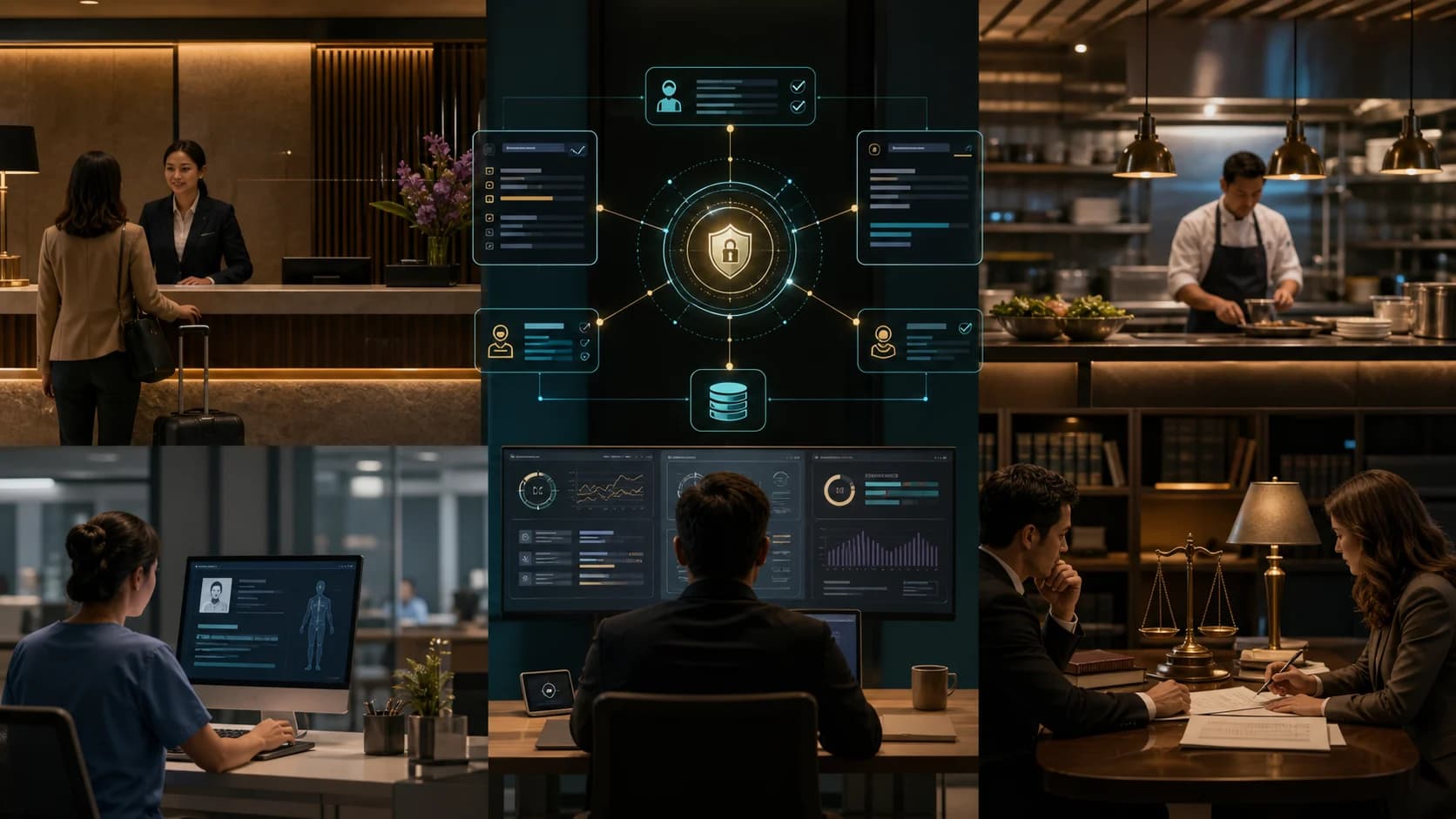
Hospitality, health tech, restaurants, and legal tech need AI that improves service speed without weakening accountability. The winning pattern is the same across all four domains: source-linked answers, scoped data access, approval gates, escalation paths, and audit trails.
Key takeaways
Hospitality AI should protect guest experience with multilingual support, escalation, and property-level data boundaries.
Health tech and legal tech need stronger evidence, privacy, and review controls because the cost of a wrong answer is higher.
Restaurants benefit from AI when POS, kitchen, supplier, menu, and labor signals are connected to action.
Hospitality AI: faster service without losing the guest
Hospitality AI works when it connects guest support, reservations, room status, property operations, and multilingual communication. The goal is not to make service feel robotic. The goal is to make every channel feel informed.
Governance matters because guest data, refunds, room changes, loyalty status, and escalations all need boundaries. The agent should know what it can answer, when it should transfer, and which manager owns the final decision.
- Use AI for 24/7 multilingual support, internal knowledge, dynamic pricing signals, and property operations.
- Escalate complaints, refunds, safety issues, and VIP requests to humans.
- Keep property-level permissions clear for multi-location groups.
Health tech and legal tech need evidence-first AI
In health tech and legal tech, AI outputs should be treated as drafts or decision support unless reviewed by an accountable professional.
These domains raise the bar. A clinic intake summary, triage note, legal research answer, or contract review cannot float free of evidence. The user needs to see where the answer came from and whether the AI is allowed to use that source.
OPAG patterns for these sectors emphasize role-based access, document citations, privacy-conscious data handling, review queues, and audit trails. The system can accelerate the work, but the accountable professional stays in control.
- For health tech: intake automation, multilingual triage, charting support, and patient communication with privacy boundaries.
- For legal tech: source-linked research, contract review, intake chat, document drafting, and compliance workflows.
- For both: visible citations, clear reviewer ownership, and no unapproved external action.
Restaurant AI: POS, kitchen, supplier, and labor signals in one loop
Restaurants have thin margins and fast feedback cycles. A demand miss can become waste, slow service, or a disappointed customer within hours. AI helps when it connects sales mix, menu engineering, kitchen throughput, supplier lead times, and labor planning.
A governed restaurant agent can recommend prep levels, supplier orders, menu changes, and staffing adjustments. The human manager should still own high-cost actions and exceptions, especially across multi-location groups.
- Forecast demand by daypart, item, channel, season, event, and weather signal where available.
- Route supplier and staffing recommendations through manager approval.
- Measure food cost, stockouts, waste, speed of service, and override rate.
The OPAG deployment pattern
Across all four industries, the implementation sequence is consistent: map the workflow, define risk boundaries, connect the data, build one governed agent, measure operator adoption, then scale the pattern.
The details change by domain. The principle does not. AI becomes durable when the business can explain it, approve it, audit it, and improve it.
- Define the accountable owner for the workflow.
- List the systems, documents, and actions the agent can access.
- Set approval thresholds before launch.
- Log every source, output, review, and action.
- Scale only after adoption and risk metrics are stable.
Frequently asked questions
How should hospitality companies use AI safely?+
Hospitality companies should use AI for multilingual support, guest knowledge, property operations, and pricing signals, while routing refunds, complaints, safety issues, and exceptions to human managers.
What makes health tech AI governance different?+
Health tech AI needs stronger privacy boundaries, role-based access, patient-context controls, review workflows, and audit logs because outputs can affect care, compliance, and sensitive personal data.
Where does AI help restaurants first?+
Restaurants usually see early value in demand forecasting, menu engineering, supplier ordering, kitchen prep planning, voice ordering, and labor optimization.
What does legal tech AI need before production?+
Legal tech AI needs source citations, document-level access control, review queues, client confidentiality safeguards, and audit trails before it should influence legal work at scale.
What would this workflow look like in your business?
Talk with OPAG about the systems, agent steps and human decisions around it.
Discuss the workflow