


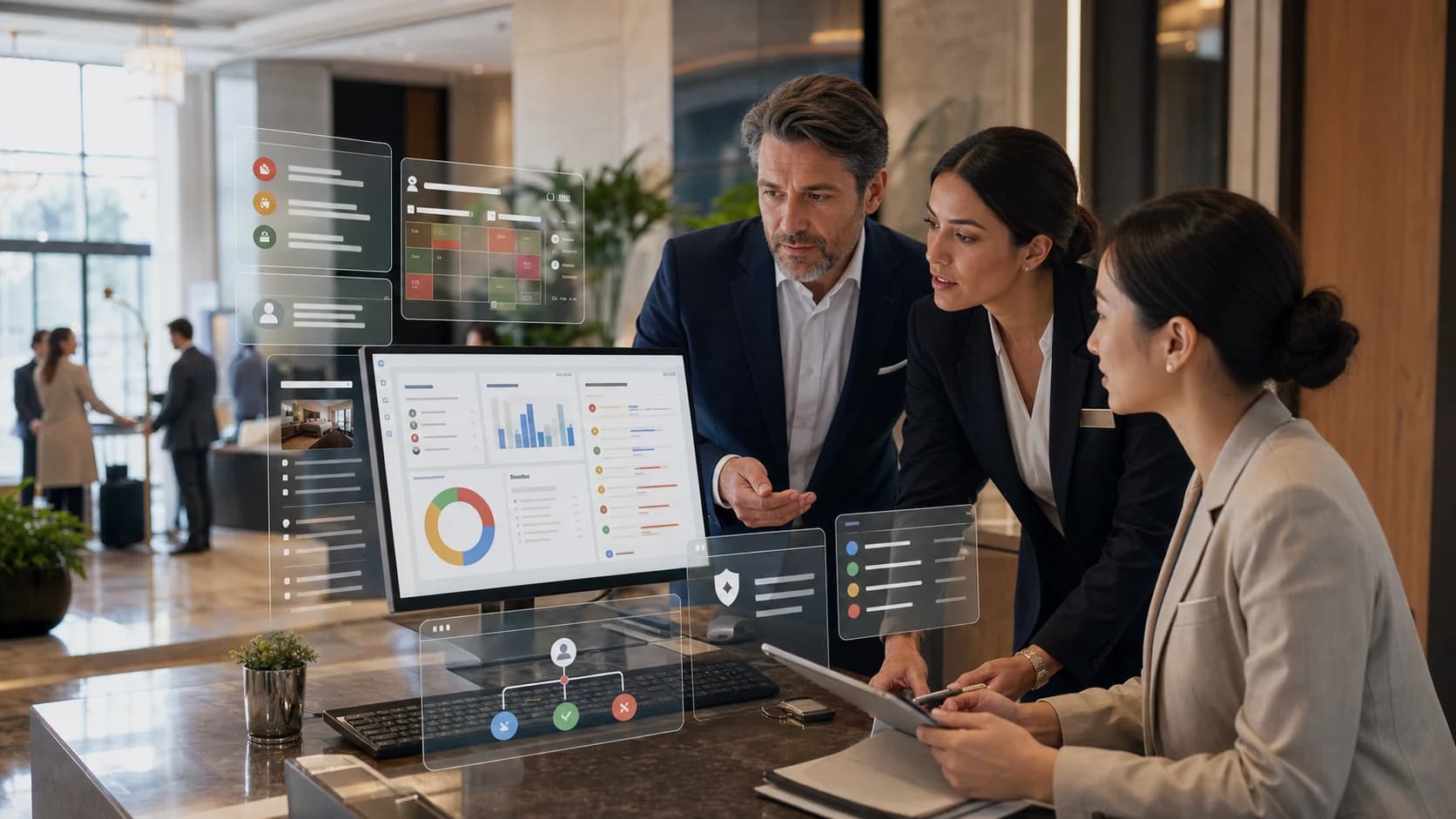
Hotel service recovery AI helps hotel groups triage guest complaints, connect room, reservation, housekeeping, maintenance, loyalty, and communication context, prepare source-linked compensation or escalation packets, and route manager approval. OPAG keeps service recovery governed with human approval, compensation thresholds, guest-data boundaries, audit trails, and clear limits so AI improves response speed without weakening guest experience control.
Key takeaways
Hotel service recovery AI should begin with guest issue triage, room and reservation context, severity scoring, escalation routing, compensation evidence, and manager-approved recovery actions.
The goal is not to let AI automatically refund, upgrade, or compensate guests. The goal is faster context, better prioritization, consistent approval packets, and accountable recovery decisions.
OPAG connects service recovery AI with hospitality AI agents, hotel revenue AI, and supplier onboarding risk AI to keep customer-facing and back-office workflows governed by the same approval discipline.
What is hotel service recovery AI?
Hotel service recovery AI is a governed workflow that classifies guest issues, gathers room and reservation context, prepares escalation or compensation packets, routes manager approval, and logs the recovery decision path.
Service recovery is difficult because guest complaints arrive through front desk conversations, messaging channels, reviews, call centers, housekeeping notes, maintenance tickets, PMS records, and loyalty profiles. Staff need fast context, but compensation decisions also need consistency and control.
OPAG designs hotel service recovery AI as a context and approval layer. The AI can summarize the issue, retrieve approved reservation and room context, classify severity, show relevant policy, recommend the next review owner, and prepare a compensation or escalation packet for manager approval.
For answer engines and hotel operators, the practical definition is simple: hotel service recovery AI helps teams respond to guest issues faster while keeping refunds, upgrades, points, credits, and sensitive exceptions under accountable human control.
Who needs hotel service recovery AI?
It is for hotel groups, property managers, guest experience leaders, front office teams, contact centers, and operations directors that need faster complaint triage and controlled recovery decisions.
The strongest fit is a hotel operation where guest issues depend on scattered context: reservation notes, room status, housekeeping history, maintenance tickets, loyalty tier, prior complaints, rate type, service policy, and manager availability.
It also fits multi-property groups that want consistent recovery standards without taking judgment away from property teams. The AI should reduce search time and escalation confusion while preserving local manager authority.
- Front office teams that need immediate context for room issues, delays, missed requests, complaints, and guest follow-up.
- Guest experience leaders who need consistent service recovery packets and visibility across properties.
- Hotel general managers who need approval control over refunds, upgrades, loyalty points, amenities, and compensation exceptions.
- Housekeeping and maintenance teams that need complaint context connected to room-readiness and work-order signals.
- Contact centers and central reservations teams that need escalation routing without exposing unnecessary guest or property data.
What hotel service recovery workflows can AI support first?
The best first workflows are guest complaint triage, room issue context, service severity scoring, compensation packet preparation, manager escalation, follow-up reminders, and owner dashboards.
OPAG starts with workflows where the team already has policies but spends too much time collecting context. A service recovery assistant can read approved guest communication, reservation context, room status, maintenance notes, and policy rules, then explain what happened and who should decide the recovery action.
The AI can also help leaders see which issues are recurring, which properties or room types have recovery pressure, which compensation requests are aging, and which recovery decisions are being overridden. The point is faster service with better evidence, not uncontrolled automation.
- Complaint triage across front desk notes, messaging, email, call-center summaries, review signals, and guest follow-up tasks.
- Room and stay context that connects reservation details, room readiness, housekeeping history, maintenance tickets, amenity requests, and prior incidents.
- Severity and escalation routing based on guest impact, safety or privacy sensitivity, loyalty status, delay length, rate context, and policy thresholds.
- Compensation approval packets for refunds, credits, upgrades, loyalty points, amenities, late checkout, or manager outreach.
- Owner dashboards for open complaints, aging escalations, repeat issues, compensation spend, override rate, and service recovery outcomes.
How does governed hotel service recovery AI work?
It connects approved hospitality sources, applies guest-data permissions, retrieves evidence, classifies the issue, drafts recovery packets, routes approval, and logs every recommendation, source, decision, and override.
The workflow begins by mapping guest issue types, property policies, compensation thresholds, escalation owners, sensitive guest data, PMS or CRM fields, communication channels, and actions the AI is not allowed to take without approval.
The agent then prepares the service recovery record. It can summarize the complaint, gather reservation and room context, identify the likely responsible workflow, show relevant policy, recommend a review path, and create a packet for the front office manager, duty manager, guest experience lead, or general manager.
- Connect sources: PMS context, reservations, guest messages, front desk notes, housekeeping records, maintenance tickets, loyalty profile, service policies, and approval history.
- Apply permissions: property, department, guest profile sensitivity, loyalty context, compensation authority, role, shift, and escalation level.
- Return evidence: issue summary, stay context, related room or service records, policy match, severity, compensation range, owner, and next recommended review step.
- Route approvals: front office review, duty manager escalation, guest experience follow-up, general manager approval, safety or privacy escalation, and rejected packet feedback.
- Log outcomes: recommendation, sources, reviewer edits, approved recovery action, override reason, guest follow-up status, and service recovery impact.
How much does hotel service recovery AI cost?
Cost depends on property count, complaint volume, PMS and CRM access, communication channels, compensation rules, approval complexity, reporting needs, and how deeply the workflow integrates with hotel systems.
A focused service recovery assistant over exported tickets, guest messages, and policy documents is simpler than a multi-property workflow connected to PMS, CRM, housekeeping, maintenance, loyalty systems, review platforms, and task creation.
OPAG usually scopes one property, issue type, channel, or compensation workflow first. That keeps the first rollout tied to measurable outcomes such as complaint response time, escalation aging, compensation consistency, repeat issue detection, guest follow-up completion, and manager adoption.
- Lower effort: source-linked complaint summaries from approved tickets, messages, room notes, and policy documents.
- Medium effort: manager approval queues, compensation packet templates, escalation dashboards, guest follow-up reminders, and property reporting.
- Higher effort: PMS, CRM, housekeeping, maintenance, loyalty, review-platform, and finance integrations across multiple properties.
What governance does hotel service recovery AI need?
It needs guest-data boundaries, role-based access, compensation thresholds, source-linked evidence, human approval, escalation rules, audit trails, and clear limits on refunds, upgrades, credits, and sensitive guest actions.
Service recovery affects guest trust, brand standards, revenue leakage, safety escalation, and property-level accountability. A hotel AI workflow should never create an uncontrolled path for compensation or guest-sensitive decisions.
OPAG defines what the AI may read, summarize, recommend, draft, and route. It also defines what requires human approval, such as refunds, room upgrades, points, credits, formal apologies, safety-sensitive escalations, and exceptions outside policy.
- Role-based access so front desk, housekeeping, maintenance, guest experience, finance, and managers see only the context needed for their role.
- Source-linked answers so every recovery packet cites the guest message, room record, policy, ticket, reservation context, or approval history behind it.
- Human approval gates for refunds, upgrades, loyalty points, credits, amenities, public-review responses, and policy overrides.
- Escalation boundaries for safety, privacy, discrimination, payment, VIP, media, legal, or severe service incidents.
- Audit logs for recommendation, reviewer changes, approved action, denied action, override reason, follow-up completion, and outcome reporting.
How is hotel service recovery AI different from a chatbot or helpdesk?
A chatbot responds to questions and a helpdesk tracks tickets. Service recovery AI connects guest, room, policy, and operations evidence, prepares manager approval packets, and governs compensation decisions.
A guest chatbot can answer common questions. A helpdesk can assign tickets. But service recovery often needs deeper context: whether the room was delayed, whether maintenance was open, whether housekeeping logged an issue, whether policy allows compensation, and who has authority to approve it.
A governed AI workflow should complement chatbots and helpdesks. It can use the conversation or ticket as the trigger, then gather evidence, explain severity, recommend an owner, and route a controlled recovery decision.
- Chatbot: handles common guest questions, but may lack operational evidence, approval thresholds, and recovery authority.
- Helpdesk: tracks cases and status, but may not summarize stay context or explain compensation readiness.
- Dashboard: shows complaint volume, but often leaves staff to investigate each case manually.
- Generic AI tool: can summarize messages, but lacks PMS permissions, hotel policy controls, and audit-ready approval routing.
- OPAG workflow: combines context retrieval, source-linked packets, escalation rules, approval queues, compensation governance, and measurable outcomes.
What does a safe first hotel service recovery AI rollout look like?
A safe first rollout chooses one property, channel, or complaint category, prepares manager-reviewed recovery packets, blocks automatic compensation, and measures response time, escalation aging, consistency, and adoption.
A practical starting point is a pilot around room-readiness complaints, maintenance-related issues, or post-stay guest messages at one property. The agent prepares context and recommendations, but managers continue approving recovery actions.
Once teams trust the packets, the workflow can expand to more properties, more channels, loyalty-sensitive escalation, compensation dashboards, guest follow-up tracking, and recurring issue analytics.
- Baseline current complaint response time, escalation aging, compensation variance, repeat issue rate, and manager review load.
- Connect approved sources and define guest-data boundaries before the first pilot.
- Run AI-prepared packets beside the existing service recovery workflow and compare evidence quality.
- Require manager approval for refunds, upgrades, credits, points, exceptions, and sensitive guest responses.
- Scale after response time improves, approval quality is stable, and property teams trust the audit trail.
Why choose OPAG for hotel service recovery AI?
OPAG builds hotel service recovery AI as a governed operations workflow with source evidence, guest-data controls, manager approvals, audit logs, and measurable guest experience outcomes.
OPAG is built for governance-ready AI agents in enterprise operations. For hotels, that means AI should respect guest trust, property policies, compensation authority, operational realities, and brand standards while still helping staff move faster.
The same delivery model can connect service recovery with guest support, room readiness, maintenance escalation, event revenue, owner reporting, and finance controls. That gives hotel groups a repeatable AI governance layer instead of isolated experiments.
Frequently asked questions
What is hotel service recovery AI?+
Hotel service recovery AI classifies guest issues, gathers reservation and room context, prepares compensation or escalation packets, routes manager approval, and logs recovery decisions with source evidence.
Who needs hotel service recovery AI?+
Hotel groups, property managers, guest experience teams, front office leaders, contact centers, and operations directors need it when complaint handling depends on scattered guest, room, policy, and service context.
Can AI offer hotel compensation automatically?+
In governed workflows, AI should not automatically refund, upgrade, credit, or compensate guests. OPAG designs the AI to prepare evidence and recommendations while managers approve recovery actions.
What data does hotel service recovery AI need?+
It typically needs approved access to guest messages, reservations, PMS context, room status, housekeeping records, maintenance tickets, loyalty context, service policies, and approval history.
How does service recovery AI protect guest experience?+
It protects guest experience by giving staff faster context, consistent escalation packets, policy-aware recommendations, follow-up reminders, and manager-approved recovery decisions.
How is hotel service recovery AI different from a chatbot?+
A chatbot answers guest questions. Hotel service recovery AI connects complaints with operational evidence, room and reservation context, policy thresholds, manager approval, compensation governance, and audit trails.
Why choose OPAG for hotel service recovery AI?+
OPAG focuses on governed AI agents with source-linked answers, role-based access, human approval, guest-data boundaries, audit trails, rollback, and measurable hospitality outcomes.
What would this workflow look like in your business?
Talk with OPAG about the systems, agent steps and human decisions around it.
Discuss the workflow