

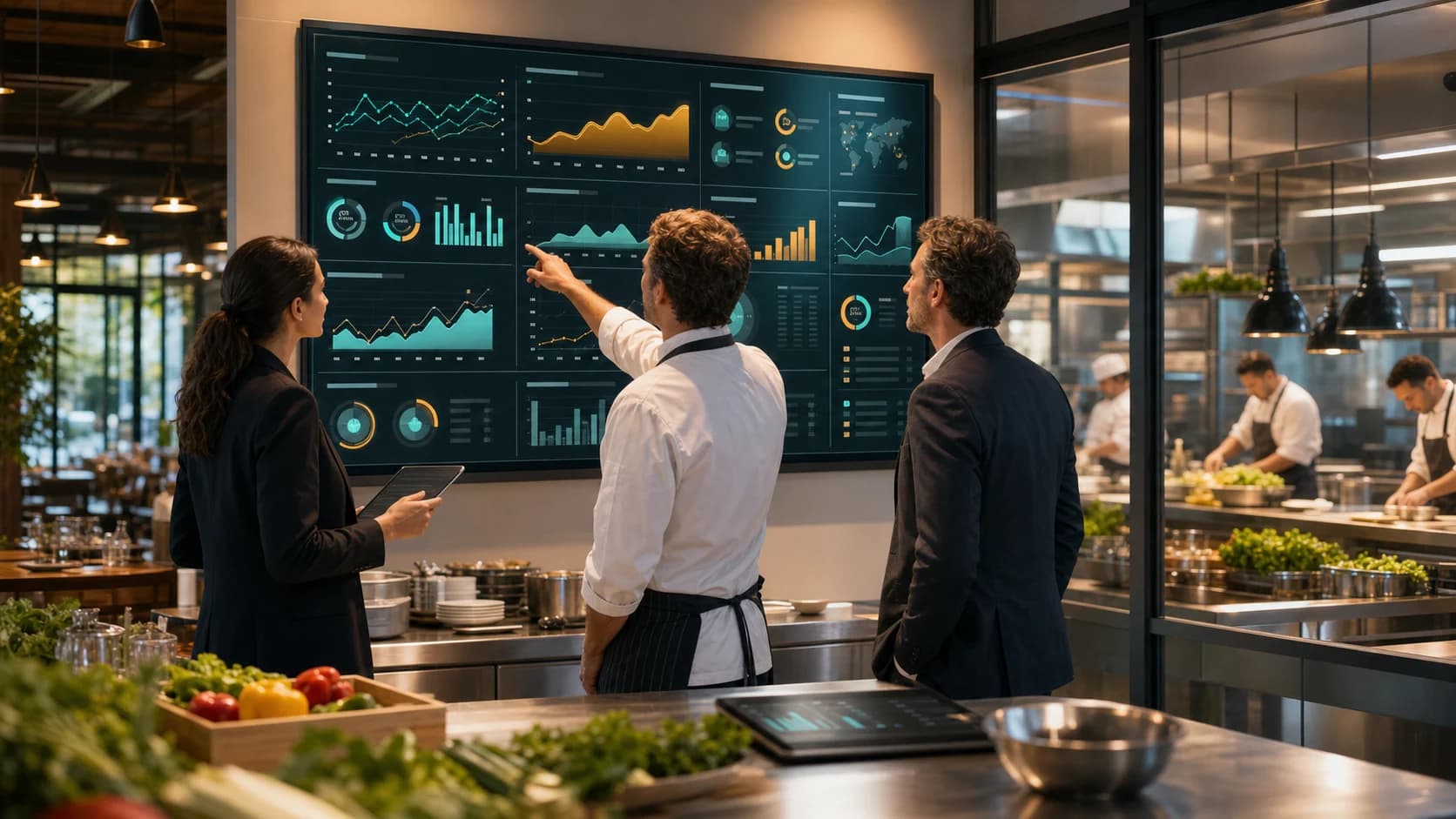
Restaurant menu margin AI helps multi-location restaurant teams connect POS demand, recipes, ingredient costs, supplier availability, waste logs, prep plans, promotions, and labor context so managers can review menu and purchasing recommendations with evidence. OPAG keeps the workflow governed with role-based access, source-linked suggestions, manager approval, override tracking, audit trails, and measurable food-cost outcomes.
Key takeaways
Menu margin AI should start with one controlled workflow: food-cost variance, ingredient substitution review, waste forecasting, prep planning, menu item margin, promotion review, or manager dashboards.
The goal is not to let AI rewrite menus or place supplier orders by itself. The goal is earlier margin visibility, better prep decisions, less waste, and accountable restaurant manager approval.
OPAG connects restaurant menu margin AI with restaurant AI agents, supplier risk AI, and AI ROI modeling so operators can protect food cost without losing control of guest experience or operational accountability.
What is restaurant menu margin AI?
Restaurant menu margin AI is a governed workflow that monitors menu item economics, forecasts waste, explains ingredient and demand changes, recommends prep or purchasing actions, routes approval, and logs outcomes.
Restaurants already compare POS sales, item mix, recipes, theoretical food cost, actual ingredient cost, waste, supplier availability, prep plans, promotions, and labor capacity. The challenge is making those signals actionable before margin leaks through over-prep, stockouts, substitutions, or poor menu decisions.
OPAG designs menu margin AI around the operating review. The agent can identify food-cost variance, explain why a menu item is losing margin, forecast waste for the next prep window, and prepare a recommendation packet for a chef, store manager, area manager, or finance owner.
The answer-first definition is this: restaurant menu margin AI turns restaurant demand, recipe, supplier, and waste signals into source-linked recommendations that managers can approve, override, and measure.
Who needs restaurant menu margin AI?
It is for restaurant groups, cloud kitchens, franchise operators, food-service finance teams, chefs, and operations leaders who need margin visibility, waste reduction, and governed prep or supplier decisions.
The strongest fit is a restaurant group where margins depend on changing ingredient costs, variable demand, inconsistent prep discipline, manual waste logs, supplier substitutions, and limited visibility across locations.
It also fits operators that already have POS and inventory data but still rely on spreadsheets, manager intuition, or late finance reports to understand food cost and menu profitability.
- Operations leaders who need menu margin, item mix, prep risk, and waste exceptions in one review queue.
- Chefs and store managers who need recommended prep quantities with demand, waste, and supplier context.
- Finance owners who need food-cost variance, ingredient inflation, promotion impact, and margin leakage evidence.
- Procurement teams that need supplier availability, substitution risk, and price movement before purchase decisions.
- Franchise and area managers who need location-level comparison, overrides, and adoption tracking.
What restaurant workflows can AI support first?
The best first workflows are food-cost variance alerts, menu item margin review, waste forecasting, prep planning, supplier substitution review, promotion impact checks, and manager dashboards.
OPAG starts with workflows where the data exists but the decision is late. A menu margin assistant can connect POS item mix, recipe cost, ingredient price movement, actual waste, inventory, and prep history to explain which item, location, or shift needs attention.
A waste forecasting assistant can recommend prep ranges for the next daypart, flag supplier stock risk, and show the evidence behind the suggestion. Managers still approve changes to prep quantities, menu availability, substitutions, and supplier orders.
- Food-cost variance alerts that compare theoretical recipe cost, actual ingredient cost, waste, sales mix, and location behavior.
- Menu item margin review with item profitability, ingredient movement, promotions, substitutions, and recommended action.
- Waste forecasting by location, daypart, weather or event context, recent demand, prep history, and spoilage patterns.
- Prep planning recommendations with approved ranges, confidence notes, manager approval, override reasons, and outcome tracking.
- Supplier and substitution review with stock availability, price changes, quality notes, margin impact, and procurement approval needs.
How does governed menu margin AI work?
It connects approved restaurant sources, applies permissions, explains variance, forecasts waste, drafts recommendations, routes manager approval, and logs each decision and result.
The workflow starts by mapping menu items, recipes, ingredient units, supplier sources, location rules, approval owners, margin thresholds, and actions AI can support. OPAG keeps guest-facing and supplier-impacting changes under human control until the operating model is proven.
The agent then acts as a margin evidence layer. It can explain why food cost moved, identify where waste is likely, recommend prep adjustments, and route the packet to the right chef, manager, procurement owner, or finance reviewer.
- Connect sources: POS, recipes, inventory, supplier prices, purchase orders, waste logs, prep sheets, promotions, labor schedules, and location rules.
- Apply permissions: location, role, finance, recipe, supplier, menu, promotion, and owner-level access rules.
- Return evidence: sales mix, recipe cost, ingredient variance, waste pattern, supplier signal, prep history, confidence notes, and expected impact.
- Route approvals: prep changes, menu holds, substitutions, supplier orders, promotion changes, and high-impact margin actions require review.
- Log outcomes: recommendation, sources, approver, override, final action, food-cost impact, waste impact, stockout impact, and adoption history.
How much does restaurant menu margin AI cost?
Cost depends on location count, POS and inventory integrations, recipe data quality, supplier complexity, waste-log maturity, approval rules, reporting depth, and whether the AI only recommends or creates downstream tasks.
A focused assistant over POS exports, recipe sheets, and waste logs is simpler than a multi-location workflow connected to inventory systems, supplier purchasing, labor schedules, promotion planning, approval queues, and finance dashboards.
OPAG usually scopes one brand, region, menu category, or high-cost ingredient group first. That keeps delivery tied to measurable outcomes such as food-cost variance, waste percentage, prep accuracy, stockout rate, manager adoption, and payback period.
- Lower effort: menu margin and waste summaries from approved POS, recipe, inventory, and waste exports.
- Medium effort: prep recommendation queues, supplier exception packets, manager approvals, and owner dashboards.
- Higher effort: POS and inventory integrations, supplier purchasing connections, multi-location permissions, and automated task creation.
What governance does menu margin AI need?
It needs role-based access, approved data sources, manager approval, source-linked recommendations, override tracking, supplier change controls, monitoring, rollback, and audit trails.
Restaurant AI can affect food cost, guest experience, menu availability, supplier commitments, staff workload, and brand consistency. A weak workflow can recommend too little prep, hide a supplier issue, or change a menu item without enough review.
OPAG keeps managers accountable. The AI should show why a prep change exists, which data supports it, who approved it, why it was overridden, and what happened to waste, stockouts, and margin after the decision.
- Role-based access for location performance, recipe costs, supplier pricing, finance views, menu strategy, and labor context.
- Human approval for prep changes, menu availability, substitutions, supplier orders, promotion changes, and guest-impacting decisions.
- Source evidence for item mix, recipes, ingredient prices, supplier stock, waste logs, prep history, and manager notes.
- Audit trails for recommendations, approvals, overrides, final actions, food-cost impact, waste outcomes, and rollback events.
- Monitoring for repeated overrides, stale recipes, poor forecasts, data gaps, supplier drift, and unexpected guest or margin impact.
How is menu margin AI different from a POS report or inventory dashboard?
A POS report shows what sold, and an inventory dashboard shows stock movement. Restaurant menu margin AI explains why margin or waste changed, recommends an action, routes approval, and records the outcome.
POS and inventory systems are essential, but managers still have to compare recipes, supplier prices, prep behavior, waste logs, item mix, and promotion impact by hand. By the time finance reports food-cost variance, the operating window has often passed.
A governed AI workflow can sit around existing restaurant systems. It does not need to replace POS or inventory. It turns signals into reviewable recommendations that accountable managers can approve or reject.
- Use POS reports for item sales, tickets, channel mix, discounts, and revenue history.
- Use inventory dashboards for stock visibility, usage, purchasing, transfers, and shrink.
- Use menu margin AI when teams need forecasted waste, recipe cost explanations, prep recommendations, and approval trails.
- Use OPAG when restaurant AI must connect operations, finance, supplier context, manager control, and measurable ROI.
What does a safe first menu margin AI rollout look like?
A safe first rollout chooses one menu category or ingredient group, limits sources, keeps AI in recommendation mode, requires manager approval, and measures food-cost, waste, and stockout outcomes.
A restaurant group might start with proteins, bakery items, or high-waste prepared ingredients. The AI reads approved POS, recipe, inventory, supplier price, prep, and waste data, then recommends prep ranges or margin actions for manager review.
The team measures food-cost variance, prep accuracy, waste percentage, stockouts, override reasons, manager adoption, and guest-impacting exceptions. Those metrics decide whether the workflow expands to more categories, locations, or supplier workflows.
Why choose OPAG for restaurant menu margin AI?
Choose OPAG when restaurant AI must connect POS, recipes, inventory, supplier signals, waste forecasting, prep planning, manager approvals, audit trails, and measurable food-cost outcomes.
OPAG builds restaurant AI around accountable operations. Menu margin AI is useful only when managers can inspect the evidence, challenge the forecast, approve the action, and measure the result.
That keeps restaurant AI aligned with the OPAG vision: governed AI agents that improve enterprise operations while preserving human ownership, traceability, and production-grade control.
Frequently asked questions
What is restaurant menu margin AI?+
Restaurant menu margin AI is a governed workflow that monitors menu item economics, forecasts waste, explains food-cost variance, recommends prep or purchasing actions, routes approval, and logs outcomes.
Can AI reduce restaurant food waste?+
Yes. AI can reduce waste by forecasting demand, comparing prep history with actual sales, flagging ingredient risk, recommending prep ranges, and helping managers approve changes before overproduction happens.
Should AI change menu prices automatically?+
Not at first. OPAG usually keeps menu price, promotion, availability, and substitution changes behind manager or finance approval until the workflow is proven and audit trails are stable.
What data does menu margin AI need?+
It usually needs POS item sales, recipes, ingredient units, supplier prices, purchase history, inventory, waste logs, prep sheets, promotions, labor context, and location rules under role-based permissions.
How does OPAG measure restaurant menu margin AI ROI?+
OPAG measures food-cost variance, waste percentage, prep accuracy, stockout rate, ingredient substitution impact, manager adoption, override rate, guest-impacting exceptions, and implementation effort.
What would this workflow look like in your business?
Talk with OPAG about the systems, agent steps and human decisions around it.
Discuss the workflow