

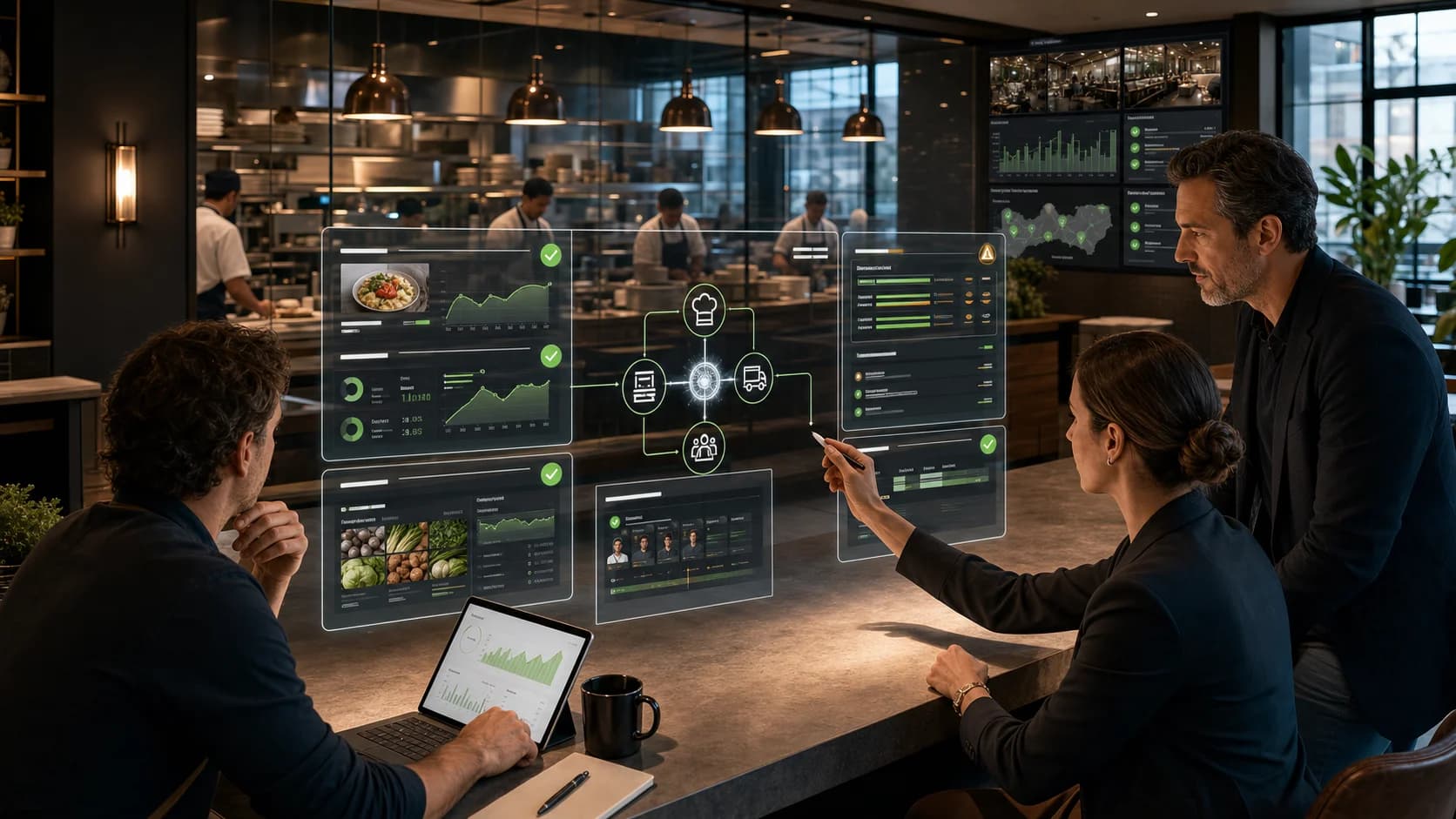
Restaurant AI agents connect POS, kitchen, inventory, supplier, menu, and labor signals so managers can forecast demand, prevent waste, improve service speed, and approve high-impact actions before they change orders, staffing, or customer experience.
Key takeaways
The best restaurant AI use cases sit close to daily operating decisions: prep, stock, supplier ordering, menu mix, labor planning, and service exceptions.
Governance matters because an AI recommendation can affect food cost, waste, staffing, customer wait time, and supplier commitments within the same day.
OPAG applies the same source-linked conversational AI and approval pattern used across enterprise workflows to restaurant operations.
What are restaurant AI agents?
Restaurant AI agents are governed workflows that read operating signals, recommend next actions, and route sensitive changes to managers across POS, kitchen, supplier, menu, inventory, and labor systems.
A restaurant has fast feedback loops. Sales mix changes by daypart, channel, promotion, weather, event, and location. Kitchen capacity, stock levels, staff availability, and supplier lead times can change before a weekly report catches up.
An AI agent helps by watching those signals, explaining the likely impact, and preparing the next action. Governance decides whether the action is informational, drafted for review, or allowed to update a workflow after manager approval.
Who are restaurant AI agents for?
They are for multi-location restaurant groups, high-volume kitchens, delivery-heavy brands, catering operations, and operators whose margins depend on fast decisions across demand, stock, labor, and suppliers.
A single-location restaurant can use simple tools well. The complexity grows when the same leadership team needs consistent decisions across several locations, menus, suppliers, channels, and managers. That is where governed AI becomes more useful.
The right first workflow is not a broad AI transformation. It is usually one high-frequency decision that is already measured: prep levels, supplier orders, labor coverage, stockout risk, waste, delivery mix, or menu margin.
- Owners who need clearer visibility across locations without waiting for manual reports.
- Operations managers who need demand, prep, supplier, and labor signals in one loop.
- Kitchen leaders who need forecasts tied to stock, menu mix, and throughput.
- Finance teams that need food cost, waste, margin, and override history they can inspect.
Which restaurant AI use cases pay back first?
The highest-return use cases usually reduce waste, prevent stockouts, improve labor coverage, protect margin, and speed up service decisions.
Restaurant AI should start where the outcome is concrete. If the business can measure waste, sellouts, ticket time, food cost, order accuracy, labor variance, or supplier exceptions, the workflow can be governed and improved.
OPAG looks for keystone workflows that create compounding value. A demand forecast improves prep. Prep informs supplier ordering. Supplier reliability changes menu availability. Menu mix affects labor and margin.
- POS demand forecasting by item, location, channel, daypart, season, event, and promotion.
- Prep recommendations that balance expected demand, shelf life, kitchen capacity, and waste risk.
- Supplier ordering suggestions with approval thresholds for unusual quantities or price movement.
- Menu engineering that flags margin drift, slow movers, bundles, and substitution opportunities.
- Labor planning that compares demand, kitchen throughput, service standards, and manager overrides.
- Conversational operating dashboards that answer owner questions with source-linked records.
How does a restaurant AI agent work with POS, kitchen, and suppliers?
It reads approved POS, kitchen, inventory, supplier, menu, and labor data, predicts operating pressure, recommends next actions, and asks a manager to approve changes that affect cost, service, or commitments.
The workflow can start from a daily planning run, an unusual sales signal, a stock risk, a supplier delay, a kitchen bottleneck, or a manager question. The AI retrieves the relevant data, explains the signal, and drafts the action.
Governance keeps the agent practical. A low-risk insight can appear instantly. A supplier order above threshold waits for approval. A labor recommendation can be reviewed by the store manager. Every accepted, edited, rejected, or overridden recommendation becomes part of the audit trail.
- Trigger: sales velocity, daypart forecast, stock exception, supplier update, or manager question.
- Context: POS, kitchen display, inventory, supplier, menu, labor, and finance records.
- Recommendation: prep, order, substitute, schedule, promote, or escalate.
- Approval: manager review for unusual, high-cost, or customer-impacting actions.
- Learning loop: compare accepted recommendations with waste, ticket time, stockouts, and margin.
How much do restaurant AI agents cost?
Costs depend on the number of locations, data quality, POS and supplier integrations, forecast complexity, approval workflow needs, and whether the first release is insight-only or action-ready.
A single dashboard assistant costs less than a multi-location agent that forecasts item demand, recommends supplier orders, routes approvals, monitors overrides, and connects to finance reporting. The right cost model starts with the operating value.
OPAG scopes the first workflow around a measurable outcome: lower waste, fewer stockouts, better labor coverage, faster reporting, stronger margin control, or reduced manager admin. The system should prove value before autonomy expands.
How is this different from dashboards, scheduling tools, or manual reporting?
Dashboards show what happened, scheduling tools manage a narrow task, and manual reports arrive late. A governed restaurant AI agent connects signals, recommends action, asks for approval, and records the decision.
Restaurants already have tools. The problem is that POS, inventory, labor, kitchen, delivery, and supplier information often sit in separate places. Managers still have to interpret the signal, remember the rule, and take action while service is moving.
An AI agent does not replace the manager. It makes the manager faster and more consistent by bringing the signal, evidence, recommendation, approval path, and outcome into one operating loop.
- Use dashboards when the question is fixed and the user only needs visibility.
- Use scheduling tools when labor is the only workflow being optimized.
- Use manual reporting when the process is low frequency and low risk.
- Use restaurant AI agents when demand, stock, kitchen, supplier, and labor decisions interact daily.
Why choose OPAG for restaurant AI agents?
OPAG builds restaurant AI around measurable operations and governance: source-linked answers, approval thresholds, manager ownership, audit trails, and ROI tracking across the workflow.
The OPAG approach starts with the operating decision, not the model demo. The team maps the signals, identifies the manager who owns the action, defines approval thresholds, connects the data, and measures the result after launch.
That makes the first restaurant AI workflow easier to trust and easier to scale. Once prep or supplier ordering is stable, the same governance model can extend to menu engineering, labor planning, service recovery, and owner dashboards.
Frequently asked questions
Can AI help restaurants reduce food waste?+
Yes. AI can forecast demand by item and daypart, compare it with shelf life and stock levels, recommend prep quantities, and track manager overrides against actual waste.
Can restaurant AI agents place supplier orders automatically?+
They can draft orders and, where risk is low, automate repeat actions. OPAG recommends manager approval for unusual quantities, high-cost orders, new suppliers, or recommendations affected by low confidence.
What restaurant systems should AI connect to first?+
Useful starting sources include POS, kitchen display, inventory, purchasing, supplier catalogs, menu data, delivery channels, labor schedules, and finance records.
Why does restaurant AI need governance?+
Governance keeps managers accountable when AI recommendations affect food cost, labor spend, stock availability, supplier commitments, and customer experience.
What would this workflow look like in your business?
Talk with OPAG about the systems, agent steps and human decisions around it.
Discuss the workflow