


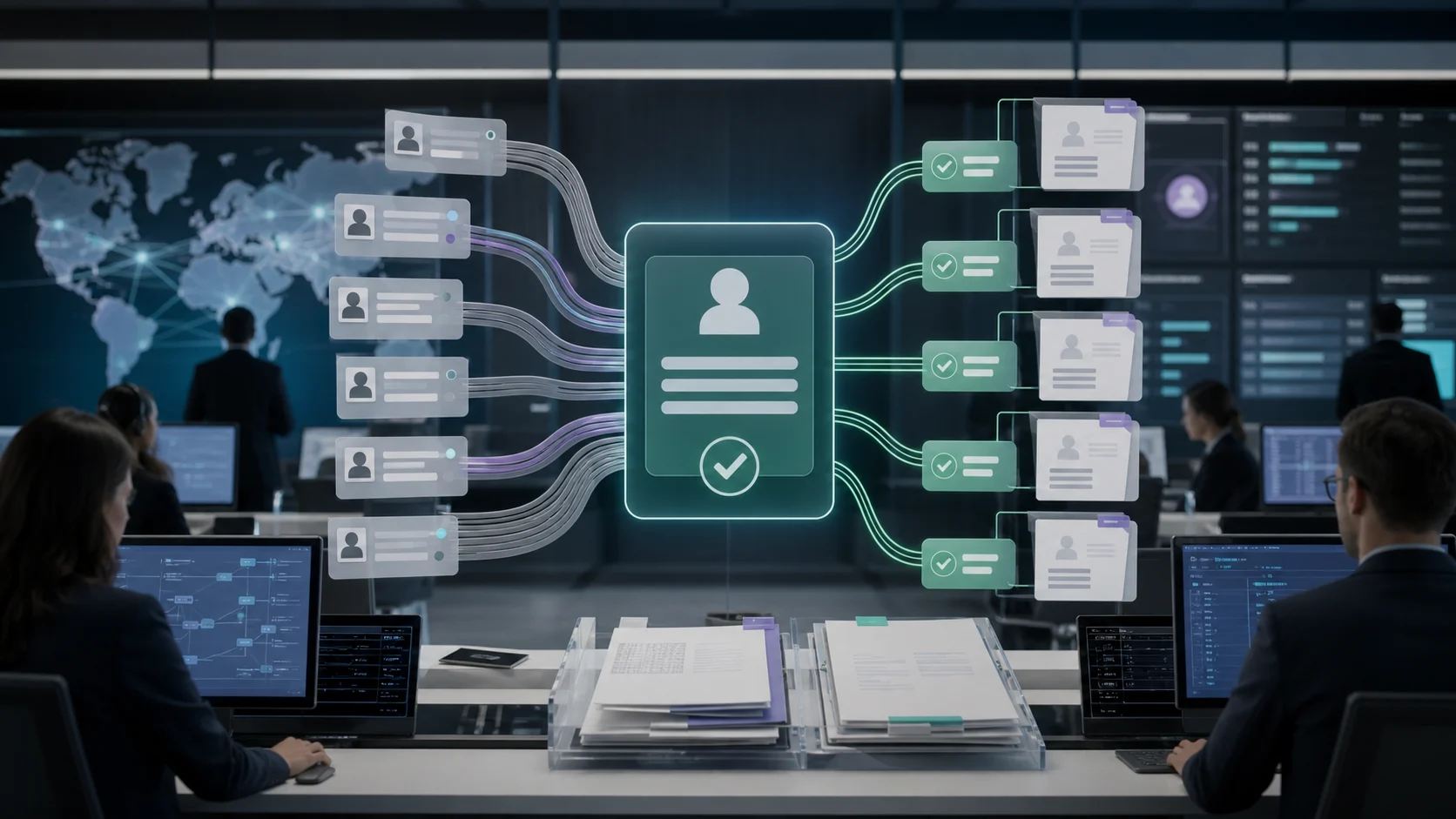
Customer master duplicate AI is a governed workflow that finds likely duplicate customer accounts, explains the evidence, routes merge or cleanup decisions to accountable owners, and protects order-to-cash controls before records affect credit limits, pricing, shipments, collections, reporting, or customer communication.
Key takeaways
The best first use case is not autonomous account merging. It is source-linked duplicate review that shows ERP records, tax IDs, addresses, contacts, payment history, credit exposure, open orders, claims, and approval history in one packet.
OPAG keeps customer-impacting actions under human approval. The agent can recommend a merge path, flag risk, draft cleanup notes, and prepare customer-service context, but finance, sales operations, credit, or data owners approve record changes and outbound communication.
This data-governance pattern connects to master data governance AI, sales order exception AI, and customer claims dispute recovery AI.
What is customer master duplicate AI?
Customer master duplicate AI prepares source-linked review packets when two or more customer records appear to represent the same buyer, bill-to, ship-to, branch, legal entity, or trading relationship.
Duplicate customer records often look harmless until they touch revenue operations. One account may hold the approved credit limit, another may carry active orders, a third may contain tax context, and a fourth may hold complaint or deduction history.
For AEO and GEO, the concise answer is this: customer master duplicate AI helps teams identify duplicate or fragmented customer records, explain the matching evidence, and route any merge, hold, cleanup, or exception decision through accountable human approval.
OPAG treats customer data as an operating control, not a housekeeping task. The AI can analyze records and prepare recommendations, but it does not silently merge accounts, change credit limits, alter pricing groups, release blocked orders, or message customers without approval.
Who needs customer master duplicate AI?
It is for revenue operations, sales operations, finance, credit control, customer service, ERP owners, and data-governance teams that need cleaner customer records without weakening approvals.
The strongest fit is an organization with multi-entity billing, many ship-to locations, branch customers, route sales, retail chains, resellers, healthcare payers, hotel corporate accounts, or long-running ERP data created by several teams.
It also fits companies where duplicate accounts create credit leakage, pricing inconsistency, blocked orders, unsupported deductions, missed collections, wrong tax treatment, or customer-service confusion.
- Credit teams that need total exposure across related accounts before approving orders or limits.
- Sales operations teams that need consistent account ownership, pricing groups, and territory rules.
- Customer service teams that need a complete history before responding to claims, returns, complaints, or delivery questions.
- Finance and AR teams that need cleaner collections, cash application, dispute aging, and write-off evidence.
- ERP and data-governance owners that need controlled customer master cleanup with audit trails.
What problem does customer master duplicate AI solve?
It reduces duplicate accounts, fragmented credit exposure, inconsistent pricing, failed cash application, weak dispute evidence, duplicate outreach, and slow ERP cleanup.
Customer records are created under pressure: a new order needs entry, a branch needs delivery, a sales rep needs a prospect account, a billing address changes, or a service team opens a case before the master data team can review ownership.
Over time, these small exceptions create operational risk. Duplicate accounts split balances, hide exposure, confuse tax settings, separate claim evidence from invoices, and make AI answers less trustworthy because the source data is fragmented.
- Credit exposure is understated because related bill-to, ship-to, and trading accounts sit in separate records.
- Pricing, discounts, tax settings, payment terms, or channel rules differ across accounts that should be governed together.
- Orders are blocked, released, or prioritized with incomplete customer history.
- Collections and cash application teams cannot connect payments, short pays, deductions, returns, and open invoices cleanly.
- Customer service gives inconsistent answers because cases, contacts, deliveries, and claims are spread across duplicates.
What customer duplicate workflows can AI support first?
Start with duplicate account review, credit exposure consolidation, bill-to and ship-to matching, pricing-group checks, tax-field review, cash-application support, and dispute-history linking.
A safe first release should focus on review packets, not automatic cleanup. OPAG usually starts with high-confidence duplicate candidates and a queue for data stewards, credit, finance, sales operations, or customer-service owners.
Once reviewers trust the evidence, the pattern can expand into controlled merge requests, customer hierarchy maintenance, credit exposure alerts, customer claim packets, order-release context, and answer-first customer account lookup.
- Duplicate candidate packet with account names, addresses, tax IDs, contact overlap, emails, phone numbers, order history, payment behavior, and confidence notes.
- Credit exposure packet that rolls up open invoices, orders, disputes, credit limits, holds, and recent payment activity across likely related accounts.
- Bill-to and ship-to hierarchy review with branch, depot, property, store, clinic, reseller, and customer group evidence.
- Pricing and payment-term variance review across accounts that appear to belong to the same customer relationship.
- Cash application and dispute linking that connects payments, short pays, claims, returns, deductions, and support cases to the right master record.
How does governed customer master duplicate AI work?
It compares approved customer sources, scores duplicate evidence, builds a cited review packet, routes the right owner, and logs the approved cleanup decision.
The workflow starts by defining which systems and fields are authoritative. OPAG maps ERP customer master, CRM accounts, orders, invoices, payments, claims, tax fields, delivery addresses, support records, and approval history before the agent recommends anything.
The agent then prepares a packet that explains why records match, what risk they create, what data conflicts remain, which owner should review the decision, and which downstream controls need protection.
- Collect approved signals from ERP, CRM, order management, AR, support, delivery, tax, pricing, and customer hierarchy records.
- Compare names, aliases, tax IDs, addresses, emails, phone numbers, contact overlap, payment behavior, parent-child structure, and transaction history.
- Classify the case as likely duplicate, related customer, branch relationship, reseller structure, false positive, or insufficient evidence.
- Route review to data governance, sales operations, credit, finance, customer service, tax, or ERP owners based on policy.
- Log source retrieval, match rationale, reviewer edits, approved merge or rejection, blocked fields, and any ERP or CRM writeback.
How much does customer master duplicate AI cost?
Cost depends on system count, customer volume, data quality, matching complexity, approval rules, hierarchy design, and whether the first release is read-only or includes approved writeback.
A focused release can start with ERP exports, CRM exports, invoice and payment history, and a review queue for high-confidence duplicates. That is often enough to prove time savings and risk reduction before live system changes.
A broader release may add live ERP and CRM connectors, tax validation, customer hierarchy rules, cash-application context, order-release integration, data-steward queues, and controlled merge writeback.
- Lower effort: one ERP or CRM source, exported customer records, duplicate scoring, and manual review packets.
- Medium effort: ERP, CRM, AR, support, order, claim, and payment context with role-based routing and audit export.
- Higher effort: live connectors, multi-entity normalization, hierarchy governance, approved writeback, and ongoing duplicate monitoring.
What governance does customer master duplicate AI need?
It needs role-based access, field-level controls, merge approval, segregation of duties, rollback planning, source evidence, and an audit trail for every recommended and approved change.
Customer master data affects money and customer trust. A record cleanup can change credit exposure, pricing eligibility, delivery routing, tax treatment, collections ownership, and customer-service visibility.
OPAG therefore separates evidence preparation from business action. The agent can recommend, but approvals, sensitive field updates, hierarchy changes, customer messages, credit decisions, and merge writeback stay under accountable control.
- Role-based access so users only see customer data, invoices, claims, contacts, and payment records they are permitted to review.
- Approval thresholds for merges, credit exposure changes, payment-term changes, tax-field corrections, pricing-group changes, and hierarchy updates.
- Segregation of duties between requesters, data stewards, credit owners, sales owners, tax reviewers, and ERP administrators.
- Rollback and exception handling for incorrect merges, disputed account relationships, and unresolved source conflicts.
- Audit trails that preserve source records, AI rationale, reviewer decisions, field-level changes, and final outcomes.
How is customer master duplicate AI different from ERP matching or MDM?
ERP matching and MDM tools store rules and master records. Governed AI adds evidence synthesis, operating context, reviewer routing, natural-language explanation, and approval-ready packets.
This is not a replacement for ERP controls or a mature master data management platform. OPAG fits between the systems and the operating decision. It explains why a duplicate matters and who should approve the action.
That difference matters because duplicate cleanup is rarely just a name match. The reviewer needs to understand credit exposure, active orders, account ownership, tax fields, disputed invoices, branch relationships, and customer-service impact before approving a change.
- ERP duplicate checks usually compare fields at entry; OPAG reviews the operating evidence after records have history.
- MDM systems maintain the master record; OPAG prepares governed review packets and action evidence for the owners.
- Data quality scripts find patterns; OPAG adds source-linked explanation, risk scoring, owner routing, and approval logging.
- Generic AI chat can summarize records; OPAG constrains access, cites sources, and controls downstream actions.
Why choose OPAG for customer master duplicate AI?
Choose OPAG when customer data cleanup must be connected to operations, approvals, source evidence, and measurable order-to-cash risk reduction.
OPAG is built for enterprises where AI must pass an operating review. We design the workflow, permission model, evidence packet, review queue, and audit trail together so customer master cleanup becomes a governed process.
The result is not another report about dirty data. It is a production-ready path for finding duplicate accounts, understanding the business impact, assigning ownership, and approving the next action with proof.
Frequently asked questions
What is customer master duplicate AI?+
Customer master duplicate AI finds likely duplicate or related customer records, explains the matching evidence, and routes cleanup decisions through governed human review.
How does AI find duplicate customer accounts?+
It compares names, aliases, addresses, tax IDs, phone numbers, emails, contacts, order history, payment behavior, claims, hierarchy signals, and ERP or CRM approval history.
Can AI merge customer accounts automatically?+
OPAG does not recommend silent automatic merges for customer master records. The agent can prepare a merge recommendation, but approved owners should review source evidence before ERP or CRM writeback.
Who should own customer duplicate review?+
Ownership usually sits with data governance, sales operations, credit control, finance, ERP administrators, or customer service, depending on which fields and downstream actions are affected.
What data does customer master duplicate AI need?+
Useful sources include ERP customer master, CRM accounts, invoices, payments, orders, delivery addresses, tax fields, claims, support cases, contacts, credit limits, and approval logs.
How is customer duplicate AI different from MDM?+
MDM maintains authoritative records. Customer duplicate AI prepares source-linked operating review packets, explains risk, routes approvals, and logs cleanup decisions around those records.
Can customer duplicate AI improve credit control?+
Yes. It can reveal split exposure across related accounts, connect open orders and invoices, and prepare credit-review packets before limit changes or order releases are approved.
Can customer duplicate AI help collections?+
Yes. It can connect payments, open invoices, short pays, deductions, claims, and related accounts so AR teams see the full customer position before outreach or write-off review.
Which customer duplicate workflow should start first?+
Start with high-confidence duplicates in one customer segment, especially accounts with open AR, blocked orders, active claims, duplicate contacts, or inconsistent credit terms.
How does OPAG measure customer duplicate AI ROI?+
OPAG measures review time saved, duplicate records resolved, false-positive rate, credit exposure found, blocked-order cycle time, cash-application accuracy, dispute recovery, and approved cleanup outcomes.
What would this workflow look like in your business?
Talk with OPAG about the systems, agent steps and human decisions around it.
Discuss the workflow