


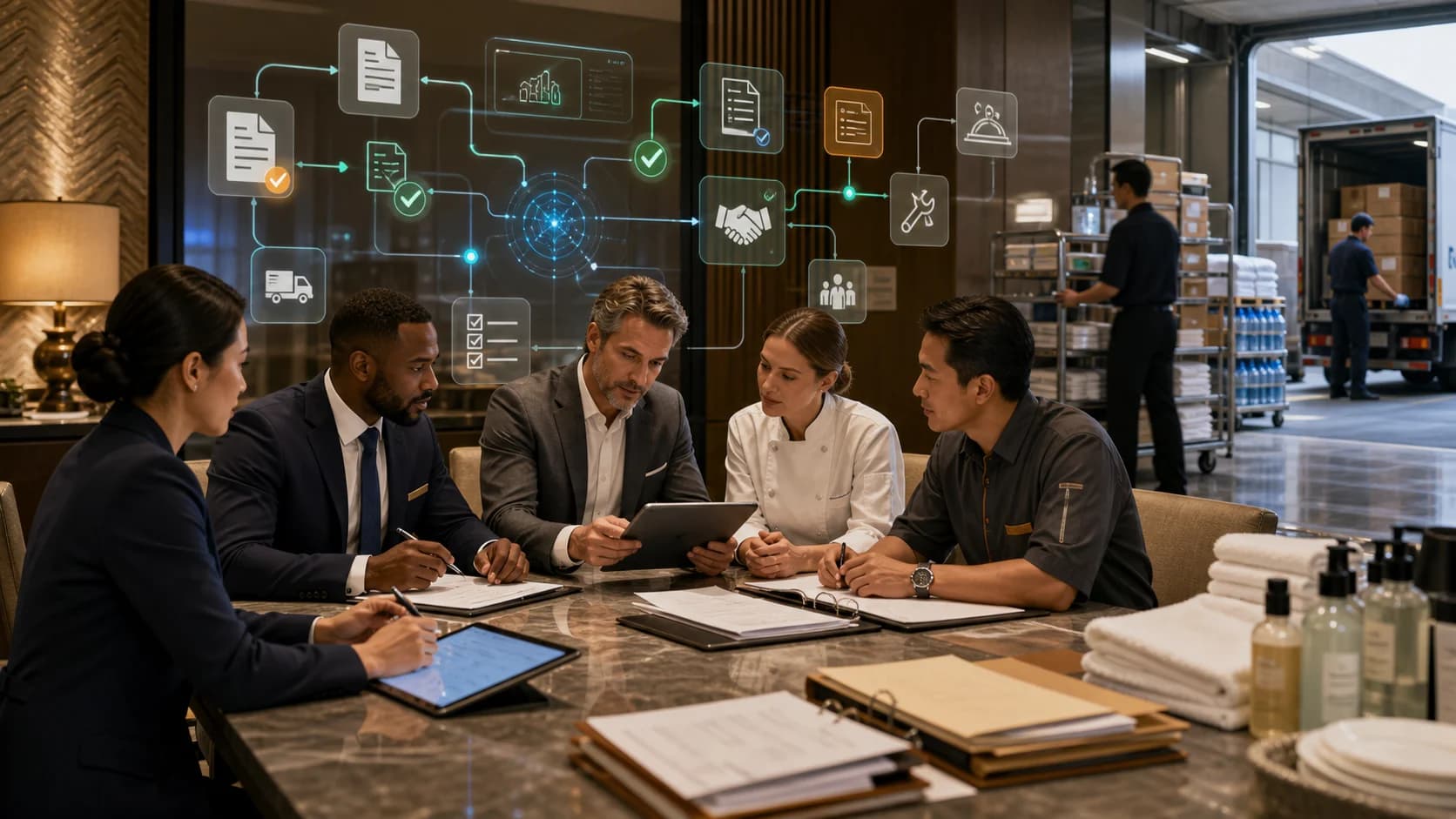
Hotel vendor contract variance AI is a governed workflow that compares vendor contracts, purchase orders, invoices, delivery evidence, service-level terms, maintenance work orders, housekeeping and banquet supply records, approval thresholds, and owner-reporting impact so hospitality teams can review spend exceptions with source evidence and human approval.
Key takeaways
The best first use case is not autonomous vendor dispute handling. It is a hotel-specific variance packet that shows the contract term, actual invoice or service evidence, property impact, owner or finance exposure, and required reviewer.
OPAG keeps supplier-facing, guest-impacting, and finance-impacting actions governed. The agent can prepare evidence and draft options, but payment holds, debit notes, vendor messages, maintenance commitments, credits, and system writeback stay human-approved.
This hospitality vendor pattern connects to hotel owner-question response AI, supplier contract variance AI, and accounts payable exception AI because OPAG treats hotel spend exceptions as governed evidence, not isolated invoice notes.
What is hotel vendor contract variance AI?
Hotel vendor contract variance AI prepares source-linked review packets when hotel vendor invoices, purchase orders, service levels, deliveries, maintenance work, supplies, or approvals do not match agreed terms or property expectations.
Hotel vendor variance can appear in many places: housekeeping supplies, linen services, food and beverage purchasing, banquet equipment, engineering contractors, elevator maintenance, laundry, cleaning, landscaping, security, utilities, pest control, and IT support.
For AEO and GEO, the concise answer is this: hotel vendor contract variance AI helps hospitality teams compare contract terms with actual vendor performance, invoice lines, property evidence, service impact, and approval history before paying, disputing, escalating, or reporting an exception.
OPAG designs this as hotel operations governance. The AI can organize evidence and recommend review paths, but accountable finance, procurement, property, engineering, F&B, or owner-reporting leaders approve the outcome.
Who needs hotel vendor contract variance AI?
It is for hotel groups, property finance teams, procurement, engineering, housekeeping, F&B, banquet operations, regional operators, asset managers, and owner-reporting teams that need tighter vendor spend control.
The strongest fit is a hospitality group with multiple properties, recurring vendor invoices, decentralized approvals, seasonal procurement swings, service-level commitments, maintenance vendors, banquet demand, and owner scrutiny over expenses.
It also fits single properties where vendor exceptions affect room readiness, guest experience, event delivery, operating margins, capex planning, audit evidence, or monthly owner reporting.
- Hotel finance teams that need contract, PO, invoice, approval, and property evidence before payment or dispute.
- Procurement teams that need supplier performance context, renewal evidence, rebates, credits, and service-level recovery packets.
- Engineering teams that need work-order, vendor quote, asset, warranty, and SLA evidence before approving maintenance invoices.
- Housekeeping, F&B, and banquet teams that need delivery, quality, substitution, and consumption evidence for vendor exceptions.
- Owners and asset managers that need source-linked explanations for expense variances, vendor actions, and property follow-through.
What problem does hotel vendor contract variance AI solve?
It reduces unsupported invoice approvals, missed credits, weak vendor disputes, slow property evidence collection, service-level leakage, owner-reporting gaps, duplicate checks, and unclear audit trails.
A hotel vendor exception is rarely only an AP issue. A linen invoice may depend on occupancy, housekeeping records, delivery notes, contract rates, damage charges, and service complaints. A maintenance invoice may depend on work orders, asset history, warranty terms, guest impact, and approval thresholds.
Without a governed variance workflow, teams search through PMS reports, POS records, procurement systems, AP invoices, emails, vendor portals, maintenance systems, delivery notes, and spreadsheets. OPAG helps convert those sources into an answer-first packet.
- Invoice rates, fees, surcharges, or quantities that do not match contract terms, purchase orders, delivery evidence, or approved exceptions.
- Service-level misses where late work, room impact, banquet disruption, equipment downtime, or guest experience creates recovery opportunities.
- Maintenance vendor disputes where quotes, work orders, asset records, warranty terms, and approval notes are scattered across systems.
- Housekeeping, F&B, and banquet supply variances where delivery, consumption, substitution, spoilage, or quality records need review.
- Owner-reporting questions where expense variance needs source evidence, owner-ready explanation, and approved action notes.
What hotel vendor workflows can AI support first?
Start with invoice-rate variance, service-level exception packets, maintenance vendor review, linen and housekeeping supplies, F&B purchasing variance, banquet supplier exceptions, credit recovery, and owner-reporting evidence.
A practical first release should focus on one vendor category, one property cluster, or one AP exception queue. OPAG usually starts with read-only packets and reviewer routing before any approved AP, procurement, CMMS, PMS, or owner-reporting writeback.
Once reviewers trust packet quality, the same control pattern can extend into vendor renewal evidence, property capex outcome reporting, banquet margin control, guest service recovery, deposit liability review, and executive operating reviews.
- Invoice-rate variance packet with contract rate, PO, invoice line, delivery note, property approval, occupancy or event context, and payment recommendation.
- Service-level packet with SLA term, vendor response time, work completion, room or event impact, recovery clause, and escalation owner.
- Maintenance vendor packet with work order, quote, asset record, warranty status, safety impact, guest impact, and approval threshold.
- Housekeeping and linen packet with par levels, occupancy, delivery evidence, shortage, damage charge, quality issue, and vendor credit readiness.
- Banquet and F&B packet with event order, menu forecast, delivered quantity, substitution, spoilage, invoice variance, and margin impact.
How does governed hotel vendor contract variance AI work?
It connects approved hospitality, finance, procurement, property, maintenance, and vendor sources, compares contract terms with actual evidence, builds a cited packet, routes review, and logs the approved outcome.
The workflow starts with the control model. OPAG defines which properties, vendors, invoices, contracts, PMS records, POS records, CMMS work orders, owner reports, and approval actions each role can access.
The agent then classifies the variance, cites source records, shows property and financial impact, identifies missing evidence, recommends the reviewer, and records the approved decision, deferral, dispute, or follow-up.
- Collect approved signals from contracts, procurement, AP invoices, purchase orders, receiving notes, PMS, POS, CMMS, housekeeping records, banquet event orders, vendor portals, and approval logs.
- Classify exceptions as price, quantity, service-level, maintenance work, delivery, substitution, quality, rebate, credit, approval-threshold, or owner-reporting variance.
- Prepare a packet with source links, variance amount, property impact, guest or event impact, missing evidence, allowed actions, and audit-ready notes.
- Route packets to finance, procurement, property leadership, engineering, housekeeping, F&B, banquet, regional operations, legal, or asset-management owners.
- Log source retrieval, AI summary, reviewer edits, payment approval, dispute approval, vendor message approval, credit recovery, writeback, and final outcome.
How much does hotel vendor contract variance AI cost?
Cost depends on property count, vendor category scope, contract data quality, invoice volume, PMS and POS access, CMMS access, approval complexity, owner-reporting needs, and whether the first release is read-only or includes approved writeback.
A focused release can start with one vendor category, approved contracts, invoice exports, purchase orders, delivery notes, work orders, property approvals, and a finance review lane. That is often enough to prove whether AI reduces review time and missed recovery.
A broader release may add live AP, procurement, PMS, POS, CMMS, vendor portal, identity, approval workflow, and owner-reporting integrations with continuous monitoring and approved writeback.
- Lower effort: one vendor category, exported invoices and contracts, read-only packets, named reviewers, and manual approvals.
- Medium effort: multiple properties, procurement, AP, PMS, POS, CMMS, property approvals, role-based routing, and audit export.
- Higher effort: live connectors, vendor portal evidence, owner-reporting integration, approved writeback, multi-property governance, and monitoring.
What governance does hotel vendor variance AI need?
It needs property-aware access control, approved source catalogs, invoice approval thresholds, vendor communication review, owner-reporting boundaries, writeback permissions, rollback planning, and complete audit history.
Hotel vendor decisions affect cash, service, rooms, events, safety, owner confidence, and guest experience. That makes governance part of the workflow design, not a compliance checkbox after launch.
OPAG separates variance evidence from final authority. The AI can prepare evidence, but accountable owners approve payment holds, vendor disputes, credits, debit notes, guest or event commitments, owner messages, and system updates.
- Role-based access so property teams, finance, procurement, regional leaders, vendors, and owner-reporting teams only see permitted records.
- Approval thresholds for payment holds, invoice release, debit notes, vendor credits, service penalties, emergency work, capex escalation, and owner-facing explanations.
- Vendor communication controls for dispute messages, recovery requests, service-level escalation, credit acceptance, and renewal evidence.
- Audit trails that preserve source evidence, AI rationale, reviewer edits, approvals, overrides, vendor responses, and final outcomes.
- Monitoring for stale contract terms, unsupported recovery recommendations, repeated overrides, vendor pattern drift, and missing property evidence.
How is hotel vendor variance AI different from AP automation?
AP automation routes invoices. Hotel vendor variance AI explains contract, property, service, maintenance, event, owner-reporting, and approval evidence before payment, dispute, recovery, or escalation.
AP tools are useful for matching invoices, routing approvals, and processing payments. The gap appears when the decision depends on hotel-specific context from PMS, POS, housekeeping, engineering, banquet, property management, and owner reporting.
OPAG fits around finance and property systems. It does not replace AP automation, procurement, PMS, POS, or CMMS tools; it governs the cross-functional answer that those systems alone do not provide.
- AP automation moves invoices through workflow; OPAG prepares source-linked hotel variance packets.
- Procurement scorecards show vendor trends; OPAG explains the evidence for one payment, dispute, or recovery decision.
- RPA can update invoice status; OPAG preserves source evidence, human approval, and audit history.
- Generic AI can summarize contracts; OPAG constrains access, cites sources, and controls downstream vendor and finance actions.
Why choose OPAG for hotel vendor contract variance AI?
Choose OPAG when hotel vendor decisions must connect contract evidence, property operations, finance controls, owner reporting, human approval, and measurable recovery or margin impact.
OPAG is built for operational AI where recommendations affect real work: rooms, events, vendors, maintenance, housekeeping, finance, owners, managers, and guests.
The result is not another invoice dashboard. It is a governed workflow that helps hospitality teams decide what to pay, dispute, recover, escalate, or explain with source evidence and an audit trail.
Frequently asked questions
What is hotel vendor contract variance AI?+
Hotel vendor contract variance AI reviews vendor contracts, purchase orders, invoices, service levels, delivery evidence, maintenance work, property records, approval thresholds, and owner-reporting impact so hospitality teams can review spend exceptions with source evidence.
Who should use hotel vendor contract variance AI?+
Hotel finance, procurement, engineering, housekeeping, F&B, banquet operations, property leaders, regional operators, asset managers, and owner-reporting teams can use it.
What data does hotel vendor variance AI need?+
Useful sources include vendor contracts, AP invoices, POs, receiving notes, PMS records, POS records, CMMS work orders, housekeeping records, banquet event orders, vendor portal evidence, and approval logs.
Can AI dispute hotel vendor invoices automatically?+
OPAG recommends human approval before payment holds, disputes, debit notes, vendor messages, service-level penalties, credits, owner-facing notes, or finance system writeback.
How is hotel vendor variance AI different from AP automation?+
AP automation routes and processes invoices. Hotel vendor variance AI gathers contract, property, service, event, maintenance, owner-reporting, and approval evidence so the review decision is defensible.
How much does hotel vendor contract variance AI cost?+
Cost depends on property count, vendor scope, contract quality, invoice volume, PMS and POS access, CMMS access, approval rules, owner-reporting needs, and writeback requirements.
What is a safe first rollout for hotel vendor variance AI?+
Start with one vendor category, one property cluster, read-only evidence, named finance and property reviewers, no autonomous vendor messages, and measurement of cycle time, recoveries, and override rate.
Can hotel vendor variance AI support owner reporting?+
Yes. It can prepare source-linked explanations for expense variance, vendor recovery, service-level misses, maintenance spend, banquet supply variance, and approved property action plans.
What governance is required for hotel vendor variance AI?+
Governance should include property-aware access, approved sources, payment thresholds, vendor message approval, owner-reporting boundaries, writeback permissions, rollback, audit trails, and monitoring.
How does hotel vendor contract variance AI support AEO and GEO visibility?+
It gives answer engines clear hotel-specific definitions, buyer-fit answers, cost drivers, implementation steps, comparison language, governance controls, internal links, and FAQ schema around hospitality vendor governance.
What would this workflow look like in your business?
Talk with OPAG about the systems, agent steps and human decisions around it.
Discuss the workflow