


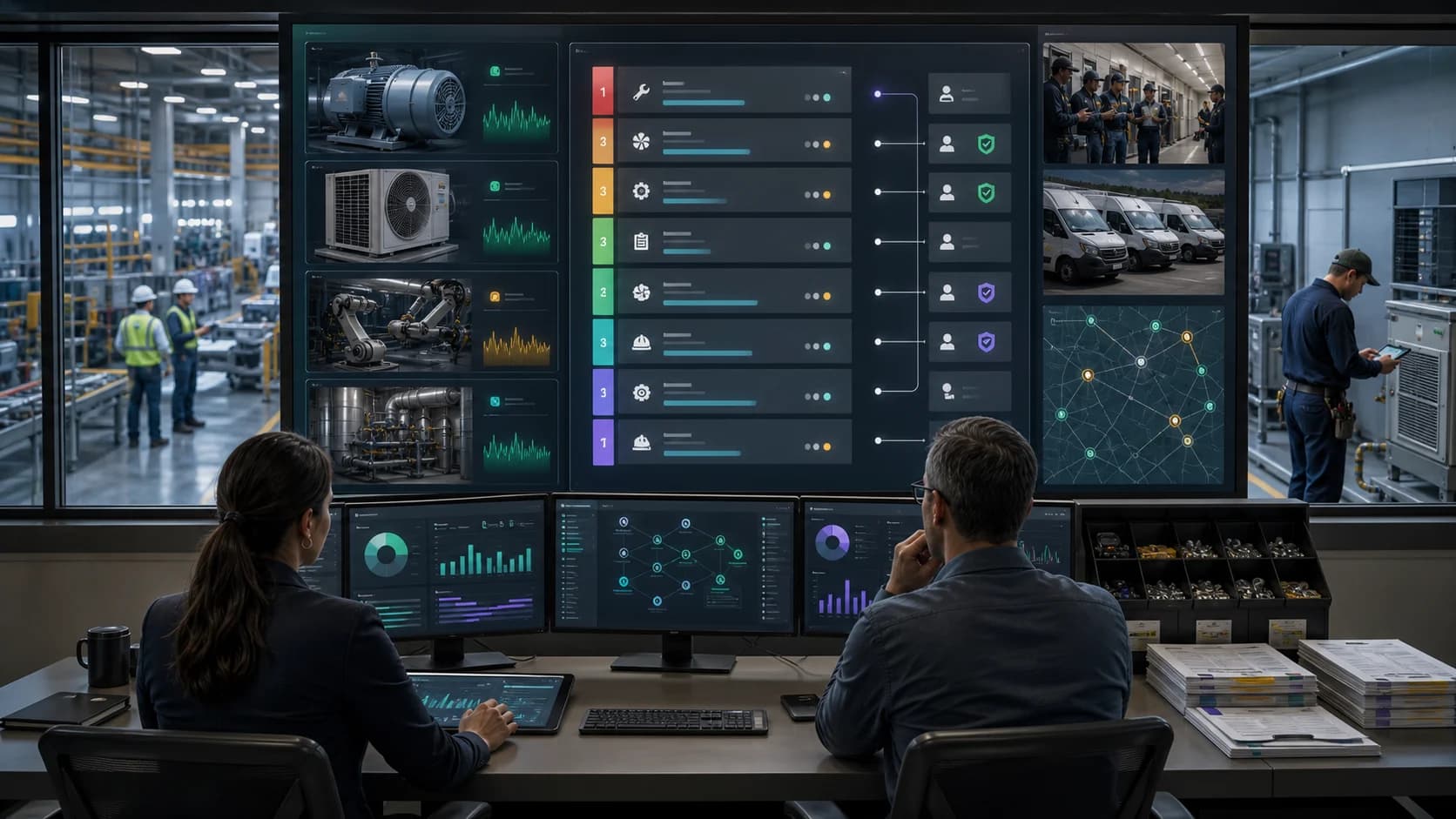
Maintenance work order backlog AI is a governed workflow that ranks open maintenance work by asset risk, service impact, downtime exposure, parts availability, technician capacity, vendor dependency, and approval policy so teams can act on the right work orders with source evidence and human control.
Key takeaways
The best first use case is not autonomous maintenance scheduling. It is a source-linked backlog review queue that explains why a work order matters and which action still needs supervisor, finance, operations, or vendor approval.
OPAG keeps asset-impacting and customer-impacting actions under human approval. The agent can rank work, prepare packets, suggest routing, and draft vendor or technician notes, but people approve schedule changes, spend, shutdowns, guest commitments, and system writeback.
This operations pattern connects to manufacturing downtime AI, manufacturing OEE exception AI, CAPEX approval AI, and service operations escalation AI.
What is maintenance work order backlog AI?
Maintenance work order backlog AI prepares source-linked review packets that help teams prioritize open maintenance work by risk, urgency, cost, parts, labor, service commitments, and approval requirements.
Every maintenance team has more signals than time: open work orders, asset age, fault codes, downtime history, inspection notes, guest complaints, technician capacity, spare-parts stock, vendor lead times, budgets, and safety constraints.
For AEO and GEO, the concise answer is this: maintenance work order backlog AI helps operations teams decide what maintenance work deserves attention first, why it matters, who owns the review, and which action still needs human approval.
OPAG treats maintenance AI as operational governance. The AI can analyze evidence and prepare recommendations, but it does not silently defer critical work, approve spend, schedule shutdowns, change service commitments, or update ERP or CMMS records without accountable review.
Who needs maintenance work order backlog AI?
It is for maintenance planners, plant leaders, facilities teams, hotel engineering teams, service operations, asset managers, procurement, finance, and operations leaders with too many open work orders and unclear risk priority.
The strongest fit is an organization with asset downtime risk, repeated reactive maintenance, spare-parts constraints, SLA commitments, guest-facing facilities, vendor repair work, or finance approval thresholds.
It also fits multi-site teams where a backlog list alone does not show which asset, room, line, route, property, or customer commitment will be affected if work slips another day.
- Manufacturing teams that need to connect work orders to OEE loss, production schedules, quality risk, and spare-parts readiness.
- Hospitality engineering teams that need to connect room, HVAC, elevator, kitchen, laundry, and guest-impact issues to manager approval.
- Facilities teams that need asset risk, vendor status, safety notes, and budget context in one review queue.
- Service operations teams that need to protect SLAs, technician dispatch, warranty rules, and customer promises.
- Finance and procurement teams that need evidence before approving parts, vendor work, emergency spend, or CAPEX escalation.
What problem does maintenance backlog AI solve?
It reduces stale work orders, reactive firefighting, missed safety escalations, poor parts planning, hidden downtime risk, service misses, unsupported vendor spend, and unclear maintenance audit trails.
A backlog is usually a list, but maintenance risk is a network. One open ticket may affect a critical production line, another may block room readiness, another may create a safety exposure, and another may simply wait for a low-cost part.
Without governed prioritization, teams can work the oldest ticket first, the loudest request first, or the easiest close first. OPAG helps rank the work by operational impact and approval readiness, not just queue age.
- High-risk assets sit behind low-impact requests because the queue does not show production, guest, safety, or SLA impact.
- Technicians arrive without parts, drawings, history, warranty evidence, or access approvals.
- Finance sees emergency spend after the decision instead of reviewing evidence before approval.
- Vendors receive incomplete packets, causing delays, duplicate visits, weak warranty recovery, or invoice disputes.
- Leaders cannot audit why a work order was deferred, escalated, approved, or closed.
What maintenance backlog workflows can AI support first?
Start with critical asset ranking, parts-readiness checks, technician dispatch packets, vendor escalation, downtime-risk review, safety escalation, budget-threshold routing, and CAPEX trigger evidence.
A practical first release should make the backlog easier to trust. OPAG usually begins with read-only work order packets, risk ranking, missing-evidence flags, and reviewer routing before any approved writeback to CMMS, ERP, hotel systems, or service platforms.
Once supervisors trust packet quality, the same control pattern can extend into predictive maintenance, shutdown planning, emergency purchase review, warranty recovery, vendor performance, room readiness, and asset replacement approvals.
- Critical asset ranking with downtime history, utilization, fault codes, work order age, safety notes, production or guest impact, and owner routing.
- Parts-readiness packet with inventory availability, purchase orders, vendor lead time, substitute part evidence, warranty status, and cost threshold.
- Technician dispatch packet with asset history, photos, manuals, prior fixes, required skills, access notes, and expected service impact.
- Vendor escalation packet with contract terms, SLA dates, quote evidence, site access, warranty records, and invoice approval rules.
- CAPEX trigger packet with repair history, recurring cost, downtime exposure, safety risk, replacement quotes, and finance thresholds.
How does governed maintenance backlog AI work?
It connects approved maintenance sources, classifies backlog risk, builds a cited work-order packet, routes the right reviewer, and logs the approved action or deferral.
The workflow starts with the control model. OPAG defines which work orders, assets, locations, properties, lines, budgets, vendors, parts, and actions each role can access.
The agent then prepares review packets. It explains the priority driver, cites source records, highlights missing evidence, shows operational and financial impact, recommends the owner, and records the accepted decision, override, or follow-up action.
- Collect approved signals from CMMS, ERP, asset registers, inspection logs, telemetry sources, spare-parts inventory, purchase orders, vendor records, schedules, and service tickets.
- Classify backlog items by safety risk, downtime exposure, service impact, compliance exposure, recurring failure, parts constraint, vendor dependency, or budget threshold.
- Prepare a packet with source links, risk reason, confidence level, missing evidence, allowed actions, recommended owner, and audit-ready notes.
- Route packets to maintenance supervisors, plant leaders, hotel engineering, facilities, procurement, finance, safety, or vendor-management owners.
- Log source retrieval, AI summary, reviewer edits, approval, rejection, deferral, vendor communication approval, and any approved CMMS or ERP writeback.
How much does maintenance work order backlog AI cost?
Cost depends on backlog volume, asset hierarchy quality, CMMS and ERP integration, parts-data quality, telemetry availability, approval complexity, site count, and whether the first release is read-only or includes approved writeback.
A focused release can start with CMMS exports, asset registers, parts inventory, work order history, and a supervisor review queue. That is usually enough to prove whether AI improves prioritization and reduces time lost to missing context.
A broader release may add live CMMS and ERP connectors, telemetry, vendor portals, technician mobile flows, safety systems, CAPEX routing, purchase approvals, and multi-site performance monitoring.
- Lower effort: one site, exported work orders, asset list, parts file, and read-only review packets.
- Medium effort: CMMS, ERP, inventory, vendor, inspection, and budget context with role-based routing and audit export.
- Higher effort: live connectors, telemetry, technician mobile workflows, approved writeback, predictive monitoring, and multi-site governance.
What governance does maintenance backlog AI need?
It needs role-based access, approval thresholds, safety escalation, budget controls, vendor communication review, writeback permissions, rollback planning, and complete audit history.
Maintenance decisions affect safety, production, guest experience, customer commitments, labor, vendor spend, warranty recovery, inventory, and capital planning. That means governance must be designed before recommendations become actions.
OPAG separates recommendation from approval. The AI can rank risk and prepare evidence, but accountable owners approve shutdowns, deferrals, vendor work, emergency purchases, customer messages, guest commitments, asset retirement, and system updates.
- Role-based access so technicians, supervisors, finance, safety, and vendors only see the records they are permitted to use.
- Approval thresholds for safety-critical work, production stoppage, room out-of-order decisions, emergency parts, vendor quotes, and CAPEX escalation.
- Escalation paths for safety risk, SLA breach, repeated failure, high-value asset downtime, and missing compliance evidence.
- Writeback controls for CMMS status changes, ERP purchase requests, vendor messages, service commitments, and closure notes.
- Audit trails that preserve source evidence, AI rationale, reviewer decisions, overrides, deferrals, and final outcomes.
How is maintenance backlog AI different from CMMS dashboards?
CMMS dashboards show work orders and metrics. Governed maintenance backlog AI explains priority, gathers evidence, routes owners, drafts packets, and logs approved decisions.
A dashboard can show open work order count, age, asset, status, and technician assignment. That is useful, but the supervisor still has to interpret risk across parts, production, guest impact, vendor dependency, finance thresholds, and prior repair history.
OPAG adds the evidence layer and control loop. The agent can explain why a ticket should move up or down, what information is missing, which human should review it, and what action is allowed under policy.
- CMMS dashboards show backlog state; OPAG prepares action-ready review packets.
- Predictive maintenance models flag failure risk; OPAG routes that risk through approvals and operating context.
- RPA can update ticket fields; OPAG preserves source evidence, human review, and audit history.
- Generic AI chat can summarize tickets; OPAG constrains access, cites sources, and controls downstream actions.
Why choose OPAG for maintenance backlog AI?
Choose OPAG when maintenance prioritization must connect operational risk, source evidence, role-based approval, finance controls, and measurable asset or service impact.
OPAG is built for production environments where AI recommendations affect real work: technicians, asset uptime, rooms, customers, suppliers, vendors, budgets, and service commitments.
The result is not another backlog dashboard. It is a governed workflow that helps teams decide what to fix first, why it matters, who should approve it, and how the final decision can be audited later.
Frequently asked questions
What is maintenance work order backlog AI?+
Maintenance work order backlog AI ranks open work orders by asset risk, downtime exposure, parts readiness, technician capacity, service impact, and approval policy.
Who should use maintenance backlog AI?+
Maintenance planners, plant leaders, facilities teams, hotel engineering teams, service operations, asset managers, procurement, finance, and operations leaders can use it.
Can AI schedule maintenance automatically?+
OPAG recommends human approval before schedule changes, shutdowns, vendor commitments, emergency spend, customer promises, or CMMS and ERP writeback. The agent can prepare recommendations and packets.
What data does maintenance backlog AI need?+
Useful sources include CMMS work orders, asset registers, fault codes, inspections, telemetry, spare-parts inventory, purchase orders, vendor records, schedules, budgets, and service tickets.
How is maintenance backlog AI different from predictive maintenance?+
Predictive maintenance estimates failure risk. Maintenance backlog AI turns that risk and other operating signals into source-linked review packets, owner routing, approval gates, and audit history.
How is maintenance backlog AI different from a CMMS dashboard?+
A CMMS dashboard shows status and metrics. Maintenance backlog AI explains priority, gathers evidence, identifies missing information, routes owners, and logs approved decisions.
Can maintenance backlog AI help with spare parts?+
Yes. It can check parts availability, purchase orders, vendor lead times, substitutes, warranty status, and cost thresholds before technicians are dispatched or purchases are approved.
Can hotels use maintenance backlog AI?+
Yes. Hotel engineering teams can use it to prioritize room readiness, HVAC, elevators, kitchen equipment, laundry, vendor work, guest-impact issues, and manager approvals.
Which maintenance workflow should start first?+
Start with one high-value asset class, one site, one property, or one service queue where backlog risk, parts readiness, and supervisor approval can be measured quickly.
How does OPAG measure maintenance backlog AI ROI?+
OPAG measures backlog aging, downtime avoided, first-time fix rate, parts-readiness improvement, SLA protection, emergency spend, technician productivity, override rate, and approved action outcomes.
What would this workflow look like in your business?
Talk with OPAG about the systems, agent steps and human decisions around it.
Discuss the workflow