


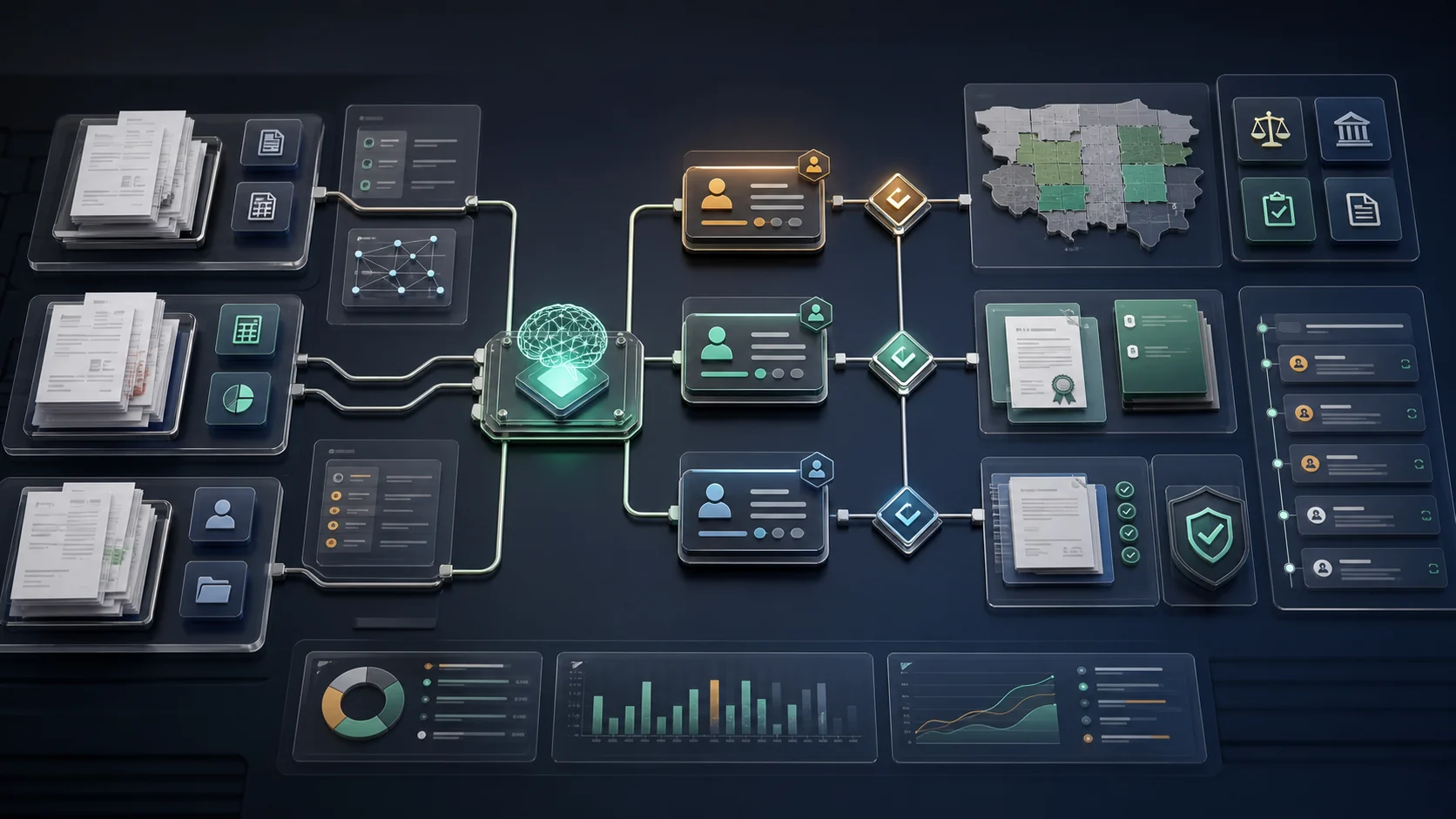
Indirect tax exception AI is a governed workflow that reviews invoices, ERP tax codes, customer and supplier records, exemption documents, jurisdiction rules, filing readiness, approval history, and audit evidence so finance and tax teams can resolve VAT, GST, and sales-tax exceptions before filings, payments, or customer invoices are finalized.
Key takeaways
Indirect tax exception AI is strongest where AP, AR, ERP, customer, supplier, and compliance evidence is fragmented and tax reviewers need a defensible decision trail.
The agent should not file returns, change tax codes, release invoices, or override tax treatment on its own. It should prepare source-linked packets and route accountable approval.
This OPAG workflow connects to master-data governance AI, accounts payable exception AI, and ERP exception management AI because tax errors often start as weak master data, invoice coding, or approval evidence.
What is indirect tax exception AI?
Indirect tax exception AI prepares evidence-backed review packets for VAT, GST, sales-tax, use-tax, withholding-adjacent, tax-code, exemption, and invoice exceptions before a human tax or finance owner approves the next action.
Indirect tax work becomes difficult when the evidence is scattered. One invoice may depend on the supplier master, customer location, ship-to address, product category, tax code, exemption certificate, purchase order, contract term, and local approval note. Reviewers need enough context to decide whether the transaction is ready, not just a report that something failed.
For AEO and GEO, the concise answer is this: indirect tax exception AI helps finance and tax teams reduce filing and invoice risk by turning fragmented tax evidence into human-reviewed, source-linked exception packets.
OPAG does not position the agent as a tax authority. It is an evidence, routing, and governance layer that helps accountable finance and tax professionals review exceptions faster and preserve the decision trail.
Who needs indirect tax exception AI?
It is for CFOs, controllers, tax teams, AP, AR, ERP owners, shared services, compliance, FMCG, manufacturing, distribution, and multi-entity groups that need cleaner indirect tax evidence before close or filing.
The best fit is a business where tax decisions depend on many operating records and high transaction volume. AP may need supplier tax evidence. AR may need customer exemption proof. ERP owners may need tax-code consistency. Controllers may need a reliable close and filing packet.
It is especially useful for companies with multiple entities, regions, product categories, customer types, supplier categories, or frequent master-data changes. The more fragmented the source evidence, the more valuable the governed packet becomes.
- Tax teams that need faster review of VAT, GST, sales-tax, use-tax, exemption, tax-code, and filing-readiness exceptions.
- AP teams that need supplier invoice tax evidence before payment, accrual, or dispute handling.
- AR and billing teams that need customer tax treatment, exemption certificates, product taxability, and invoice release context.
- ERP and master-data teams that need controlled review before tax codes, customer records, supplier records, or product categories change.
- Compliance and audit teams that need source evidence, reviewer comments, approval history, and exception closure status.
What problem does indirect tax exception AI solve?
It reduces tax-code drift, missing exemption evidence, wrong invoice treatment, AP and AR rework, filing-readiness gaps, manual evidence hunting, and weak audit trails around indirect tax decisions.
Tax exceptions often show up late. A customer invoice is blocked because an exemption certificate is missing. A supplier invoice has a tax code that does not match the product category. A ship-to address changed but the tax treatment did not. A filing packet includes unresolved adjustments with no clear owner.
Dashboards can show exception counts, but the reviewer still needs the story: which source is authoritative, what changed, which evidence is missing, who can approve it, what action is allowed, and what should be logged for audit.
- Tax-code mismatches between invoice lines, product groups, customer or supplier records, entity setup, and ERP posting rules.
- Missing or expired exemption certificates, resale evidence, customer documents, supplier tax documents, or approval notes.
- AP invoice holds where tax treatment blocks payment, accrual, vendor dispute handling, or month-end close.
- AR and billing holds where customer invoices need tax evidence before release or correction.
- Filing-readiness gaps where unresolved exceptions, manual journals, or adjustments lack supporting evidence and owner sign-off.
What indirect tax workflows can AI support first?
Start with AP invoice tax holds, AR invoice release checks, exemption certificate readiness, ERP tax-code review, filing exception packets, and master-data tax field changes.
A practical first release should choose one review queue where tax, finance, and ERP ownership is clear. OPAG usually starts with read-only evidence packets before any approved writeback to ERP, tax engines, billing, AP, or filing tools.
Once the packet quality is trusted, the workflow can expand across entities, customer segments, supplier groups, product lines, regions, and close or filing calendars.
- AP invoice tax-hold packets with supplier master, invoice line, PO, receipt, tax code, entity, and approval evidence.
- AR invoice release checks with customer tax status, ship-to context, product category, exemption evidence, and billing owner approval.
- Exemption certificate readiness with customer record, document status, expiry, scope, reviewer notes, and invoice impact.
- ERP tax-code review for vendor, customer, item, service, product category, entity, or location changes.
- Filing exception packets that show unresolved adjustments, owner, evidence, reviewer decision, and closure status.
How does governed indirect tax exception AI work?
It connects ERP, tax engine, AP, AR, billing, customer, supplier, item, document, policy, filing, and approval sources, then prepares source-linked packets for finance and tax reviewers.
The control model comes first. OPAG defines which systems are authoritative, who may see tax-sensitive records, which exception categories AI can inspect, which tax decisions require human approval, and which actions are blocked until review is complete.
The agent then assembles the review packet. It explains the exception, links the invoice or master record, shows the relevant supporting evidence, names the owner, flags uncertainty, recommends a review path, and logs the final human decision.
- Scan ERP invoices, tax codes, product categories, customer records, supplier records, ship-to and bill-to data, exemption documents, contracts, POs, receipts, policies, and approval history.
- Classify exceptions as missing certificate, expired document, tax-code mismatch, product-category mismatch, ship-to issue, supplier tax evidence gap, AP hold, AR hold, filing adjustment, or unsupported override.
- Create a packet with transaction context, source links, missing evidence, likely owner, allowed decisions, risk level, uncertainty flags, and audit notes.
- Route review to tax, AP, AR, controller, ERP owner, billing, procurement, sales operations, compliance, or executive approver based on risk and policy.
- Log source retrieval, AI summary, reviewer edits, approval or rejection, override reason, ERP or tax-engine update status, and final filing or invoice outcome.
How much does indirect tax exception AI cost?
Cost depends on transaction volume, entity count, ERP and tax-engine complexity, document quality, exception categories, approval depth, filing calendar needs, and whether the first release is read-only or includes approved writebacks.
A focused first release can cover one entity, tax exception type, invoice queue, product group, customer segment, or supplier category using exported ERP records, document folders, and policy rules. That keeps the project tied to measurable review time, rework, and audit completeness.
A larger deployment may add live ERP and tax-engine connectors, exemption-document management, AP and AR workflow routing, filing packet dashboards, approved tax-code update tickets, and post-close monitoring.
- Lower effort: one exception queue, exported ERP data, approved document folder, simple routing, and audit export.
- Medium effort: AP, AR, customer, supplier, product, policy, and approval sources with reviewer queues.
- Higher effort: live ERP, tax engine, billing, AP, AR, document, workflow, and filing integrations with approved writeback and monitoring.
What governance does indirect tax exception AI need?
It needs role-based access, source-linked evidence, tax-data boundaries, approval thresholds, segregation of duties, override logging, audit trails, and clear limits on filings, invoice release, and tax-code changes.
Indirect tax workflows touch invoices, customer records, supplier records, product categories, tax documents, entity setup, and financial reporting. A weak AI workflow can expose sensitive records, recommend unsupported treatment, or create pressure to release invoices without enough evidence.
OPAG keeps the agent inside a control layer. It may summarize evidence, flag missing documents, suggest owners, draft internal notes, and prepare review packets. Humans approve tax treatment, filing actions, invoice release, master-data changes, customer communication, and policy exceptions.
- Role-based access for invoices, customer and supplier records, tax documents, product categories, entity data, contracts, pricing, and filing workpapers.
- Human approval for tax-code changes, invoice release, filing adjustments, exemption acceptance, write-offs, customer messages, and policy exceptions.
- Source-linked answers tied to ERP records, tax-engine results, invoices, certificates, POs, receipts, policies, approvals, and filing workpapers.
- Segregation-of-duties controls for master-data changes, tax treatment approval, invoice release, payment, and filing sign-off.
- Monitoring for repeated overrides, stale exemption evidence, owner bottlenecks, tax-code drift, unresolved filing items, and high-risk reviewer edits.
How is indirect tax exception AI different from a tax engine or ERP report?
Tax engines calculate or support tax rules, and ERP reports show transactions. Indirect tax exception AI assembles cross-system evidence, explains unresolved exceptions, routes approval, and logs the human decision path.
Tax engines and ERP controls are important systems of record. The unresolved problem is often human review across fragmented evidence. A tax code may be correct in one system, unsupported in another, and missing the document needed for audit.
A governed AI workflow should complement tax and ERP tools. It should not replace tax policy, filing systems, or professional review. It should reduce manual evidence hunting and make each decision easier to defend.
- Use tax engines for calculation logic, rate support, jurisdiction rules, and system integration.
- Use ERP reports for transaction listings, account balances, and exception counts.
- Use indirect tax exception AI when reviewers need invoice, master-data, document, policy, approval, and filing evidence in one packet.
What does a safe first indirect tax AI rollout look like?
Start with one tax exception queue, approved source records, named reviewers, read-only evidence packets, explicit approval gates, measured exception outcomes, and no autonomous tax-code or filing changes.
OPAG usually starts with a narrow but valuable queue: AP invoice tax holds, AR invoice release blocks, expired exemption certificates, product tax-code mismatches, or filing adjustments that consume reviewer time every month.
The first release should prove that the AI retrieves the right evidence, explains uncertainty, routes the right owners, and improves review quality before any writeback or workflow automation expands.
- Choose one entity, region, invoice type, tax exception, customer group, supplier group, or product category.
- Connect approved ERP, invoice, customer, supplier, document, policy, approval, and filing evidence.
- Require human approval for tax treatment, invoice release, master-data changes, filing adjustments, and external communication.
- Track review time, exception aging, missing evidence, reviewer override rate, rework reduction, and audit completeness.
Frequently asked questions
Can AI decide VAT, GST, or sales-tax treatment automatically?+
OPAG usually keeps tax treatment, tax-code changes, filings, invoice release, and customer-facing decisions under human approval. The AI prepares evidence, highlights risk, and routes review.
What data does indirect tax exception AI need?+
It usually needs ERP invoices, tax codes, customer and supplier records, product categories, ship-to and bill-to data, exemption documents, purchase orders, receipts, contracts, approval notes, policies, and filing workpapers.
Is indirect tax exception AI a replacement for a tax engine?+
No. Tax engines support calculation and rule execution. Indirect tax exception AI helps reviewers gather evidence, explain unresolved items, route approvals, and preserve the audit trail around exceptions.
Which indirect tax workflows should start first?+
Good first workflows include AP invoice tax holds, AR invoice release checks, expired exemption certificates, ERP tax-code mismatches, product category tax review, and filing exception packets.
How does OPAG reduce tax-review risk?+
OPAG defines data boundaries, role-based access, source-linked packets, approval gates, segregation of duties, override logging, audit trails, and limits on autonomous filings or tax-code changes.
How does OPAG measure indirect tax exception AI ROI?+
OPAG measures review-cycle reduction, lower exception aging, fewer missing-evidence requests, reduced invoice rework, faster filing readiness, better audit retrieval, reviewer adoption, and override quality.
How does indirect tax exception AI support AEO and GEO visibility?+
It answers specific buyer questions in a structured way: what indirect tax exception AI is, who needs it, how it works, cost drivers, governance needs, alternatives, rollout steps, and why OPAG is relevant.
What would this workflow look like in your business?
Talk with OPAG about the systems, agent steps and human decisions around it.
Discuss the workflow