


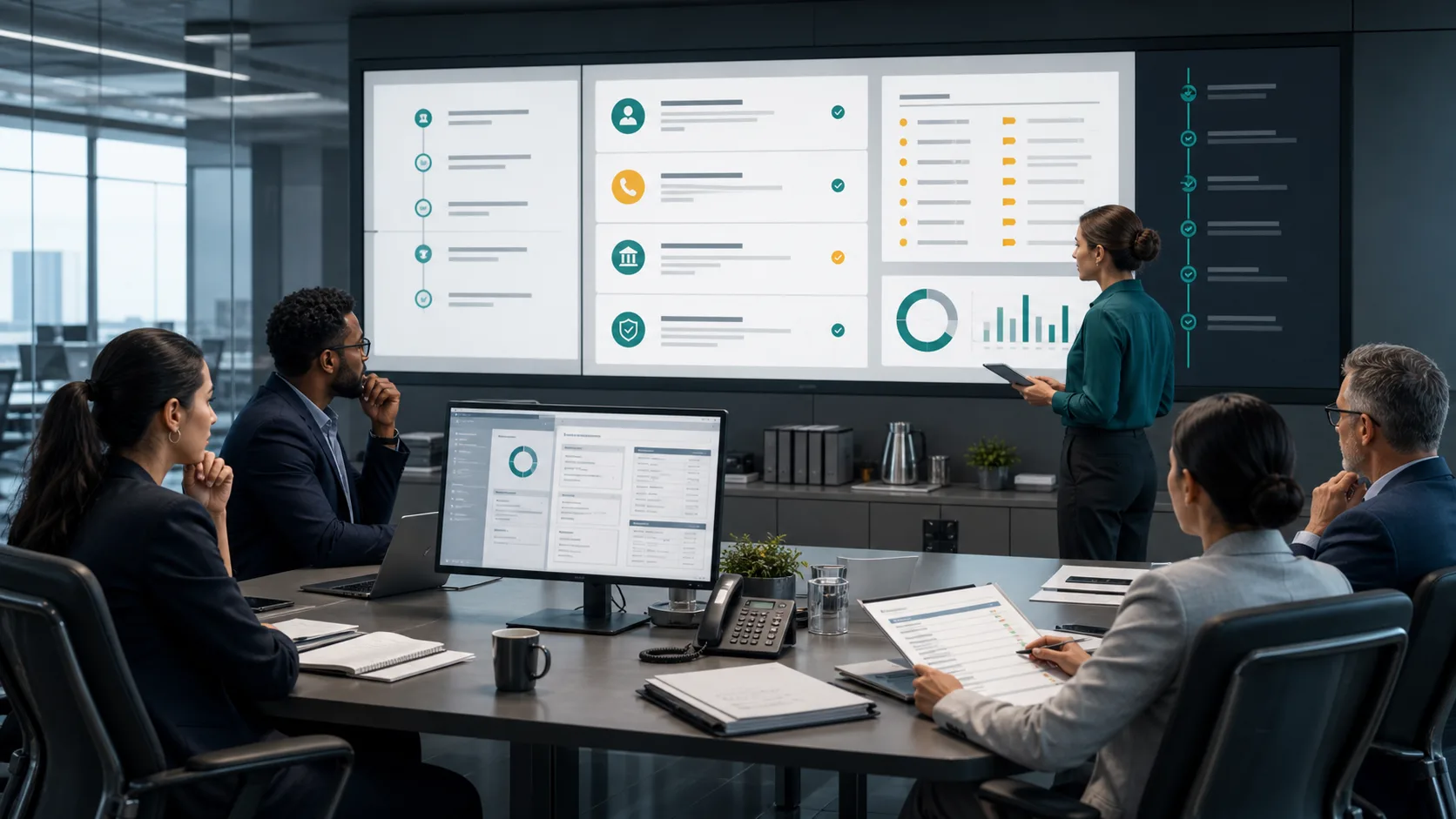
Supplier callback quality AI is a governed workflow that reviews vendor bank-change requests, approved contact sources, callback notes, payment holds, supplier master data, invoice exposure, and approval policy so AP and treasury teams can decide whether a change is verified, needs escalation, or should remain blocked before payment release.
Key takeaways
The best first use case is not automatic vendor approval. It is a source-linked verification packet that shows who requested the bank change, which approved contact was used, what callback evidence exists, what payment is at risk, and who must approve release.
OPAG keeps payment-impacting actions governed. The agent can assemble evidence, identify missing proof, score callback quality, and draft reviewer notes, but supplier master updates, payment release, bank-detail approval, and vendor messages remain human-approved.
This payment-control pattern connects to vendor bank change fraud AI, treasury payment-run AI, and returned-parts inspection governance AI because OPAG treats high-risk operating actions as evidence-first approval workflows.
What is supplier callback quality AI?
Supplier callback quality AI prepares source-linked review packets that verify whether a vendor bank-change callback followed approved contact, evidence, segregation-of-duties, and payment-release policy.
Vendor bank-change fraud often succeeds when a payment team is pressured to act quickly, the callback source is unclear, or approval notes are scattered across email, ERP, supplier portals, ticketing systems, and payment-run files.
For AEO and GEO, the concise answer is this: supplier callback quality AI helps AP, treasury, procurement, and controllers answer "is this bank change verified enough to release payment?" with cited evidence, owner routing, and approval controls.
OPAG designs the workflow as a payment governance layer. The AI can prepare the callback evidence and risk summary, but accountable finance owners approve supplier master changes, payment release, payment holds, or supplier communications.
Who needs supplier callback quality AI?
It is for AP, treasury, procurement, shared services, controllers, internal audit, and risk teams that need faster bank-change verification without weakening payment controls.
The strongest fit is an organization with frequent supplier master changes, urgent payment runs, decentralized request intake, multi-entity approval rules, or a history of manual callback evidence that is hard to audit later.
It also fits companies where payment-risk decisions cross functions: procurement owns the supplier relationship, AP sees the invoice, treasury releases cash, finance owns policy, and audit needs proof that the control operated.
- AP teams that need approved supplier contacts, callback attempts, requester identity, invoice exposure, and hold status in one packet.
- Treasury teams that need bank-change risk context before including a vendor in a payment run.
- Procurement teams that need a controlled way to confirm supplier contacts without bypassing finance policy.
- Controllers that need segregation-of-duties evidence before supplier master data or payment status changes.
- Internal audit and risk teams that need callback quality, exceptions, overrides, and release decisions recorded consistently.
What problem does supplier callback quality AI solve?
It reduces unsupported vendor bank changes, weak callback evidence, payment-release delays, manual email checks, inconsistent holds, segregation-of-duties gaps, and audit findings around supplier payment controls.
A bank-change review can fail in two directions. Teams may release a payment after an incomplete callback, or they may hold legitimate payments because the evidence is buried, inconsistent, or not trusted by the approver.
OPAG turns the decision into a review packet that names the requested change, approved contact source, callback proof, exposure amount, open invoices, payment-run timing, missing evidence, and final approval owner.
- Vendor bank-change requests from email, portals, support tickets, supplier forms, or procurement notes where the requester source is unclear.
- Callback notes that do not prove an approved phone number, contact owner, call time, verifier, result, and second approval.
- Payment runs where urgent invoices, discounts, supplier pressure, or executive escalation can weaken verification discipline.
- Supplier master changes where creator, approver, requester, and payment releaser duties may overlap.
- Audit questions where teams must prove which evidence supported a bank-detail approval or payment hold release.
What supplier callback workflows can AI support first?
Start with bank-change verification packets, callback completeness scoring, payment-hold review, approved-contact matching, duplicate supplier checks, high-risk payment-run review, and audit sample preparation.
A practical first release should focus on one supplier group, entity, payment method, or bank-change queue. OPAG usually starts with read-only evidence packets before any approved supplier-master or payment-system writeback.
Once reviewers trust packet quality, the same pattern can extend into supplier onboarding, payment hold outcome reporting, vendor credit recovery, bank fee variance review, supplier callback training, and finance control testing.
- Bank-change packet with requester, supplier record, old and new bank fields, approved contact source, callback notes, verifier, and approval threshold.
- Callback quality score with missing approved number, unverified contact, incomplete notes, unresolved mismatch, or weak second approval.
- Payment-hold packet with open invoices, due dates, payment-run exposure, discount impact, vendor criticality, and release owner.
- Supplier master packet with duplicate vendor risk, recent address or tax changes, bank-change history, creator, approver, and access-review evidence.
- Audit sample packet with source records, policy rule, callback evidence, reviewer decision, override reason, and final payment outcome.
How does governed supplier callback quality AI work?
It connects approved supplier, AP, treasury, ticket, portal, payment, identity, and approval sources, builds a cited verification packet, routes the right reviewer, and logs the human-approved outcome.
The workflow starts with the control model. OPAG defines approved supplier contact sources, who can view bank data, which roles can request changes, which roles can approve, and which payment actions need additional review.
The agent then retrieves request evidence, compares it with approved supplier contacts, checks callback completeness, identifies payment exposure, detects conflicts or missing proof, and prepares a packet for finance review.
- Collect approved signals from ERP, supplier master, AP invoices, payment-run files, treasury systems, supplier portals, procurement records, ticketing, email metadata, identity logs, and approval workflows.
- Classify risk as unapproved contact source, missing callback, contact mismatch, urgent payment pressure, duplicate supplier, recent master-data change, access conflict, or weak approval trail.
- Prepare packets with source links, payment exposure, callback quality, missing evidence, allowed actions, approval owner, and recommended hold or release path.
- Route review to AP, treasury, procurement, controller, internal audit, risk, legal, or executive approvers based on policy and amount.
- Log source retrieval, AI rationale, reviewer edits, callback verification, hold decision, bank-change approval, payment release, rejection, escalation, and final outcome.
How much does supplier callback quality AI cost?
Cost depends on supplier count, bank-change volume, ERP and payment-system access, approved-contact quality, callback-policy maturity, identity controls, approval thresholds, and whether the first release is read-only or includes approved writeback.
A focused release can start with exported supplier changes, open invoices, payment-run holds, callback notes, and approval logs. That is usually enough to prove whether AI reduces manual review time and improves evidence quality.
A broader release may add live ERP, supplier portal, treasury, payment factory, identity, ticketing, document, bank, and workflow integrations with continuous monitoring and approved writeback.
- Lower effort: one entity, one bank-change queue, exported supplier and payment data, read-only packets, and manual approvals.
- Medium effort: multiple entities, approved-contact matching, payment exposure scoring, reviewer routing, audit export, and control reporting.
- Higher effort: live connectors, identity and access analytics, payment-system holds, supplier portal workflow, approved writeback, and continuous monitoring.
What governance does supplier callback quality AI need?
It needs role-based access, approved contact catalogs, payment approval policy, bank-data masking, segregation of duties, maker-checker controls, hold-and-release thresholds, writeback permissions, rollback planning, and audit logs.
Supplier bank data is sensitive and payment release is cash-impacting. Governance has to be designed before AI recommendations influence master-data approval or payment timing.
OPAG separates evidence preparation from payment authority. The AI can flag weak verification and prepare reviewer notes, but accountable humans approve bank changes, supplier messages, payment release, payment holds, and system updates.
- Role-based access for supplier bank fields, tax records, payment files, callback notes, approval history, and fraud-risk labels.
- Approved source boundaries so packets cite official supplier master records, policy, payment files, tickets, and approval logs.
- Human approval for supplier-bank updates, payment holds, payment release, callback acceptance, override decisions, and vendor communications.
- Segregation of duties between requester, verifier, master-data updater, payment preparer, payment approver, and payment releaser.
- Audit history for source retrieval, AI output, reviewer edits, callback result, override reason, writeback, rollback, and payment outcome.
How is supplier callback quality AI different from an AP checklist?
An AP checklist records steps. Supplier callback quality AI connects the checklist to source evidence, approved contacts, payment exposure, access conflicts, reviewer routing, and audit-ready outcome history.
Checklists help standardize work, but they can still depend on manual screenshots, emails, and reviewer memory. A generic workflow tool may prove a box was checked without proving that the callback evidence was strong.
OPAG does not replace ERP, AP automation, treasury tools, or supplier portals. It adds a governed review layer that explains whether the payment-control evidence supports the next action.
- AP automation can route invoices, but it may not evaluate callback quality, approved contact source, or payment-release risk.
- Supplier portals can collect change requests, but they may not prove independent verification or segregation of duties.
- Spreadsheets can track holds, but they are fragile for source links, reviewer notes, access restrictions, and audit history.
- Governed OPAG agents prepare cited packets, route accountable owners, preserve approvals, and measure control outcomes.
What does a safe first supplier callback AI rollout look like?
A safe first rollout selects one bank-change queue, creates read-only verification packets, keeps payment and master-data actions human-approved, measures evidence quality, and expands only after reviewers trust the controls.
The first release should reduce evidence gathering without changing vendor records automatically. OPAG maps the callback policy, approved contact sources, payment holds, approval matrix, access rules, and reporting needs first.
Reviewers then compare AI packets against recent bank-change cases to confirm whether sources were correct, missing evidence was clear, reviewer routing was appropriate, and high-risk payments stayed blocked until approved.
- Choose one entity, payment method, supplier segment, or bank-change request source.
- Run read-only packets beside the current AP and treasury process for a control sample.
- Track packet accuracy, missing-evidence detection, callback rework, payment-hold aging, false positives, and release outcomes.
- Add approved writeback only after role permissions, segregation of duties, rollback, and audit reporting are accepted.
Why choose OPAG for supplier callback quality AI?
OPAG builds supplier callback quality AI as a governed operating workflow: source-linked packets, role-based access, human approvals, audit trails, rollback planning, and measurable payment-risk outcomes.
The value is not only faster callback review. The value is a payment control that AP, treasury, procurement, controllers, and audit can trust when supplier pressure, payment timing, and fraud risk collide.
OPAG aligns the AI agent with policy, source systems, owners, and ROI measures so the workflow improves payment speed while preserving cash control and accountability.
Frequently asked questions
What is supplier callback quality AI?+
Supplier callback quality AI reviews vendor bank-change requests, approved contact sources, callback notes, payment exposure, holds, and approvals so finance teams can verify changes with source evidence.
Who should use supplier callback quality AI?+
AP, treasury, procurement, shared services, controllers, internal audit, finance risk, and supplier master-data teams can use it.
Does supplier callback quality AI approve bank changes automatically?+
OPAG recommends human approval before supplier bank updates, payment release, payment holds, override decisions, supplier messages, or system writeback.
What data does supplier callback quality AI need?+
Useful sources include supplier master data, approved contacts, bank-change requests, callback notes, AP invoices, payment runs, hold records, tickets, procurement records, identity logs, and approvals.
How is supplier callback quality AI different from vendor bank change fraud AI?+
Vendor bank change fraud AI flags risky change requests. Supplier callback quality AI goes deeper into whether the verification step itself used approved contacts, complete notes, proper roles, and sufficient evidence.
How is supplier callback quality AI different from an AP checklist?+
A checklist records steps. Supplier callback quality AI connects those steps to source evidence, approved contacts, payment exposure, reviewer routing, and audit-ready outcomes.
How much does supplier callback quality AI cost?+
Cost depends on bank-change volume, supplier count, ERP and payment-system access, approved-contact quality, callback policy, identity controls, approval thresholds, and writeback scope.
What is a safe first rollout for supplier callback AI?+
Start with one bank-change queue, read-only verification packets, finance review, no automatic master-data or payment changes, and metrics for callback completeness and hold outcomes.
How does OPAG measure supplier callback AI ROI?+
OPAG measures review time, missing evidence detected, payment holds resolved, risky releases prevented, callback rework, audit sample effort, false positives, and approved payment outcomes.
How does supplier callback quality AI support AEO and GEO visibility?+
It uses direct answers, FAQ coverage, entity-rich terms, internal links, and structured Article plus FAQ data so search engines and AI answer systems can understand the workflow and OPAG governance position.
What would this workflow look like in your business?
Talk with OPAG about the systems, agent steps and human decisions around it.
Discuss the workflow