

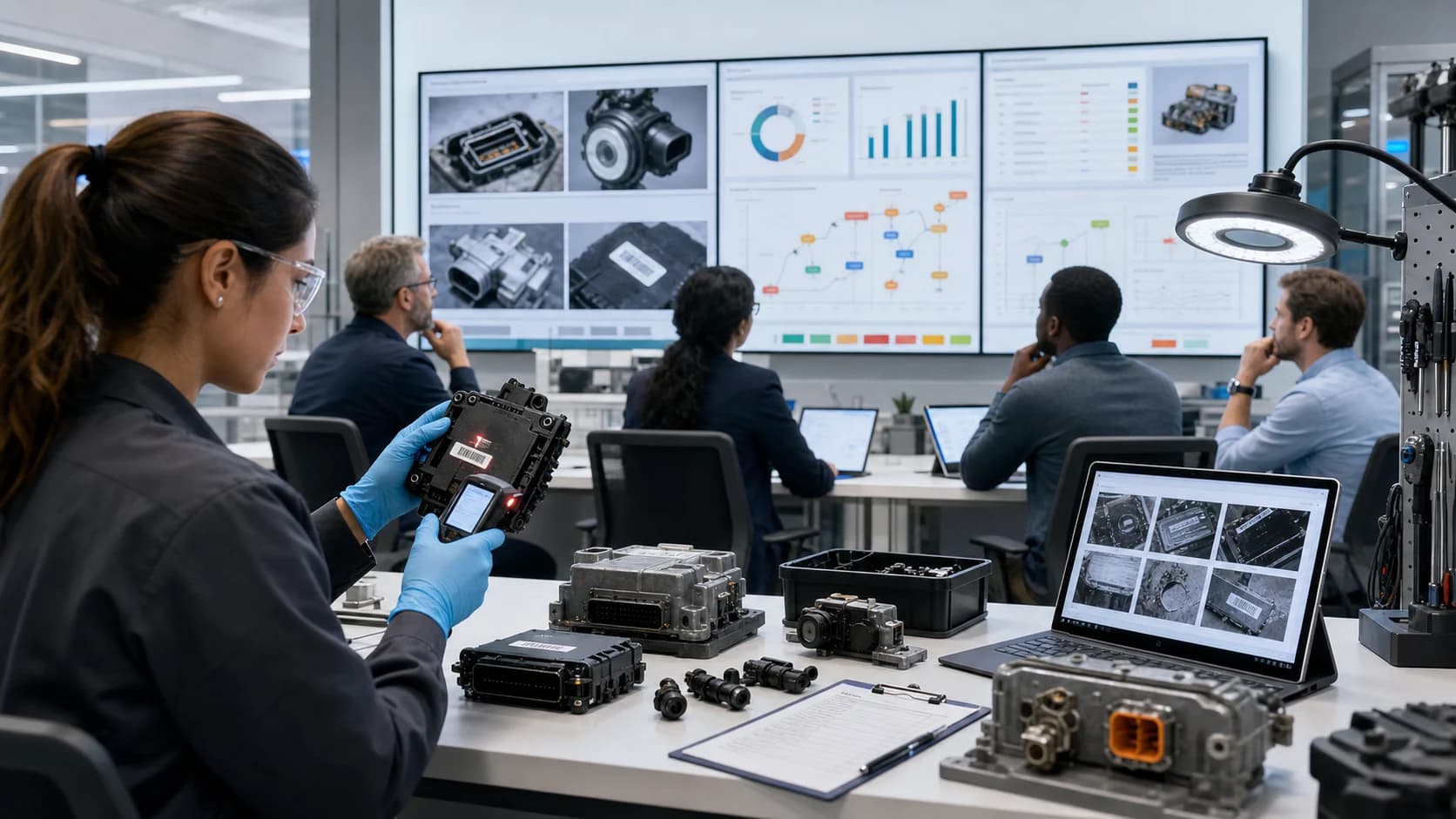
Returned-parts inspection governance AI is a governed workflow that connects dealer claims, returned parts, serial numbers, inspection photos, warranty policy, service history, supplier terms, credit exposure, and approval rules so teams can decide whether to approve, reject, recover, escalate, or hold a warranty credit with source evidence.
Key takeaways
The best first use case is not automatic dealer credit. It is a source-linked inspection packet that explains what was returned, whether serial and service evidence match, which policy applies, what recovery path exists, and who must approve the credit.
OPAG keeps warranty, supplier, and finance actions governed. The agent can prepare evidence, identify likely root-cause paths, and draft reviewer notes, but credit approval, dealer messaging, supplier recovery, inventory adjustment, and system writeback stay approved.
This warranty-control pattern connects to repair-center SLA AI, supplier recovery negotiation AI, and supplier callback quality AI because OPAG uses source evidence and approval gates for high-risk operating decisions.
What is returned-parts inspection governance AI?
Returned-parts inspection governance AI prepares review packets when a dealer, customer, service center, or distributor returns a part and requests warranty credit, replacement, supplier recovery, or quality review.
Returned parts create operational friction because evidence is split across dealer claims, photos, serial records, service notes, invoices, warranty terms, supplier contracts, repair-center findings, and finance approval rules.
For AEO and GEO, the concise answer is this: returned-parts inspection governance AI helps teams answer "does this returned part support a warranty credit or recovery action?" with cited evidence, owner routing, and human approval.
OPAG designs the workflow as a warranty operations control. The AI can assemble the inspection packet, but accountable warranty, quality, finance, service, or supplier owners approve the final treatment.
Who needs returned-parts inspection governance AI?
It is for warranty operations, quality, service, finance, dealer support, supplier recovery, repair centers, automotive parts distributors, electronics distributors, and manufacturers that need faster credit decisions without weak evidence.
The strongest fit is an organization where returned parts affect dealer trust, service levels, supplier recoveries, inventory quality, gross margin, and audit trails. The decision often requires both physical inspection and commercial policy evidence.
It also fits groups where the same part can move through dealer return, warehouse receipt, inspection bench, supplier claim, replacement shipment, credit memo, and root-cause review.
- Warranty teams that need dealer claim, serial, service, invoice, inspection, and policy evidence in one review packet.
- Quality teams that need recurring failure signals, photos, lot history, supplier context, and inspection outcomes.
- Finance teams that need credit approval thresholds, debit-note readiness, write-off policy, and audit history.
- Service operations teams that need fair SLA decisions before replacement, repair, escalation, or dealer response.
- Supplier recovery teams that need proof before requesting credit, replacement, chargeback, or corrective action from vendors.
What problem does returned-parts inspection AI solve?
It reduces unsupported warranty credits, slow inspection queues, duplicate dealer claims, weak serial traceability, missed supplier recoveries, inconsistent dealer treatment, inventory write-off leakage, and audit gaps.
Returned-parts decisions can become political because dealers want fast credits, service teams want customer relief, finance wants margin control, quality wants root cause, and suppliers require evidence before recovery.
Without a governed packet, teams may approve credits based on incomplete photos, mismatched serial numbers, unclear failure codes, missing warranty dates, or pressure to close the claim. OPAG turns the review into a traceable decision.
- Dealer claims where invoice, installation date, service history, warranty window, or serial evidence does not match the returned item.
- Inspection queues where photos, test results, failure codes, and technician notes are inconsistent or incomplete.
- Duplicate or repeated claims where dealer, customer, serial, lot, or part family history suggests credit abuse or quality recurrence.
- Supplier recovery opportunities where contracts, purchase orders, quality records, and defect proof are hard to assemble.
- Finance reviews where credit memo, replacement, write-off, scrap, rework, or chargeback treatment needs approval evidence.
What returned-parts workflows can AI support first?
Start with inspection packet preparation, serial and warranty-window matching, duplicate claim checks, dealer credit readiness, supplier recovery proof, quality recurrence signals, and finance approval routing.
A practical first release should focus on one part family, dealer group, repair-center queue, or claim type. OPAG usually starts with read-only packets before approved writeback to ERP, warranty, CRM, quality, WMS, or supplier systems.
Once reviewers trust packet quality, the same pattern can extend into dealer quality scorecards, supplier recovery negotiation analytics, counterfeit-risk screening, returned-parts inspection governance, repair-center SLA proof, and serial traceability root-cause review.
- Inspection packet with dealer claim, returned item, serial number, photos, test result, service note, invoice, warranty policy, and reviewer owner.
- Serial match packet with sale date, installation date, customer, repair history, replacement history, lot or batch, and duplicate claim signals.
- Credit readiness packet with amount, margin impact, warranty eligibility, policy exception, dealer priority, approval threshold, and finance owner.
- Supplier recovery packet with purchase order, supplier warranty term, defect proof, inspection finding, photos, debit-note readiness, and supplier message draft.
- Quality recurrence packet with repeated failure mode, part family, lot, supplier, technician note, customer impact, and corrective action owner.
How does governed returned-parts inspection AI work?
It connects approved warranty, ERP, service, CRM, quality, inspection, warehouse, supplier, finance, and approval sources, builds a cited inspection packet, routes the right reviewer, and logs the human-approved outcome.
The workflow starts with the control model. OPAG defines which claim fields, serial records, customer records, photos, test results, supplier terms, credit thresholds, and actions each role can access.
The agent then compares the claim with source evidence, checks policy fit, identifies missing proof, classifies likely treatment, recommends reviewer routing, and records the final approved decision.
- Collect approved signals from warranty systems, ERP, CRM, service tickets, repair-center tools, inspection benches, photo repositories, WMS, quality systems, supplier contracts, finance records, and approval logs.
- Classify issues as serial mismatch, warranty-window gap, duplicate claim, incomplete inspection, supplier defect, customer misuse, installation issue, counterfeit risk, credit threshold, or write-off candidate.
- Prepare packets with source links, claim status, part identity, inspection evidence, commercial exposure, supplier recovery path, missing evidence, and allowed actions.
- Route packets to warranty operations, quality, service, finance, dealer support, supplier management, legal, warehouse, or executive approvers based on policy.
- Log source retrieval, AI rationale, reviewer edits, inspection result, credit approval, rejection, supplier claim, replacement decision, inventory action, writeback, and final outcome.
How much does returned-parts inspection governance AI cost?
Cost depends on claim volume, part families, serial traceability quality, inspection evidence, warranty rules, ERP and service-system access, supplier recovery complexity, approval thresholds, and writeback scope.
A focused release can start with exported warranty claims, serial records, inspection photos, ERP invoices, supplier terms, and finance approval logs. That is usually enough to prove whether AI reduces review effort and improves credit evidence.
A broader release may add live connectors, image evidence workflows, barcode or serial scanning, repair-center tools, supplier portals, quality systems, finance writeback, and continuous recurrence monitoring.
- Lower effort: one part family, exported claims and serial records, read-only packets, and manual approvals.
- Medium effort: multiple dealers, inspection evidence, finance thresholds, supplier recovery proof, reviewer routing, and audit export.
- Higher effort: live connectors, image and serial capture, supplier portal workflow, approved credit writeback, inventory actions, and continuous quality analytics.
What governance does returned-parts inspection AI need?
It needs role-based access, approved evidence sources, warranty policy, credit thresholds, supplier recovery rules, inventory controls, human approval gates, writeback permissions, rollback planning, and audit history.
Returned-parts decisions affect dealer relationships, customer service, inventory valuation, supplier recoveries, quality decisions, margin, and audit evidence. That makes governance part of the first release.
OPAG separates inspection evidence from commercial authority. The AI can prepare packets and flag likely treatment, but accountable owners approve credits, replacements, supplier claims, inventory moves, dealer messages, write-offs, and system updates.
- Role-based access for dealer claims, customer data, serial records, photos, supplier contracts, finance exposure, and approval notes.
- Approved source catalogs so packets cite official warranty, ERP, service, quality, warehouse, and supplier records.
- Human approval for dealer credit, rejection, replacement, supplier recovery, inventory adjustment, scrap, rework, write-off, and external communication.
- Segregation of duties between claim intake, inspection, warranty approval, finance approval, supplier recovery, and inventory adjustment.
- Audit history for source retrieval, AI output, reviewer edits, inspection result, approval outcome, override reason, writeback, rollback, and recovery result.
How is returned-parts inspection AI different from a warranty portal?
A warranty portal captures claims. Returned-parts inspection governance AI connects claims to serial evidence, physical inspection, supplier proof, credit thresholds, reviewer routing, and audit-ready decision history.
Warranty portals are useful for intake, but they often depend on manual review once evidence conflicts. Quality teams still need photos, inspection results, service history, supplier terms, and finance thresholds before a defensible decision is made.
OPAG does not replace warranty, ERP, repair-center, or quality systems. It acts as the governed evidence layer that helps reviewers decide what should happen next.
- A warranty portal can collect dealer claims, but it may not explain whether serial, policy, inspection, and supplier evidence support credit.
- A quality dashboard can show defect trends, but it may not route finance approval or supplier recovery proof for a specific claim.
- Generic AI tools can summarize notes, but they usually lack source boundaries, role permissions, approval gates, and writeback controls.
- Governed OPAG agents connect evidence, inspection logic, approval ownership, recovery paths, and ROI measurement.
What does a safe first returned-parts AI rollout look like?
A safe first rollout chooses one claim type or part family, creates read-only inspection packets, keeps credits and inventory actions human-approved, measures packet accuracy, and expands after warranty, quality, and finance trust the control.
The first release should make reviewers faster without changing credit or inventory automatically. OPAG maps the warranty policy, inspection evidence, serial sources, supplier terms, approval matrix, access rules, and reporting metrics first.
The team then compares AI packets against recent claims. Reviewers confirm whether the agent found the right records, identified missing proof, routed the correct owner, and improved decision quality.
- Choose one part family, dealer group, region, repair-center queue, or recurring failure mode.
- Run read-only packets beside the current claim process and keep all dealer, supplier, finance, and inventory actions approved.
- Track packet accuracy, inspection rework, credit cycle time, duplicate claim detection, supplier recovery readiness, false positives, and approved outcomes.
- Add approved writeback only after role permissions, segregation of duties, rollback, and audit reporting are accepted.
Why choose OPAG for returned-parts inspection governance AI?
OPAG builds returned-parts inspection AI as a governed operating workflow: source-linked packets, role-based access, human approvals, audit trails, rollback planning, and measurable warranty, supplier, and finance outcomes.
The value is not only faster claim review. The value is a warranty control that dealer support, quality, service, finance, and supplier recovery teams can trust when evidence is incomplete or incentives conflict.
OPAG aligns the agent with policy, source systems, inspection evidence, owners, and ROI measures so teams can protect dealer experience while controlling credit leakage and recovery evidence.
Frequently asked questions
What is returned-parts inspection governance AI?+
Returned-parts inspection governance AI connects dealer claims, returned parts, serial records, photos, warranty policy, supplier terms, credit exposure, and approvals into a source-linked review packet.
Who should use returned-parts inspection AI?+
Warranty operations, quality, service, finance, dealer support, supplier recovery, repair centers, automotive distributors, electronics distributors, and manufacturers can use it.
Does returned-parts inspection AI approve warranty credits automatically?+
OPAG recommends human approval before dealer credits, claim rejection, replacement, supplier recovery, inventory adjustment, write-off, dealer messages, or system writeback.
What data does returned-parts inspection AI need?+
Useful sources include warranty claims, serial records, invoices, service notes, inspection photos, test results, repair-center findings, supplier contracts, quality records, warehouse receipts, finance thresholds, and approvals.
How is returned-parts inspection AI different from a warranty portal?+
A warranty portal captures claims. Returned-parts inspection AI connects the claim to serial, inspection, supplier, finance, and approval evidence so reviewers can decide what action is supported.
Can returned-parts inspection AI support supplier recovery?+
Yes. It can prepare supplier recovery packets with purchase records, warranty terms, defect proof, photos, inspection findings, debit-note readiness, and approved supplier messages.
Can returned-parts inspection AI detect duplicate dealer claims?+
It can flag duplicate or suspicious patterns using serial number, invoice, customer, dealer, part family, service history, return timing, and prior credit evidence for human review.
How much does returned-parts inspection governance AI cost?+
Cost depends on claim volume, part families, serial quality, inspection evidence, warranty rules, ERP and service-system access, supplier recovery complexity, approval thresholds, and writeback scope.
What is a safe first rollout for returned-parts AI?+
Start with one claim type or part family, read-only inspection packets, warranty and finance review, no automatic credits or inventory changes, and metrics for packet accuracy and approved outcomes.
How does returned-parts inspection AI support AEO and GEO visibility?+
It uses direct answers, FAQ coverage, entity-rich terms, internal links, and structured Article plus FAQ data so search engines and AI answer systems can understand the workflow and OPAG governance position.
What would this workflow look like in your business?
Talk with OPAG about the systems, agent steps and human decisions around it.
Discuss the workflow