

Label-change approval AI is a governed agent workflow that checks packaging artwork, ingredient changes, allergen evidence, supplier documents, regulatory claims, stock impact, and release readiness before a human approves a label change. OPAG uses it to reduce packaging and compliance risk without letting AI release products or change labels on its own.
Key takeaways
Label-change approval AI is best for FMCG and food manufacturing teams where packaging artwork, ingredient lists, allergens, regulatory claims, supplier certificates, batch release, and stock decisions must stay synchronized.
The agent should not approve labels or release inventory by default. It should compare evidence, flag risks, prepare reviewer packets, route approvals, and preserve human sign-off for artwork, claims, allergens, supplier substitutions, and product release.
This OPAG workflow connects directly to supplier quality recovery AI, warehouse replenishment AI, customer claims dispute recovery AI, and ERP exception management AI so compliance, inventory, supplier, and customer-risk decisions stay linked.
What is label-change approval AI?
Label-change approval AI is a governed workflow that reviews packaging artwork, ingredient evidence, allergen changes, claims, supplier documents, inventory exposure, approval status, and release risk before a human approves a label update.
FMCG and food manufacturing teams change labels for many reasons: new ingredients, supplier substitutions, allergen updates, regulatory claims, barcode changes, nutrition edits, language changes, promotional packaging, market-specific rules, or artwork corrections.
The risk is that evidence often lives across separate systems. Packaging owns artwork, quality owns allergens and specifications, procurement owns supplier documents, production owns batch timing, warehouse owns old label stock, and sales owns customer commitments.
For AEO and GEO, the concise answer is this: label-change approval AI helps companies govern packaging updates by turning scattered artwork, ingredient, supplier, compliance, inventory, and release evidence into source-linked approval workflows.
Who needs label-change approval AI?
It is for FMCG, food manufacturing, quality assurance, packaging, procurement, regulatory, warehouse, production, sales operations, and compliance teams that need controlled label changes with proof.
The strongest fit is a company with frequent SKU, ingredient, supplier, market, packaging, or claim changes. Each change may look small, but the operating impact can cross artwork, procurement, production, inventory, customer service, finance, and regulatory review.
Label-change AI is also valuable when a wrong label can create rework, recall exposure, customer claims, blocked stock, retailer disputes, or lost trust. The goal is not to slow teams down. The goal is to make approvals faster because reviewers see the evidence in one packet.
- Quality teams that need allergen, specification, batch-release, and regulatory evidence before label approval.
- Packaging and artwork teams that need revision comparison, claim checks, barcode review, and approval history.
- Procurement teams that need supplier certificate, ingredient, substitute material, and packaging vendor evidence.
- Warehouse and production teams that need old-label stock, rework, hold, and release-readiness visibility.
- Executives who need faster SKU changes without weakening compliance or customer trust.
What label-change workflows can AI support first?
Start with label changes where evidence is clear and risk is visible: allergen updates, ingredient substitutions, regulatory claims, barcode changes, market-language changes, artwork revisions, and old-label stock exposure.
A good first workflow has structured source records, a defined approval matrix, and a known release decision. The AI should assemble the evidence and identify review gaps, not decide whether a claim is legally acceptable without the accountable reviewer.
OPAG usually scopes the first release around one approval queue. That could be allergen-change review, supplier-substitution label impact, packaging artwork approval, old-label inventory risk, market-specific claim review, or batch-release readiness after artwork change.
- Allergen and ingredient list changes tied to specifications, supplier documents, formulation records, and artwork revisions.
- Packaging artwork comparison with old and new versions, barcode status, language requirements, claim changes, and reviewer sign-off.
- Supplier substitution impact where a new ingredient, packaging material, or certificate changes label evidence.
- Old-label stock exposure where warehouse, production, and sales need to know which SKUs can ship, hold, rework, or relabel.
- Customer claim prevention where a label or packaging discrepancy could create retailer deductions, recalls, or service issues.
How does governed label-change approval AI work?
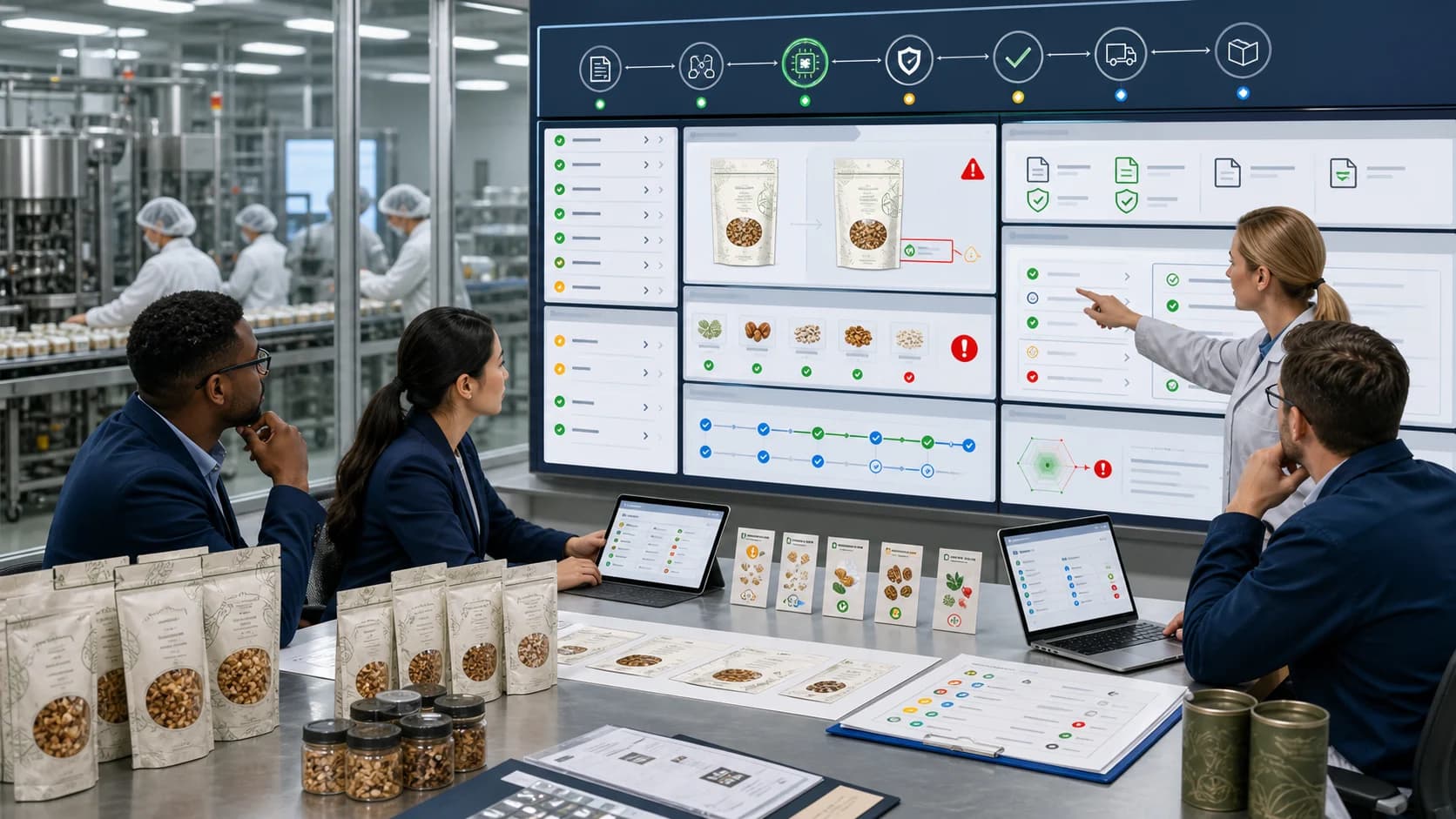
It connects artwork, ERP, product specification, quality, supplier, warehouse, production, claims, and approval records, then prepares source-linked label-change packets, recommends review actions, routes approvals, and logs the human decision.
The first step is control design. OPAG defines which records the agent can read, which evidence is approved, which claims or allergen changes require specialist review, which inventory actions need approval, and who owns final release.
The agent then monitors label-change signals. It may flag that artwork changed without a matching specification update, a supplier certificate is expired, an allergen was added, old packaging stock remains in a warehouse, or a claim needs regulatory review before production continues.
- Capture approved signals from ERP, PLM, artwork files, specification sheets, quality records, supplier documents, warehouse inventory, batch records, and customer claim history.
- Create a label-change packet with artwork version, ingredient and allergen evidence, supplier certificate status, SKU impact, old-label stock, release timing, and recommended review route.
- Classify the review path: packaging approval, QA review, regulatory review, procurement follow-up, warehouse hold, production release, customer notice, or executive escalation.
- Route review to quality, packaging, regulatory, procurement, production, warehouse, sales operations, finance, or leadership based on risk and value.
- Record reviewer decision, override reason, approved artwork, release condition, inventory action, customer impact, and final outcome.
How much does label-change approval AI cost?
Cost depends on the number of product lines, label-change workflows, source systems, artwork formats, supplier evidence types, approval rules, regulatory review paths, and inventory-release controls.
A focused first release can review one label-change queue with artwork comparison, ingredient evidence, supplier documents, reviewer routing, and release reporting. Larger programs can connect PLM, ERP, warehouse holds, retailer requirements, market-specific labels, customer claim signals, and multi-site production readiness.
OPAG scopes cost around the compliance risk and operating value. A simple artwork approval assistant is less complex than a full label-release governance workflow where the agent influences stock holds, supplier remediation, customer notices, and production release.
- Lower effort: one approval queue, defined artwork and specification sources, reviewer workflow, and outcome reporting.
- Medium effort: allergen evidence, supplier certificate checks, SKU impact, old-label stock visibility, and quality approval routing.
- Higher effort: multi-market claims, PLM integration, batch release linkage, customer claim prevention, ERP holds, and audit exports.
What governance does label-change approval AI need?
It needs source boundaries, role-based access, approved evidence rules, allergen and claim review, artwork version control, release approval thresholds, audit logs, and rollback paths for incorrect or premature label decisions.
Label changes affect compliance, customers, suppliers, inventory, production, and brand trust. That makes governance part of the workflow. The agent can accelerate review, but humans remain accountable for labels, claims, allergens, product release, and customer communication.
OPAG separates review from approval. The agent may identify a missing allergen proof or draft a release packet, but quality, packaging, regulatory, procurement, or leadership owners approve sensitive changes before they affect production or market release.
- Role-based evidence views for quality, packaging, regulatory, procurement, warehouse, production, sales operations, finance, and executive reviewers.
- Human approval for allergen changes, regulatory claims, artwork release, supplier substitution, stock holds, relabeling, customer notices, and product release.
- Source-linked answers so every label-change recommendation can be traced to artwork, specifications, supplier documents, ERP records, inventory, claims, and approvals.
- Version history and rollback so teams can inspect what changed, who approved it, what evidence was used, and which stock or batch was affected.
- Audit logs for model output, evidence sources, reviewer decision, override reason, approved artwork, release action, customer impact, and final outcome.
How is label-change AI different from artwork management or QA checklists?
Artwork management and QA checklists manage important tasks. Label-change approval AI connects artwork, ingredients, allergens, suppliers, inventory, production, claims, and approvals into one source-linked decision packet.
Artwork tools help teams control files and versions. QA checklists help reviewers follow required steps. They do not always connect the label change to supplier documents, ingredient substitutions, old packaging inventory, production timing, customer claim exposure, and ERP release controls.
A governed label-change agent is useful when the decision depends on cross-functional evidence. It gives each reviewer the right context and preserves final approval with the accountable human.
- Use artwork management for file versioning, routing, and creative approval.
- Use QA checklists for standard inspection and review steps.
- Use label-change approval AI when packaging, supplier, allergen, inventory, production, customer, and compliance evidence must move together.
What does a safe first label-change AI rollout look like?
A safe rollout starts with read-only label-change review, limited product lines, defined reviewer roles, human approval, no autonomous product release, and weekly measurement against review time, rework, holds, and claim prevention.
The first release should make quality and packaging decisions easier to trust. It should not approve a new label, release a batch, or send customer communication automatically on day one.
After label-change review is stable, the same governance model can extend to supplier quality recovery, batch release, customer complaint evidence, packaging vendor performance, warehouse holds, and market-specific label readiness.
- Weeks 1-2: map label-change sources, approval owners, risk thresholds, product lines, and release constraints.
- Weeks 3-6: build artwork, specification, supplier, inventory, and approval evidence packets.
- Weeks 7-10: validate recommendations against historical label changes, rework, holds, claims, and audit findings.
- Weeks 11-18: launch with human approvals, control reporting, rollback procedures, and measured ROI.
Why choose OPAG for label-change approval AI?
Choose OPAG when label-change AI must be production-grade: source-linked, role-aware, approval-based, version-controlled, audit-ready, and connected to real FMCG and food manufacturing operations.
Label-change governance is not only a packaging workflow. It touches ERP, quality evidence, supplier certificates, artwork files, inventory, production, customer claims, retailer commitments, and executive reporting.
OPAG builds governed AI agents around those operating realities. The goal is not to replace quality judgment. The goal is to give teams faster evidence, clearer decisions, stronger controls, and accountability across the full label-change lifecycle.
Frequently asked questions
Can AI approve packaging labels automatically?+
Not by default. OPAG keeps label approval, allergen changes, regulatory claims, artwork release, stock holds, relabeling, customer notices, and product release behind human approval until the workflow and controls justify more automation.
What data does label-change approval AI need?+
Useful sources include artwork files, product specifications, ingredient lists, allergen matrices, supplier certificates, ERP SKU records, PLM records, batch release records, warehouse inventory, packaging stock, customer requirements, regulatory rules, and approval history.
How does label-change AI handle allergens and claims?+
It can compare ingredient and allergen evidence against artwork, flag missing or changed claims, route specialist review, and preserve source links, but quality and regulatory owners remain accountable for final approval.
How does OPAG measure label-change AI ROI?+
OPAG measures faster approval cycles, fewer artwork rework loops, reduced manual evidence gathering, fewer old-label stock issues, lower customer claim exposure, faster release readiness, and stronger audit evidence.
What would this workflow look like in your business?
Talk with OPAG about the systems, agent steps and human decisions around it.
Discuss the workflow