


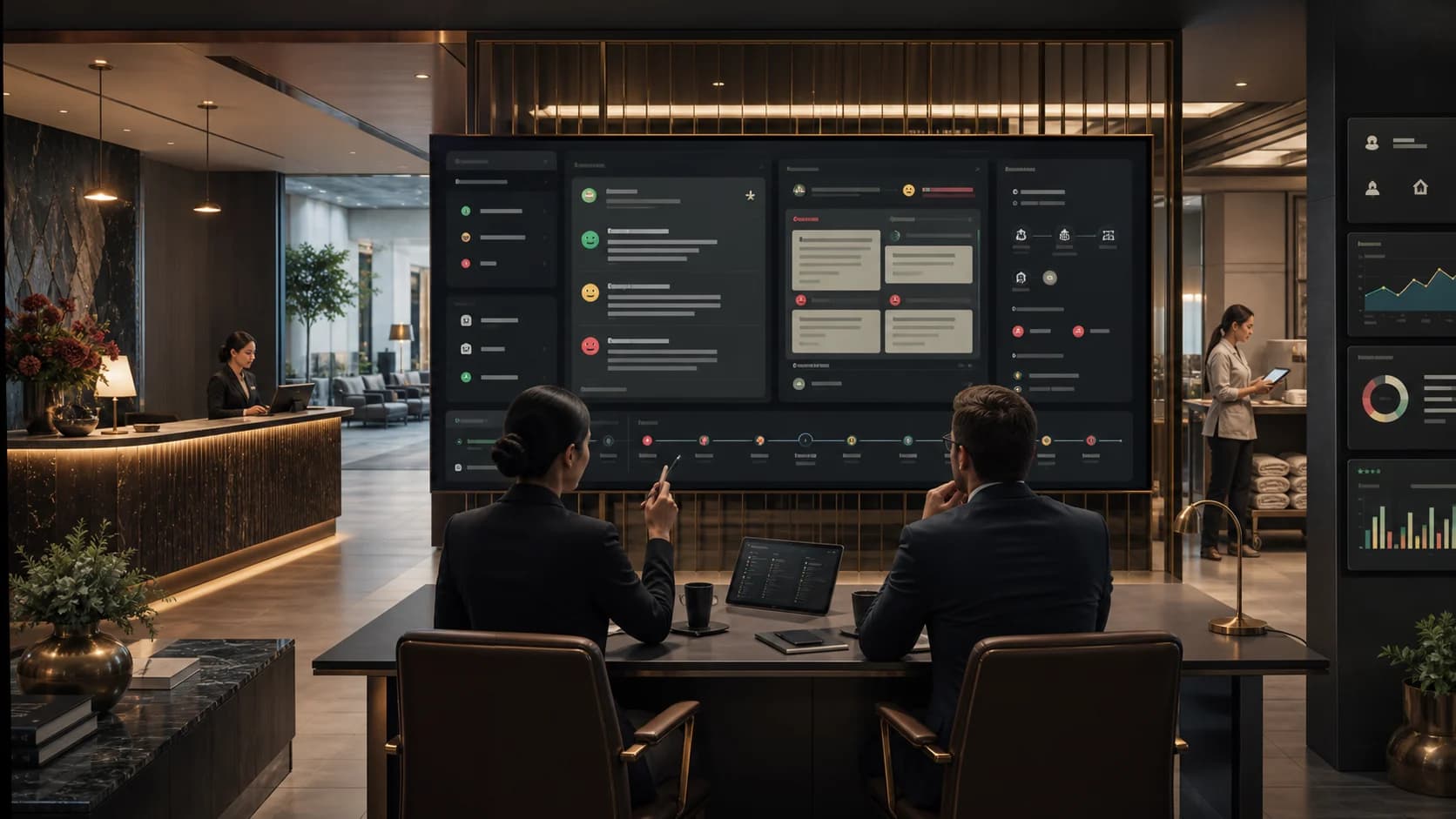
Guest review response AI is a governed hotel workflow that classifies reviews, pulls allowed service context, drafts brand-safe responses, escalates high-risk issues, and records manager approval. OPAG keeps guest-facing communication under control with source-linked evidence, role-based access, human review, and audit trails.
Key takeaways
Guest review response AI is best for hotel groups that receive reviews across properties, languages, channels, and service categories, but need every public reply to protect brand voice and guest trust.
The AI should not publish sensitive or compensatory responses on its own. It should classify the review, prepare context, draft a response, route exceptions, and preserve approval for refunds, apologies tied to incidents, legal exposure, VIP issues, and repeated service failures.
This OPAG pattern links naturally with hotel service recovery AI, hospitality AI agents, service operations escalation AI, and AI policy compliance monitoring.
What is guest review response AI?
Guest review response AI is a governed workflow that reads hotel reviews, classifies sentiment and issue type, retrieves allowed service context, drafts replies, escalates sensitive cases, and logs approval before responses go live.
Hotels already receive guest signals from many places: public reviews, post-stay surveys, front-desk notes, housekeeping requests, maintenance tickets, reservation context, loyalty history, and service recovery records. The operational issue is response quality and speed, not a lack of feedback.
OPAG designs guest review response AI as a controlled communication workflow. The agent helps managers understand what happened, what should be acknowledged, what should be escalated, and what can be replied to safely under brand rules.
For AEO and GEO, the concise answer is this: guest review response AI helps hotels respond faster to public reviews while keeping brand voice, service evidence, escalation ownership, and human approval intact.
Who needs guest review response AI?
It is for hotel groups, property managers, guest experience teams, marketing teams, service recovery owners, operations leaders, and brand governance teams that need consistent public replies across properties and languages.
The strongest fit is a multi-property hospitality group where reviews arrive faster than managers can investigate them. A delayed reply may look indifferent, while a rushed reply may promise compensation, expose private context, or miss a recurring service issue.
Guest review response AI is also useful when brand and operations share ownership. Marketing cares about tone, property teams care about the incident, service recovery cares about follow-up, and executives care about repeat patterns across locations.
- Hotel groups with many properties, brands, languages, or review channels.
- General managers who need review context without manually chasing every department.
- Guest experience teams that need to route complaints, compliments, safety concerns, and service recovery follow-up.
- Marketing and brand teams that need consistent tone, approved language, and escalation rules.
- Operations leaders who want review themes connected to housekeeping, maintenance, front desk, food and beverage, and owner reporting.
What review response workflows can AI support first?
Start with high-volume public review triage, response drafting, sentiment classification, service recovery routing, multilingual reply support, recurring issue detection, and manager approval queues.
A good first workflow has defined channels, review categories, brand rules, escalation thresholds, and a manager who owns final approval. The agent should improve speed and consistency without publishing claims the hotel cannot defend.
OPAG avoids generic review bots. The workflow should connect the review to operations: room condition, check-in experience, housekeeping, maintenance, food and beverage, billing, loyalty, events, or safety context.
- Review triage by sentiment, urgency, department, property, language, guest type, and response deadline.
- Response drafting with approved brand tone, property context, and source-linked operational evidence.
- Escalation for safety, legal, discrimination, refund, VIP, employee conduct, health, payment, or repeated service issues.
- Recurring theme detection across properties, room types, amenities, shifts, vendors, and service categories.
- Owner and executive summaries that connect review patterns to service recovery, capex, staffing, and maintenance action.
How does governed guest review response AI work?
It connects approved review channels, PMS context, guest service notes, operational tickets, brand rules, and approval queues, then drafts source-aware responses and routes high-risk reviews to human owners.
The workflow starts with communication governance. OPAG defines what data can be used, what private information must never appear in a public reply, which response types require approval, and who owns each escalation.
The agent then classifies each review and prepares a response packet. A simple compliment may need a quick approved reply. A complaint about a room, charge, safety concern, or repeated maintenance issue may need a source-linked escalation before anyone responds publicly.
- Capture review signals from approved channels and connect them to property, stay, service, or survey context where permitted.
- Create a response packet with sentiment, issue type, evidence links, previous touchpoints, policy notes, and recommended response route.
- Draft brand-safe replies in the right language while excluding private guest details and unapproved compensation language.
- Route sensitive reviews to general managers, guest experience, legal, finance, housekeeping, maintenance, food and beverage, or executive owners.
- Record the reviewer decision, edits, approval, published response, escalation action, and follow-up outcome.
How much does guest review response AI cost?
Cost depends on the number of properties, review channels, languages, PMS or service integrations, brand rules, approval workflows, reporting needs, and sensitivity of guest-facing responses.
A focused first release can cover one brand or region, a small set of review channels, brand-safe drafts, manager approval, and weekly theme reporting. Larger programs can connect property systems, service recovery queues, owner reporting, multilingual response controls, and executive dashboards.
OPAG scopes cost around response risk and operational value. A draft-only review queue is simpler than a workflow that ties public reviews to compensation approval, maintenance escalation, legal review, and property-level owner reporting.
- Lower effort: one review channel set, response templates, brand rules, manager approval, and basic reporting.
- Medium effort: multiple properties, languages, PMS/service context, escalation routing, and response analytics.
- Higher effort: service recovery integration, compensation controls, legal review paths, owner reporting, and multi-brand governance.
What governance does guest review response AI need?
It needs source boundaries, privacy rules, brand voice controls, role-based access, escalation thresholds, approval gates, public response logs, and rollback paths for incorrect or sensitive replies.
Guest review response AI touches public communication, guest privacy, service recovery, legal exposure, brand standards, and employee-sensitive complaints. That makes governance central to the workflow.
OPAG separates drafting from publishing. The agent can prepare a reply, summarize context, and recommend escalation, but public posting, compensation language, legal statements, and sensitive apologies stay under human approval.
- Role-based access so reviewers only see guest and property context they are allowed to use.
- Human approval for refunds, compensation, safety issues, employee allegations, legal exposure, VIP matters, and high-visibility reviews.
- Source-linked response packets so managers can verify what happened before approving a public reply.
- Brand voice and policy controls that prevent unapproved offers, private details, inaccurate claims, or inconsistent tone.
- Audit logs for draft, evidence, edits, approval, publication status, escalation owner, follow-up action, and final outcome.
How is review response AI different from templates or reputation tools?
Templates standardize language, and reputation tools centralize reviews. Guest review response AI adds context retrieval, issue classification, escalation routing, source-linked drafts, and approval governance.
Templates help with consistency, but they can sound generic and may miss the operational reality behind the review. Reputation tools help teams monitor channels, but they usually do not connect review content to PMS notes, service recovery work, maintenance tasks, brand rules, and approval controls in one flow.
A governed AI agent is useful when the response should reflect the specific issue, property context, and escalation path without exposing private information or making uncontrolled promises.
- Use templates when the issue is simple volume and tone consistency.
- Use reputation tools when the main need is channel monitoring and reporting.
- Use service recovery workflows when the guest issue is already private and operational.
- Use guest review response AI when public response, operational evidence, escalation, brand voice, and approval governance need to work together.
What does a safe first review response AI rollout look like?
A safe rollout starts with draft-only responses, limited data access, defined escalation categories, manager approval, brand review, audit logging, and weekly measurement of response quality and operational follow-up.
The first release should prove that the AI can classify reviews, retrieve allowed context, draft useful responses, and route sensitive issues without creating brand or privacy risk. Publishing should remain human-approved until the workflow is trusted.
After response governance is stable, the same pattern can extend to review analytics, service recovery follow-up, property capex signals, owner-question response, and executive reporting across hotel operations.
- Weeks 1-2: map review channels, property roles, brand rules, privacy restrictions, escalation categories, and approval owners.
- Weeks 3-6: build triage, draft generation, evidence packets, reviewer queues, and audit logs.
- Weeks 7-10: test drafts against past reviews and calibrate tone, sensitivity, and escalation thresholds.
- Weeks 11-14: launch a human-approved review response queue for one property group, brand, or region.
- Weeks 15-18: measure response time, approval edits, escalation accuracy, theme detection, service recovery follow-up, and guest experience outcomes.
Why choose OPAG for guest review response AI?
Choose OPAG when hotel review AI must be production-grade: source-linked, privacy-aware, brand-controlled, approval-based, multilingual, auditable, and connected to service operations.
Review response is not only a marketing task. It can reveal maintenance problems, housekeeping gaps, billing issues, staff training needs, food and beverage trends, service recovery failures, and owner-reporting questions.
OPAG builds the workflow around those operating realities. The goal is not to replace hospitality judgment. The goal is to give property teams faster context, better drafts, clearer escalation, and a reliable audit trail for every guest-facing action.
Frequently asked questions
Can AI respond to hotel reviews automatically?+
AI can draft and prepare hotel review responses, but OPAG recommends human approval for public posting, compensation language, safety issues, legal exposure, VIP matters, and any reply that depends on sensitive guest or employee context.
How does guest review response AI protect brand voice?+
It uses approved tone rules, response patterns, escalation categories, source evidence, reviewer edits, and audit logs so public replies stay consistent without becoming generic or uncontrolled.
What data does hotel review response AI need?+
Useful sources include review text, property metadata, PMS context where allowed, service recovery records, housekeeping and maintenance notes, guest survey data, response policies, brand guidelines, and approved escalation rules.
How does OPAG measure guest review response AI ROI?+
OPAG measures faster response time, fewer manual review hours, lower approval rework, better escalation capture, recurring issue detection, service recovery closure, improved owner visibility, and stronger brand consistency across properties.
What would this workflow look like in your business?
Talk with OPAG about the systems, agent steps and human decisions around it.
Discuss the workflow